
Bangladesh is attracting a steady amount of interest from international companies who wish to establish a presence in South Asia. In many cases, the first step is not to set up full commercial operations but instead to register a liaison office in Bangladesh: this is a less risky method of investigating the market, remaining in close contact with local partners, and laying the foundation for a larger investment at a later stage.

To set up a liaison office you have to go through a number of government organisations, beginning with the Bangladesh Investment Development Authority (BIDA). This guide explains what a liaison office really is, the reasons why companies select this option, and the practical steps involved in registering and operating one.

Key Takeaways

• The liaison office is not able to generate income in Bangladesh; its function is restricted to carrying out communication, coordination, and market research.

Approval is obtained first from BIDA, then from RJSC, after that a TIN is acquired from the NBR and finally a local trade license is obtained.

• Generally, it is necessary to send at least USD 50,000 from the parent company via official banking channels.

The BIDA approval typically lasts for two to three years and must be renewed about two months before it expires.

• A liaison office is suitable for carrying out market research and for building relationships, while a joint venture or a branch office is appropriate for companies that are ready to trade or issue invoices locally in Bangladesh.

What a Liaison Office Is — and Isn’t

A liaison office is not a commercial organisation; it cannot earn money, prepare invoices, or enter into sales contracts within Bangladesh, its only function being that of carrying out communication, coordination, and market research for the parent company based abroad. This distinction is the reason for almost all the rules that come next: those relating to what BIDA will approve, the taxes that will apply, and the actions which your local representative is permitted or not permitted to take.

It helps to see how this compares with two other common structures:

Structure         What it’s for    Legal status

Liaison Office  Communication and market research, no local revenue       Non-commercial extension of the parent company

Branch Office  Direct operational activity in-country Extension of the parent company

Joint Venture  Commercial partnership with a local firm      Independent legal entity

A liaison office is generally the simpler option if you are still at the stage of carrying out research and building relationships; however, if your aim is to sell, invoice or manufacture in Bangladesh a joint venture or a branch office would be more appropriate.

Why Companies Choose This Route

A liaison office enables a foreign company to have a real physical presence—such as an address, a local team, and a means of being contacted—without having to set up a complete commercial operation right from the start. There are several reasons why this is useful.

• This allows you to test the market and check your assumptions before putting in serious capital.

• It provides headquarters with local partners a direct and continuous means of communication.

• It increases its visibility and builds credibility among the people whom you will eventually want to do business with.

For a company which is still deciding if Bangladesh is worth making a bigger investment, adopting this lighter structure is usually the sensible first step.

Step 1: Confirm the Structure Actually Fits

It’s worthwhile carrying out some stress testing to determine whether a liaison office really fits your plans, since these offices are not allowed to generate local income and any situation that appears to involve a sale, a service charge, or a local transaction puts both your application and your future compliance position at risk.

By this stage you should be able to:

Make sure that the parent company is correctly incorporated and is in good standing in its home country.

• Explain the planned activities in Bangladesh using language that is clearly not commercial.

Find a local representative who will be in charge of submitting the documents and dealing with the regulators.

If you get it right from the start, you’ll be able to avoid a considerably more difficult discussion with BIDA later on.

Step 2: Secure BIDA’s Approval

A liaison or representative office cannot function without BIDA’s approval. This is the key stage at which the main amount of examination takes place—approval usually takes between four and six weeks once the application is complete and thoroughly documented.

You submit your application through BIDA’s online portal by uploading the company’s documents together with a description of the activities you plan to carry out. BIDA then evaluates the application based on a number of key factors.

What BIDA looks at     What it’s checking for Weight in the decision

Financial position       Audited statements from the parent company          High

Track record    The company’s global standing and reputation         Medium

Planned activities       Whether the scope described is genuinely non-commercial            High

Compliance history    Any past regulatory issues     Medium

The greater the precision with which you describe the activities you intend to carry out, and the clearer your financial statements make it that the parent company can afford the office, the smoother this stage tends to be.

Step 3: Prepare and Authenticate Your Documents

When you know what BIDA expects, your next step is to put together a full set of corporate documents. This typically involves:

•          A certified copy of the Certificate of Incorporation

•          A board resolution specifically authorizing the liaison office

•          The Memorandum and Articles of Association

•          Recent audited financial statements

•          A written description of planned activities and organizational structure

Since the documents in question are foreign, they must undergo notarization and attestation — usually carried out via your embassy or consulate — before they will be accepted by Bangladeshi authorities. The fact that the attestation process can be a lengthy one often surprises many applicants, which is why it’s advisable to begin it early rather than putting it off until later.

Step 4: Register with the RJSC

Once you have the approval letter from BIDA, your next step is to go to the Registrar of Joint Stock Companies and Firms (RJSC)—the organisation responsible for keeping the official record of every business that is registered in the country.

You have to submit the BIDA approval together with the certified documents of the company via RJSC’s portal, pay the relevant government fees, and when all the details have been verified, obtain a registration certificate. This certificate then serves as your legal evidence of registration and forms the basis for the subsequent steps — such as opening a bank account or applying for a TIN, etc.

The registration of RJSC also involves a number of continuing obligations, such as making annual submissions and reporting to the office or its representatives if there are any changes. Far from being merely minor administrative tasks, failing to meet these requirements could put your registered status in danger.

Step 5: Get a Taxpayer Identification Number (TIN)

A liaison office may earn no income locally, yet it still requires a Taxpayer Identification Number from the National Board of Revenue (NBR). You will need this number for banking and for various administrative filings.

The application is completed online and the details that you provide—such as company information, BIDA approval, and the registered address—must exactly match those in your other filings; any discrepancy tends to delay the process. When it has been approved you are given a digital TIN certificate.

The fact of holding a TIN means that you will have to file annual tax returns in future situations, even if no tax is actually due, just to keep your status up to date with the NBR.

Step 6: Apply for a Trade License

An office that has a physical address must obtain a trade license from the appropriate City Corporation or Municipality—namely, the one that has authority over the actual location of the office. It is a frequent mistake yet completely preventable to file with the wrong authority, so it is essential to verify the address against the municipal boundaries before submitting the application.

The application generally needs:

•          The BIDA approval letter

•          The office lease or rental agreement

•          A completed, signed application form from the authorized representative

•          Proof that municipal fees have been paid

•          The company’s Memorandum and Articles of Association

As in the case with everything else involved in this process, it’s important to be consistent—if the application for the trade licence does not match what was told BIDA, further questions will be asked.

Step 7: Work Out Your VAT and BIN Position

It is often thought that liaison offices are automatically exempt from VAT, but that is not exactly correct. Whether or not a Business Identification Number (BIN) is required will depend on the actual activities carried out by the office:

Activity            VAT/BIN status What to do

Pure liaison work (communication, coordination)    Generally exempt       Keep BIDA records current

Procuring local services          Depends on the arrangement Check withholding tax obligations

Importing office equipment   Registration required Apply for a BIN

Providing any taxable service Registration required Full VAT compliance

Registration becomes a necessity if the office pays VAT on services or is in charge of withholding tax on payments made to local vendors. It would be a good idea to get an opinion from a local tax advisor on this as early as possible since the distinction between ‘pure liaison work’ and ‘taxable activity’ is not always clear in practice.

Step 8: Open a Bank Account and Bring In Funds

It is necessary for the office to have a corporate account with an authorized dealer branch of a Bangladeshi commercial bank—this is not optional—and it is in this way that the central bank ensures that foreign investment is transparent and traceable.

To open the account you generally have to provide the BIDA approval, the incorporation documents, and the board resolution. All the funds must come via official banking channels—therefore no informal transfers and nothing should be introduced outside the banking system. A large amount is often paid in advance (figures of about USD 50,000 are frequently mentioned) to meet the costs associated with setting up the company and with its initial operations, although it is advisable to check directly with your bank about the present requirement.

Step 9: Set Up the Office and Appoint a Local Representative

At this point, you’re moving from paperwork into actual operations. The office needs to be located in a recognized commercial zone with a properly documented lease, plus the basics — reliable internet, secure record storage, and enough space for the team.

The local representative is arguably the most important hire in this entire process. They’re the bridge to BIDA, the RJSC, and the NBR, and typically handle:

  • Day-to-day communication with government agencies
  • Making sure reports and tax filings go in on time
  • Overseeing the office and staff records
  • Acting as the point of contact during any audit or inquiry

Choosing someone who genuinely understands the local regulatory landscape — not just someone who happens to be available — saves a lot of trouble later.

Staying Compliant Over Time

Registration isn’t a one-off event; it’s the start of an ongoing relationship with several regulators. A few things worth keeping on the calendar:

  • Regular reporting to BIDA to confirm activities remain within the approved scope.
  • Accurate financial record-keeping, since the books need to show funds are used only for approved operational costs.
  • Renewals, since BIDA approval typically runs two to three years. Applications should go in roughly two months before expiry, with updated financials and remittance evidence attached.
  • Staying current on policy changes — regulations shift, and what was compliant last year may need adjusting this year.

Many companies bring in a local consultant for this ongoing work rather than tracking every deadline internally, especially once the compliance calendar gets more complex after the first couple of years.

Frequently Asked Questions

What are the main steps to register a liaison office in Bangladesh?

In order: BIDA approval, RJSC registration, a TIN from the NBR, and a trade license from the relevant City Corporation.

What exactly can’t a liaison office do?

It can’t generate revenue or engage in any profit-making activity. It needs a physical office and a local representative, and the parent company covers all costs.

What documents do BIDA and RJSC actually require?

Notarized copies of the Certificate of Incorporation, Memorandum and Articles of Association, and a board resolution — all attested by the Bangladeshi embassy or high commission in the home country.

How does BIDA decide whether to approve an application?

Mainly on the parent company’s financial health and reputation, plus how clearly the planned — and strictly non-commercial — activities are described.

What does setup typically cost?

Beyond registration and notarization fees, expect to remit a meaningful sum from abroad, commonly cited around USD 50,000, to fund initial setup and operations.

Would a joint venture make more sense instead?

If the goal is eventually trading, manufacturing, or invoicing locally — yes. A joint venture or wholly foreign-owned subsidiary allows commercial activity in a way a liaison office simply doesn’t.

How often does this need renewing?

BIDA approval usually runs two to three years. Renewal applications, with updated reports and remittance evidence, should be filed about two months before expiry.

Is a consultant necessary?

Not strictly, but most companies use one — the process touches several agencies (BIDA, RJSC, NBR), and someone who tracks current requirements can meaningfully speed things up.

What tax obligations come with a representative office?

Both a TIN and, depending on activities, a BIN. Even without local profit, returns still need filing, and VAT applies to eligible local expenses and salaries.

How does the bank account get opened?

Once BIDA approval and RJSC registration are in place, a corporate account can be opened at an authorized dealer bank — this account becomes the channel for all foreign fund transfers into the office

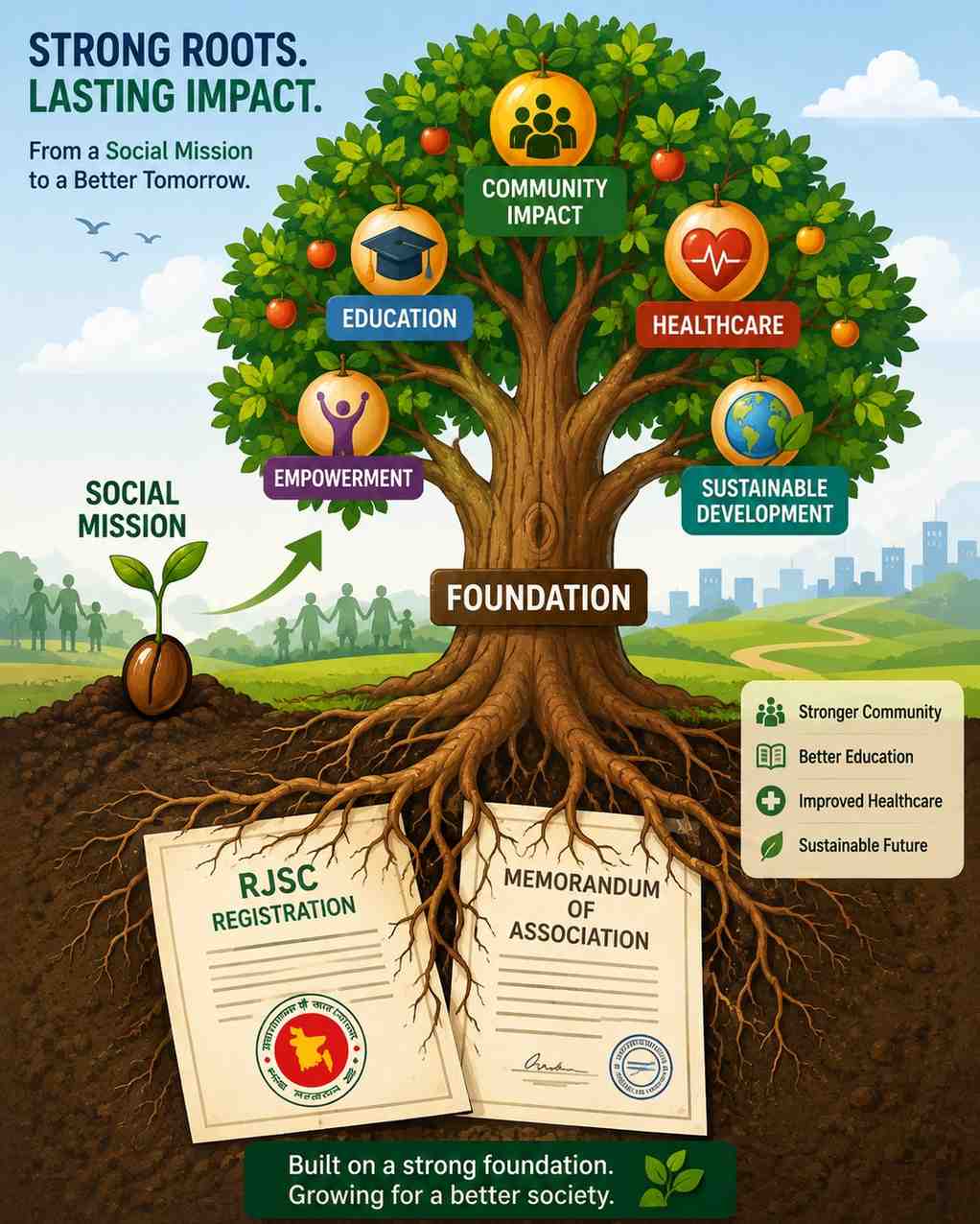
Setting up a non-profit requires meticulous planning and a deep understanding of local laws. You must overcome specific administrative challenges to ensure your organization operates legally. Understanding these requirements is crucial for creating a lasting social impact.

This guide offers a clear path forward. We delve into the key steps to meet government regulations. By adhering to these professional guidelines, you’ll gain the clarity need

Establishing a legitimate entity empowers you to pursue your mission confidently. We demystify the legal complexities, allowing you to concentrate on your core objectives. We’ll guide you through the necessary documentation and filing processes for the needs.

These article findings into the key requirements for your firm. We’ll cover everything from primary name clearance to obtaining your final certificate of incorporation.  Joint Stock Company Registration in Bangladesh sole authority is mostly known as RJSC. Office of the Registrar of Joint Stock Companies and Firms (RJSC) is a Government organization of Bangladesh

Branch Office Registration in Bangladesh
RJSC Company Share Transfer in Bangladesh documentation requirements
×
Enlarged View

The RJSC issues approval or registration of nonprofit organization and approvals other business incorporation certificate, such as Company’s Annual Return Filling/ Company Schedule X Submission in Bangladesh, Company Share Transfer in Bangladesh, Society Registration in Bangladesh, Company Winding up in Bangladesh, Company Share Allotment/Increase, Partnership Firm Registration in Bangladesh, Branch Office Registration in Bangladesh, Liaison Office/ Representative Office Registration in Bangladesh, Trade Organization Registration at RJSC, One Person Company(OPC) registration at RJSC, Foreign Company Registration in Bangladesh, Joint Venture Company Registration in Bangladesh,  Certified Copy issue, and others certificates.

Let us guide

Key Takeaways

  1. Identify the core objectives of your organization before filing.
  2. Ensure all legal documents meet the standards of the Registrar of Joint Stock Companies.
  3. Follow a structured approach to avoid common administrative delays.
  4. Verify that your chosen name complies with local naming conventions.
  5. Maintain accurate records to simplify future compliance audits.

Understanding the Legal Framework for Foundations in Bangladesh

Deciding how to register a foundation registration in Bangladesh requires a deep understanding of the regulatory environment. The legal framework for non-profit entities is designed to promote transparency and accountability in social welfare activities. Adhering to these rules safeguards your organization from potential legal challenges.

When you aim to register a foundation in Bangladesh, identifying the appropriate legal structure is crucial. Different laws govern various types of organizations. Selecting the right structure is a pivotal decision for your board members. Common structures include:

  • Trusts: Regulated under the Trust Act of 1882.
  • Societies: Governed by the Societies Registration Act of 1860.
  • Companies: Registered as non-profit entities under the Companies Act of 1994.

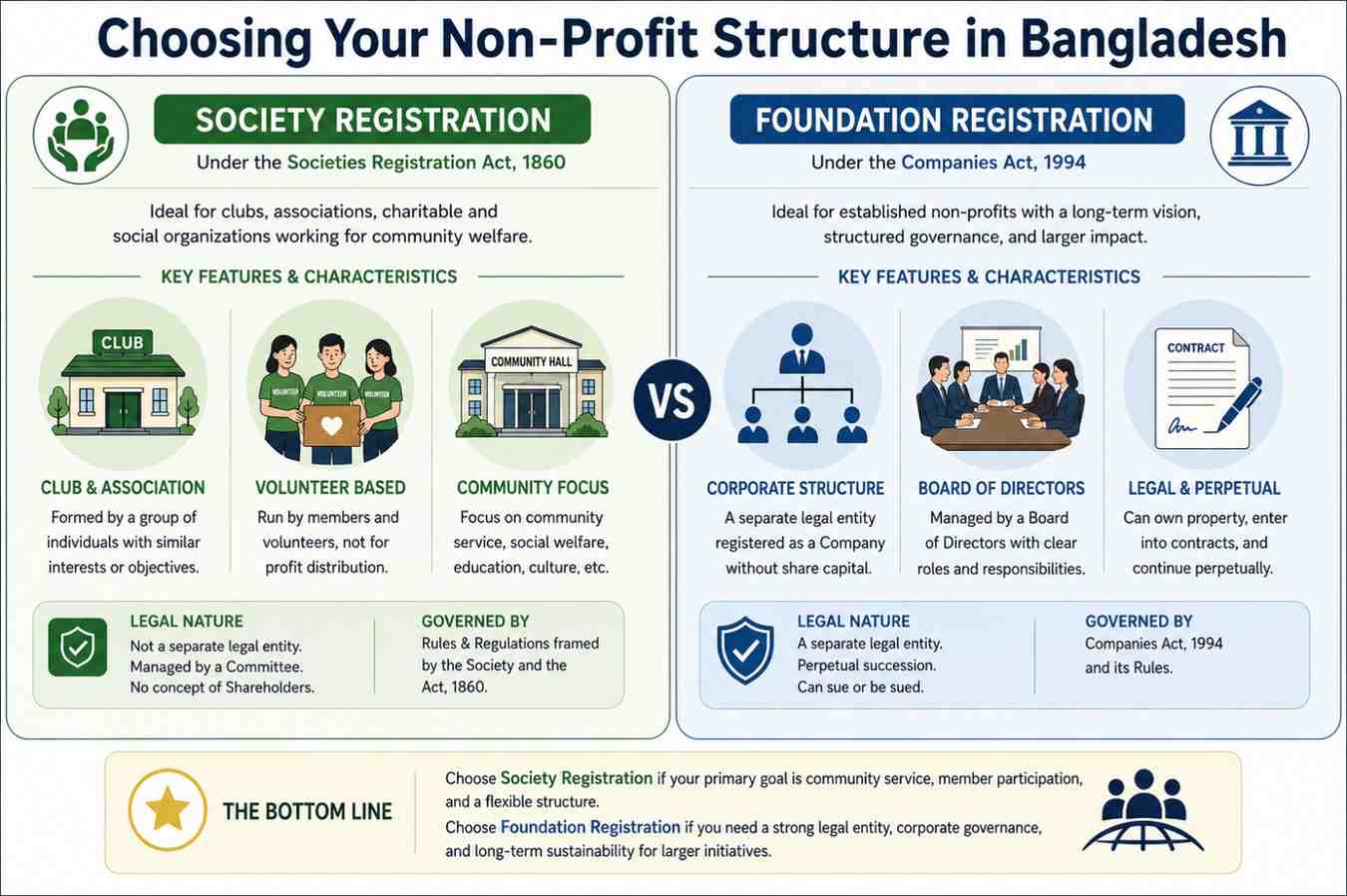
Many opt for society registration in Bangladesh due to its clear framework for collective action. This structure is perfect for groups focused on community development, education, or cultural promotion. It grants your organization a distinct legal identity, enabling it to own property and enter into contracts in its name.

The RJSC society registration in Bangladesh is the formal route to achieving this status. You must adhere to the specific Society registration process in Bangladesh to ensure your documentation complies with all statutory requirements. Strict adherence to these regulations is key to the long-term success of your charitable endeavors.

Strategic Planning and Selecting a Unique Foundation Name

Your journey toward foundation incorporation in Bangladesh starts with a clear vision and a distinct identity. Strategic planning is the foundation for any successful foundation formation in Bangladesh. By defining your mission early, you create a roadmap through complex regulatory landscapes.

A unique name is the first critical step when you decide to register a non-profit organization in Bangladesh. Your chosen name must reflect your core values and adhere to the naming conventions of the Registrar of Joint Stock Companies and Firms (RJSC). This approach helps avoid legal conflicts or potential rejection by authorities.

When researching how to register a foundation in Bangladesh, name availability is a primary hurdle. A name too similar to existing entities will likely be denied. Use the following criteria to evaluate your potential foundation name before starting submission process.

CriteriaDescriptionImportance
UniquenessMust not match existing entitiesHigh
RelevanceReflects the mission statementMedium
ComplianceFollows RJSC naming rulesCritical
AvailabilityVerified via official databaseHigh

By following these guidelines, your organization starts on a solid legal footing. Careful planning during this initial phase saves significant time and resources. It allows you to focus on your charitable goals.

Navigating the RJSC Name Clearance Process

Understanding the RJSC name clearance process is crucial for a smooth application. This step is essential when you learn how to register foundation with RJSC. It secures your unique brand identity in the national database. Without this verification, you cannot proceed to the next stages of legal incorporation.

The Registrar of Joint Stock Companies and Firms (RJSC) has strict guidelines to avoid name duplication and confusion. When applying for foundation name clearance Bangladesh, your proposed title must be distinct and professional. A name too similar to existing entities often leads to rejection, delaying your progress.

To boost your chances of a swift approval, remember these key criteria during submission:

  • Uniqueness: Ensure the name does not mirror any existing registered organizations.
  • Relevance: The name should reflect the core objectives and mission of your foundation.
  • Compliance: Avoid using restricted words or terms that imply government affiliation without proper authorization.
  • Clarity: Use clear, professional language that is easy for the public to identify.

Mastering the RJSC name clearance for foundation is a mandatory prerequisite before moving forward with your formal registration documents. Once you submit your request through the online portal, the authorities will review your application against their internal database. Patience is key during this phase, as the verification process ensures that your foundation stands on a solid, legally protected foundation.

Drafting the Memorandum of Association for Your Foundation

Starting the non-profit foundation registration Bangladesh journey, the Memorandum of Association (MOA) is your foundational document. It outlines your legal identity and operational scope. Crafting a detailed memorandum of association for foundation is crucial for securing your legal standing.

It’s vital to clearly define your objectives and the scope of your activities. For charitable foundation registration in Bangladesh, the language must be precise and legally compliant. Any ambiguity in your goals can cause delays in the review process.

For those focused on social welfare foundation registration in Bangladesh, your MOA should highlight community development. It should outline how you plan to manage resources and fulfill your mission. Transparency in these objectives aids regulators in grasping your vision.

For NGO foundation registration in Bangladesh, adherence to government regulations is paramount. Include clauses on asset dissolution and fund management. Legal compliance at this stage avoids future operational challenges.

To meet all requirements, use a template that covers statutory necessities. A solid memorandum of association for foundation should include essential elements:

  • Name of the Foundation: The officially cleared name.
  • Registered Office: The physical location of your operations.
  • Objectives: A detailed list of your charitable or social goals.
  • Liability Clause: A clear statement regarding the liability of members.
  • Capital and Membership: Details on how the foundation is funded and governed.

Establishing Rules and Regulations for Internal Governance

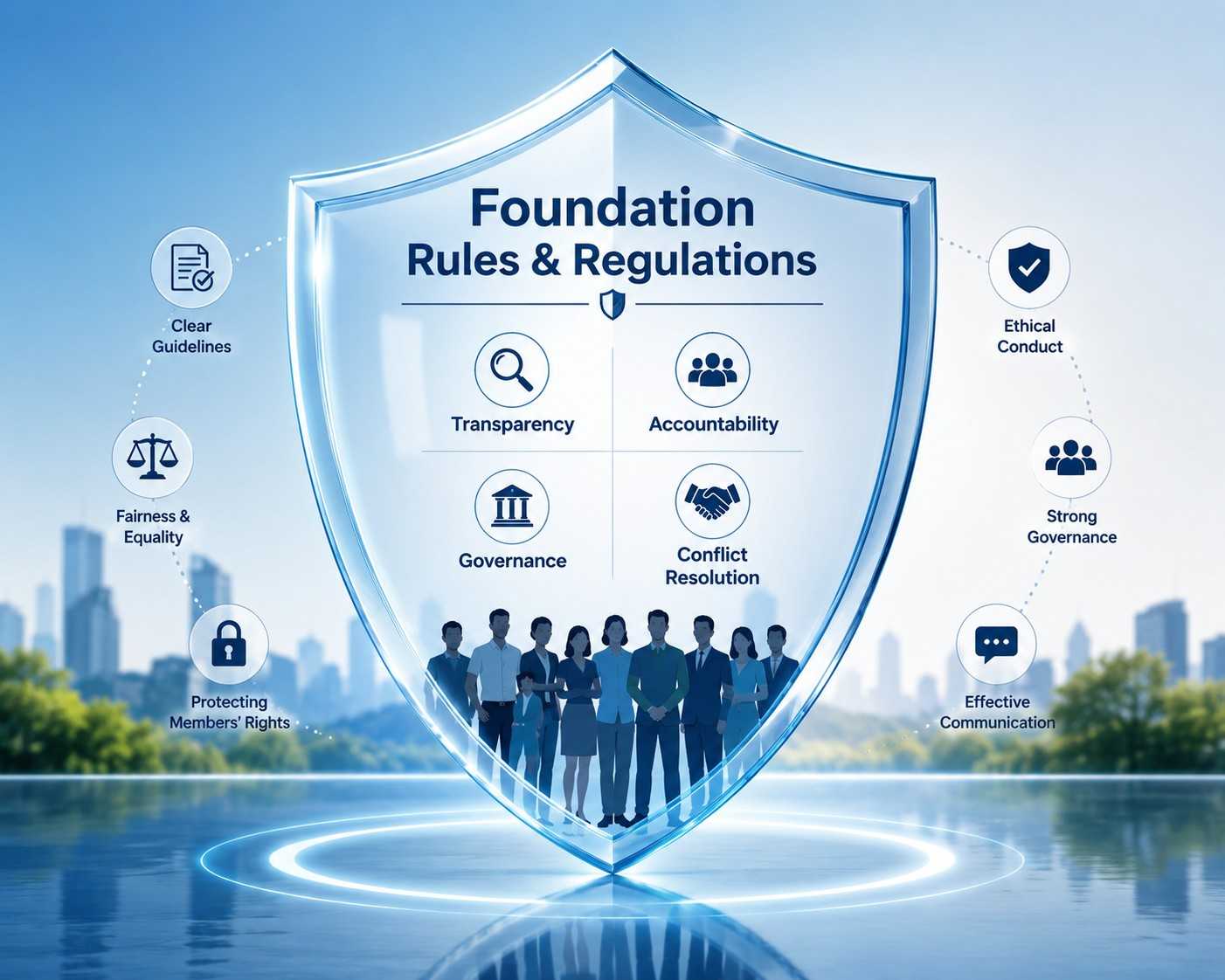
Creating a robust internal governance structure is crucial for any successful organization in Bangladesh. By formalizing your Joint Stock Foundation Rules and Regulations Bangladesh, you set a clear path for daily operations. This framework acts as a protective shield, ensuring your mission stays focused and actions comply with local standards.

It’s important to draft these documents to define the specific roles of your members clearly. By outlining responsibilities, you prevent confusion and ensure everyone knows their role. Transparency is key here, as it builds trust among stakeholders and potential donors.

Effective governance also requires well-defined voting procedures and conflict resolution mechanisms. Without these, your foundation may face administrative disputes that could hinder your progress. Implementing foundation rules and regulations in Bangladesh early on helps you navigate disagreements professionally and ethically.

Consider the following table to understand the essential components required for your internal policy documents:

Governance ComponentPrimary ObjectiveImplementation Strategy
Member RolesDefine accountabilityFormal job descriptions
Voting ProceduresEnsure fair decisionsStandardized meeting protocols
Conflict ResolutionMaintain harmonyMediation and arbitration steps
Ethical StandardsPromote integrityCode of conduct enforcement

By formalizing these internal policies, you protect your foundation from future administrative disputes and governance failures. A well-structured organization is better equipped to handle growth and long-term challenges. Always ensure that your foundation rules and regulations in Bangladesh are reviewed periodically to reflect the evolving needs of your team and the community you serve.

Compiling Founding Member Details and Documentation

Creating a strong foundation demands meticulous documentation of each member’s information. Accurate data collection is a key component in fulfilling the RJSC foundation registration in Bangladesh requirements. It’s crucial to verify every detail against official government records.

Branch Office Registration in Bangladesh
RJSC Company Share Transfer in Bangladesh documentation requirements
×
Enlarged View

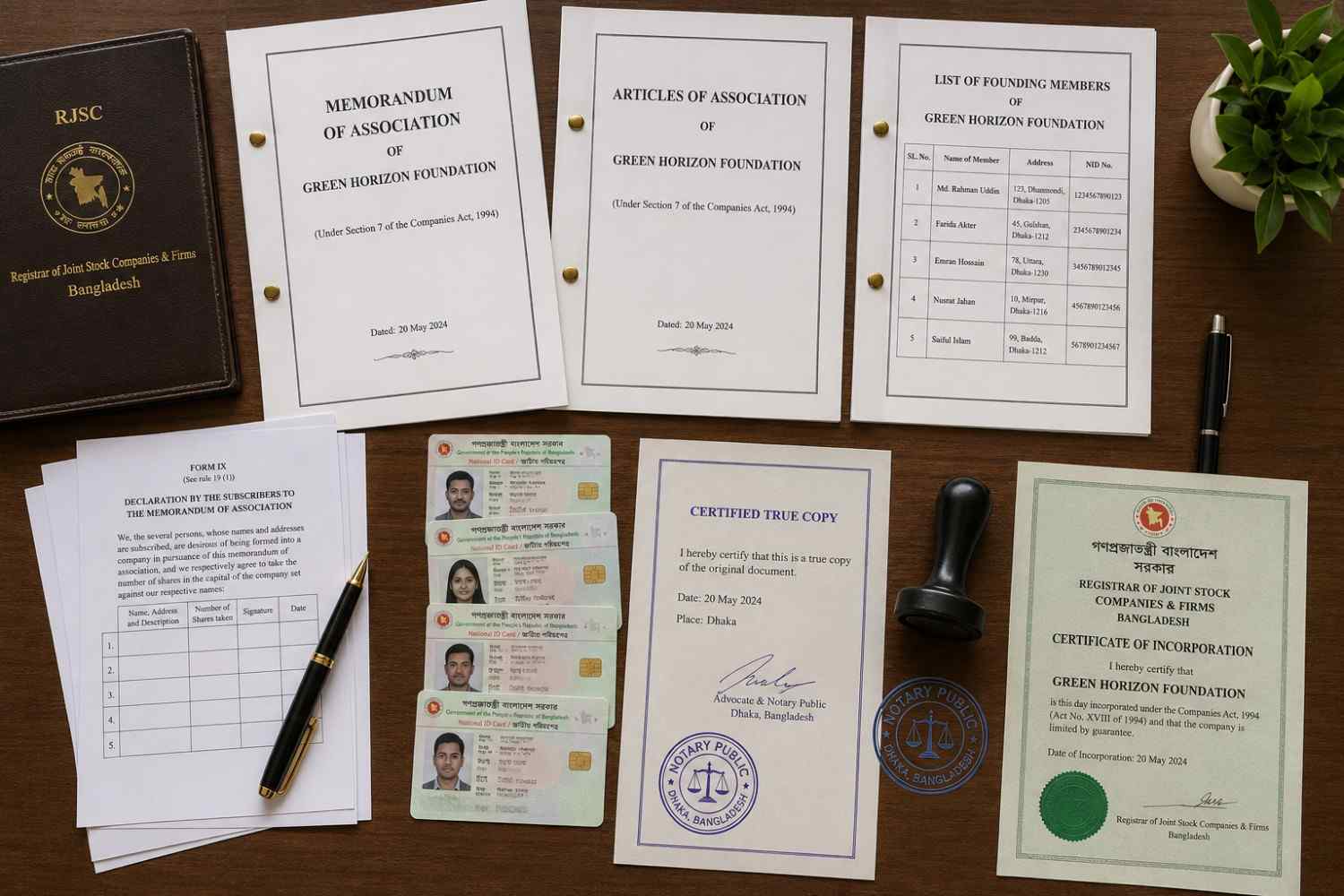
First, compile a detailed list of all founding members. This list must include full legal names, current addresses, and valid contact information. Precision at this stage is vital to avoid delays in the review process.

You also need to gather specific foundation registration documents Bangladesh to support your application. These documents act as legal proof of identity and residency for each member. Adhering to these requirements Bangladesh will greatly reduce the chance of your application being returned for missing information.

The table below outlines the essential items you must prepare for your submission. Make sure all copies are clear and legible before finalizing your file.

Document TypePurposeVerification Method
National ID (NID)Identity ProofSmart Card or Paper Copy
Contact DetailsCommunicationVerified Phone and Email
Passport Size PhotoRecord KeepingRecent Color Photograph
Professional BioBackground CheckSigned Member Profile

Organizing these files systematically shows your commitment to transparency. Proper documentation is essential for a successful registration. Always verify your records against the latest guidelines to ensure full compliance.

Structuring the Executive Committee and Governing Body

Creating a strong leadership structure is crucial for your organization’s success. When setting up your foundation executive committee Bangladesh, focus on individuals with both professional skills and personal commitment to your mission. A well-organized team ensures transparency and efficiency from the start.

The foundation governing body Bangladesh is key to your strategic direction. Defining each member’s role clearly promotes accountability and sustainability. It’s vital to document these roles to prevent confusion in managing your foundation.

When choosing your leaders, consider the legal needs for a foundation governing body Bangladesh. Ensure each member knows their fiduciary duties and legally responsible of the executive committee.

Your foundation executive committee Bangladesh should have a shared vision for the future. Encourage teamwork to make decisions that support your main goals. A unified governing structure helps navigate regulatory challenges and achieve your charitable objectives.

Securing a Registered Office Address and Required Legal Proofs

Embarking on the path to legal status necessitates a dedicated space for official operations. Every entity pursuing legal foundation registration in Bangladesh must provide a verifiable physical address for all official correspondence. This ensures regulatory bodies can contact your organization for audits or notifications.

Securing the registered office address and gathering all necessary legal documents is paramount. You’ll need a valid rental agreement or a deed of ownership for the premises. Also, prepare recent utility bills, like electricity or gas statements, to confirm the office space’s active status.

This step is crucial for both non-profit organization registration Bangladesh and charitable organization registration in Bangladesh. It ensures complete legal transparency.

We will guide you through the specific legal foundation registration in Bangladesh requirements for documenting your office space correctly. It’s vital to ensure the address provided matches your Memorandum of Association. Organizing these documents early streamlines the path to successful legal foundation registration inBangladesh. It sets a solid foundation for your future activities.

Completing Prescribed RJSC Forms and Statutory Declarations

Starting the foundation registration procedure Bangladesh demands meticulous documentation. The Registrar of Joint Stock Companies and Firms (RJSC) expects perfect consistency in all documents. Any small discrepancy can cause delays or even rejection.

Every detail, from the foundation’s name to the addresses of your board members, must match your legal documents precisely. Accuracy is the foundation of your success in this regulatory process. Double-checking your entries can prevent common errors that often delay approval.
Branch Office Registration in Bangladesh
RJSC Company Share Transfer in Bangladesh documentation requirements
×
Enlarged View

Many opt for professional RJSC registration services Bangladesh to tackle these complex requirements. These services help spot potential issues, like incomplete statutory

The table below highlights common errors in the foundation registration procedure in Bangladesh. Knowing these pitfalls can help you prepare a stronger application package.

Document TypeCommon ErrorImpact on Application
Form XIIMismatched Member DetailsImmediate Rejection
Statutory DeclarationMissing NotarizationProcessing Delay
MemorandumInconsistent ObjectivesQuery Issued by RJSC
Address ProofExpired Utility BillVerification Failure

Your attention to detail in these forms shows your organization’s integrity. Reliable RJSC registration services in Bangladesh ensure your statutory declarations are legally valid and compliant. By focusing on these details, you ensure a smooth and efficient registration process.

The Official Submission Process for Foundation Registration in Bangladesh | RJSC Foundation Registration

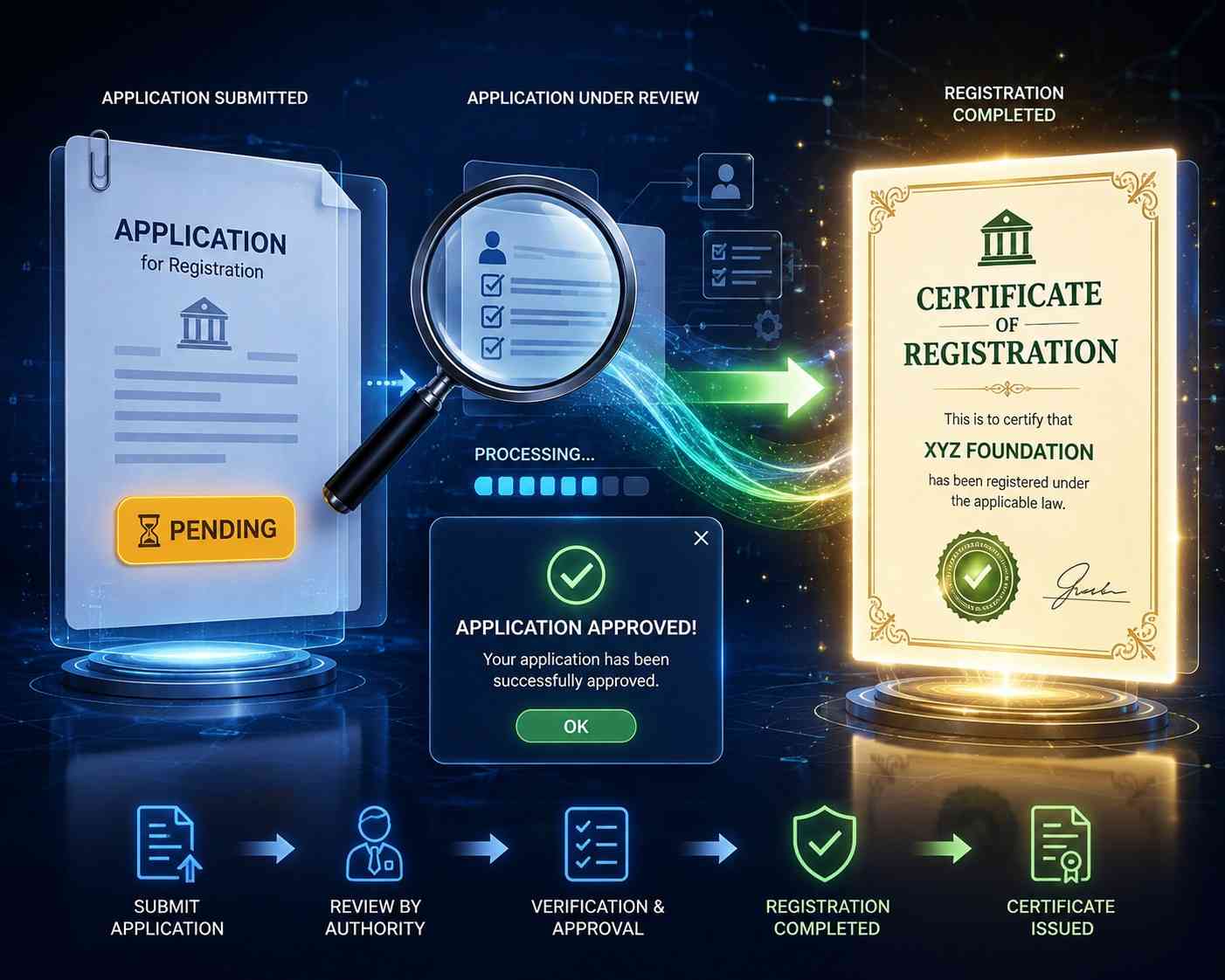
Your journey to legal recognition ends with the submission of your foundation registration application in Bangladesh. This marks the end of your planning phase and the start of the regulatory review by authorities.

First, organize all your documents as per the RJSC’s specific requirements. Whether you choose the digital portal or a physical filing, precision is crucial to prevent delays.

The foundation registration process in Bangladesh demands submission through official government channels. Adhering to these protocols showcases your dedication to

Completing the foundation registration process in Bangladesh is a major milestone for your organization. Once the RJSC reviews your documents, your rjsc foundation registration moves to verification. Here, officials will check if you meet national laws.

Before you finalize, thoroughly check your submission package. A flawless foundation registration application in Bangladesh boosts your chances of a hassle-free approval. Remain vigilant, as this step is the last hurdle to your foundation’s legal recognition.

Managing Registration Fees and Financial Compliance

Understanding the costs of your foundation registration is crucial. Financial compliance starts with timely payment of fees to the Registrar of Joint Stock Companies and Firms (RJSC). You must pay the foundation registration fees in Bangladesh to keep your application moving forward.

Knowing the foundation registration fees Bangladesh structure is key for planning. Budgeting for these costs avoids unnecessary delays. Incorrect payments can cause significant delays in your incorporation.

To uphold financial integrity, check the current fee schedule before making payments. Keeping detailed records of your payments proves compliance during reviews. Proper handling of foundation registration fees Bangladesh shows your commitment to transparency and professionalism.

Make sure to keep your payment receipts safe for audits. Staying on top of foundation registration fees in Bangladesh ensures a smooth path to legal approval.

Handling RJSC Queries and Post-Submission Corrections

Managing post-submission queries is crucial for finalizing your foundation’s legal status in Bangladesh. It’s common for authorities to request clarification during the RJSC foundation registration process in Bangladesh. View these inquiries as a normal part of the review, not a setback.

Upon receiving a notification, carefully review the requirements. Responding with precision and speed is key to keeping your timeline on track. Adhering to the correct RJSC foundation registration procedure in Bangladesh ensures your documents meet government standards.

Branch Office Registration in Bangladesh
RJSC Company Share Transfer in Bangladesh documentation requirements
×
Enlarged View

Encountering legal or technical issues? Consulting a foundation registration lawyer Bangladesh might be wise. A qualified lawyer can guide you through disputes or unclear regulations. Addressing these corrections promptly and professionally paves the way for smoother approval.

Obtaining Your Foundation Registration Certificate and Post-Registration Approvals

Receiving formal recognition is a significant step, marking the shift from planning to legal operation. This achievement in the Foundation Registration in Bangladesh journey confirms your organization’s official government recognition. It allows you to proceed with confidence, knowing your legal status is fully secured.

The significance of completing your foundation registration at RJSC cannot be overstated. This document is your primary legal proof of incorporation. It’s crucial for opening bank accounts and signing contracts. Without it, your organization cannot operate as a formal entity.

After your application is approved, follow specific steps to collect your foundation registration certificate Bangladesh. Ensure you have all original receipts and identifica Here are the essential steps to finalize your collection:

  • Verify the approval status through the official RJSC online portal.
  • Visit the designated RJSC office with your original submission receipts.
  • Present valid identification of the authorized representative.
  • Collect the certified copies of your Memorandum and Articles of Association.

Once you have your certificate, you are legally authorized to start your charitable or social activities. It’s crucial to keep your registration documents in a secure location for future audits. Keeping these records ensures your organization remains compliant with regulatory authorities at all times.

Maintaining Long-Term Compliance and Operational Excellence

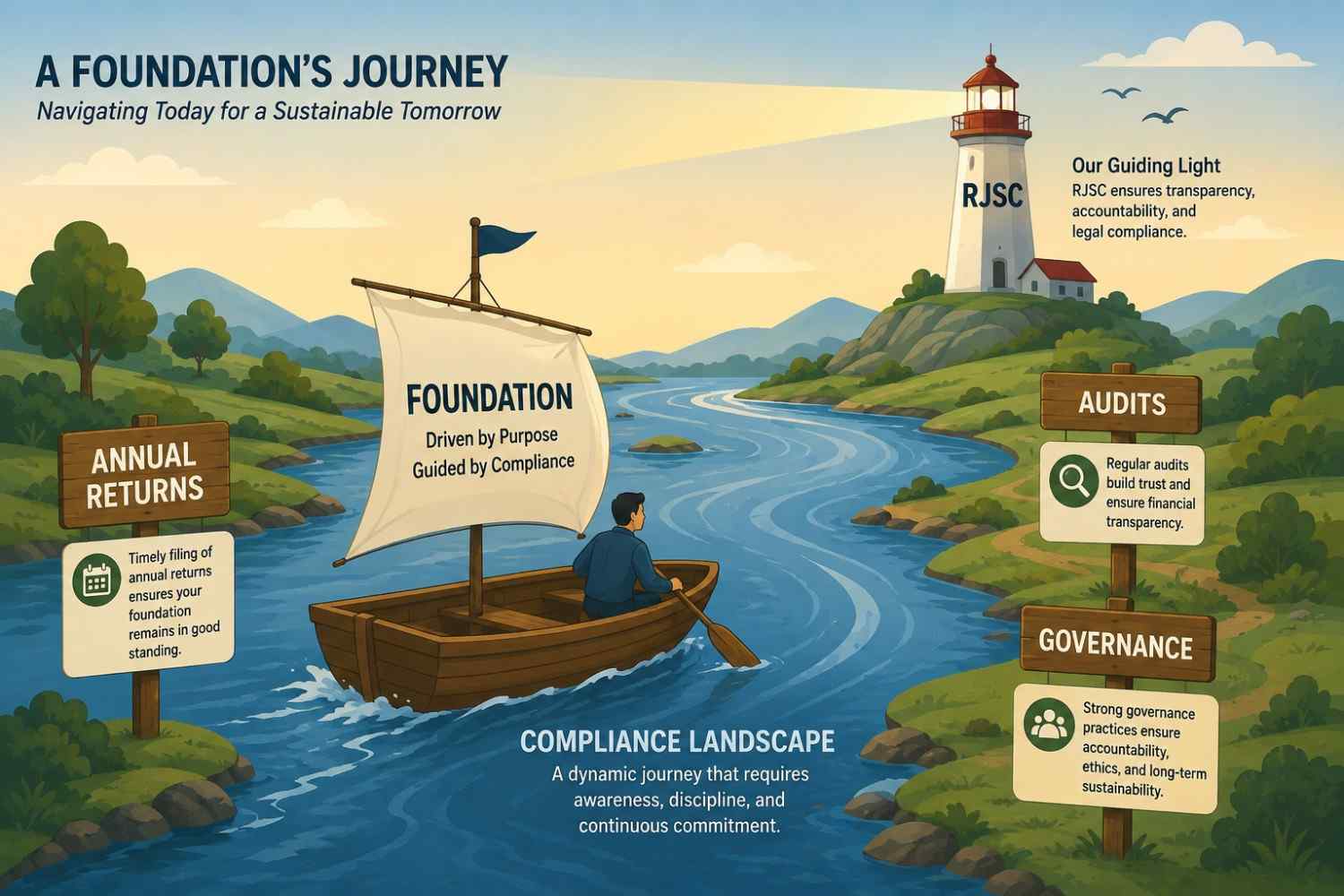
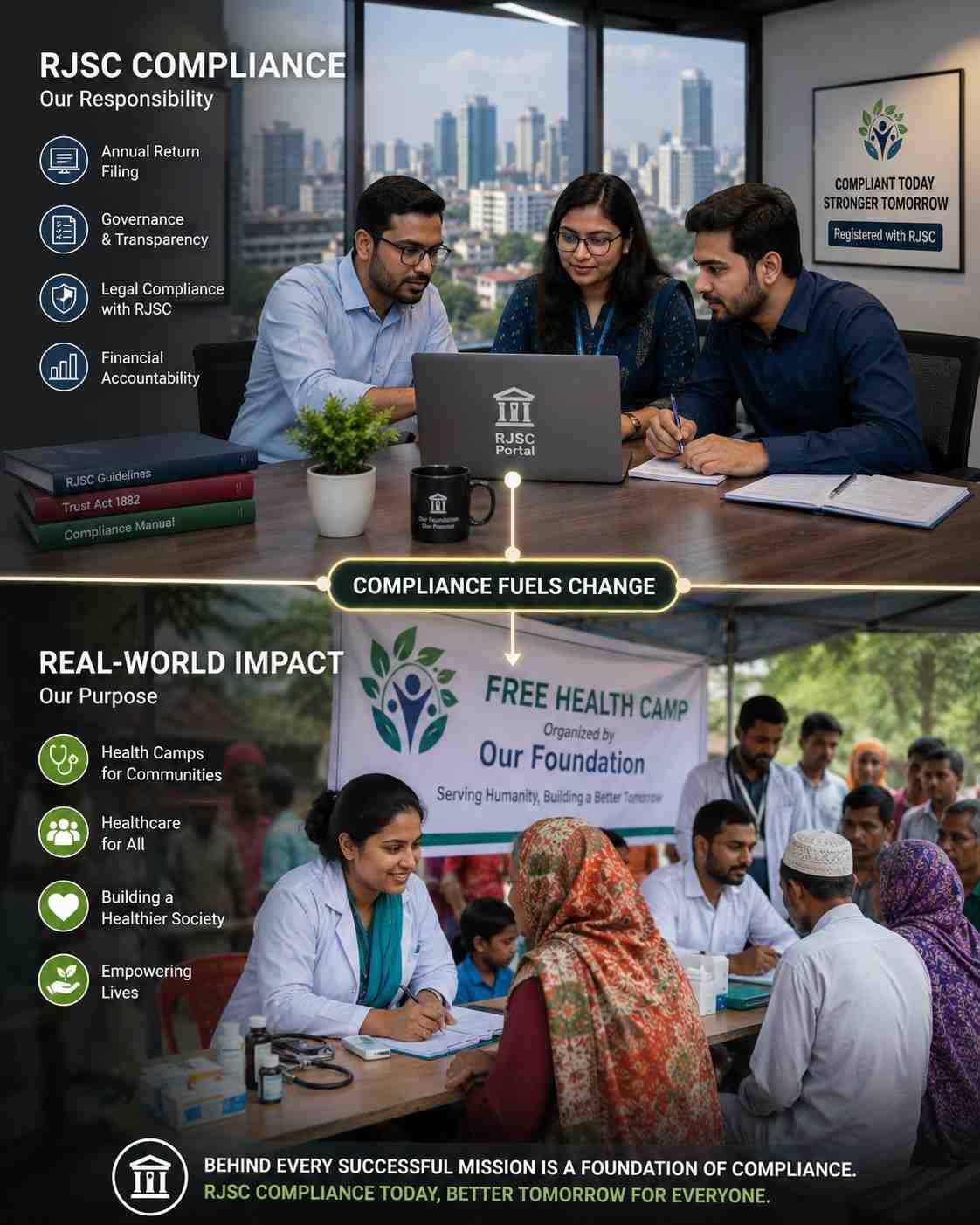
Obtaining legal status is just the start of your path to making a difference. To achieve long-term success, you must adhere to regulatory standards. This ensures your organization’s safety and operational efficiency. Prioritizing foundation compliance in Bangladesh is essential for smooth operations.

Your foundation annual return filing in Bangladesh is a crucial task. It’s vital to keep track of all deadlines to maintain your RJSC annual return for foundation. Ignoring these filings can jeopardize your legal status.
Branch Office Registration in Bangladesh
RJSC Company Share Transfer in Bangladesh documentation requirements
×
Enlarged View

Consider using the best foundation registration service in Bangladesh to manage these tasks. Expert advice ensures you meet all requirements for your activities. A trustworthy service gives you the confidence to concentrate on your mission.

Ensure your internal records are well-organized and ready for audits. Regularly review your governing documents to reflect any leadership or scope changes. This diligence enhances your organization’s reputation in the country.

If you encounter challenges with regulatory updates, seek professional consultants. Being proactive helps avoid legal issues. Your dedication to transparency and governance will shape your organization’s lasting legacy.

FAQ

How do you begin the process of foundation registration in Bangladesh with the RJSC?

To start the RJSC foundation registration, first define your organization’s mission. Ensure it aligns with the legal foundation registration Bangladesh framework. Begin by securing a unique name. Then, proceed with the foundation registration process in Bangladesh. This involves preparing constitutional documents and submitting them to the Registrar of Joint Stock Companies and Firms (RJSC).

What is the difference between a foundation and RJSC society registration?

A foundation and a society registration serve non-profit goals but differ. Societies register under the Societies Registration Act, 1860. This is often for clubs or voluntary associations. Foundations, registered under the Companies Act as non-profits, offer a more robust corporate structure. Understanding these differences is crucial for non-profit organization registration Bangladesh.

How can you successfully obtain foundation name clearance Bangladesh?

To get RJSC name clearance for foundation, apply through the official portal. Choose a name not identical or deceptively similar to existing ones. This is a critical step in foundation formation in Bangladesh. Once approved, the name is reserved, allowing you to finalize your foundation registration documents Bangladesh.

What should be included in the memorandum of association for foundation?

The memorandum of association for foundation must state your organization’s name, office address, and objectives. For charitable foundation registration in Bangladesh or NGO foundation registration in Bangladesh, specify that all income will be used for promoting the foundation’s social or welfare objects. Also, state that no dividends will be paid to members.

What are the primary RJSC foundation registration requirements for the governing body?

You must establish a foundation executive committee Bangladesh with qualified individuals. The RJSC foundation registration requirements demand providing the full names, occupations, and addresses of the foundation governing body Bangladesh. Ensure these members are committed to the social welfare foundation registration Bangladesh goals.

How do you draft effective foundation rules and regulations Bangladesh?

When registering a foundation in Bangladesh, draft “Articles of Association” or internal foundation rules and regulations Bangladesh. These should cover membership eligibility, meeting protocols, the powers of the executive committee, and financial audit procedures. This ensures your legal foundation registration in Bangladesh is transparent and well-governed.

What documentation is required to prove your registered office address?

For successful foundation incorporation in Bangladesh, provide proof of a physical location. This includes a rental agreement or a utility bill in the name of the owner. A verifiable address is crucial for all official correspondence with the RJSC.

What are the typical foundation registration fees in Bangladesh?

The foundation registration fees Bangladesh vary based on the entity type and application specifics. You will encounter costs for name clearance, registration filing fees, and stamp duties. Consulting the best foundation registration service Bangladesh can help estimate the total foundation registration fees in Bangladesh for your project.

How long does the RJSC foundation registration process usually take?

The RJSC foundation registration procedure can take weeks to months, depending on your application’s accuracy. If the RJSC issues queries, respond promptly. Many organizations hire a foundation registration lawyer Bangladesh to expedite the RJSC foundation registration in Bangladesh by ensuring error-free documents.

What happens after you receive the foundation registration certificate Bangladesh?

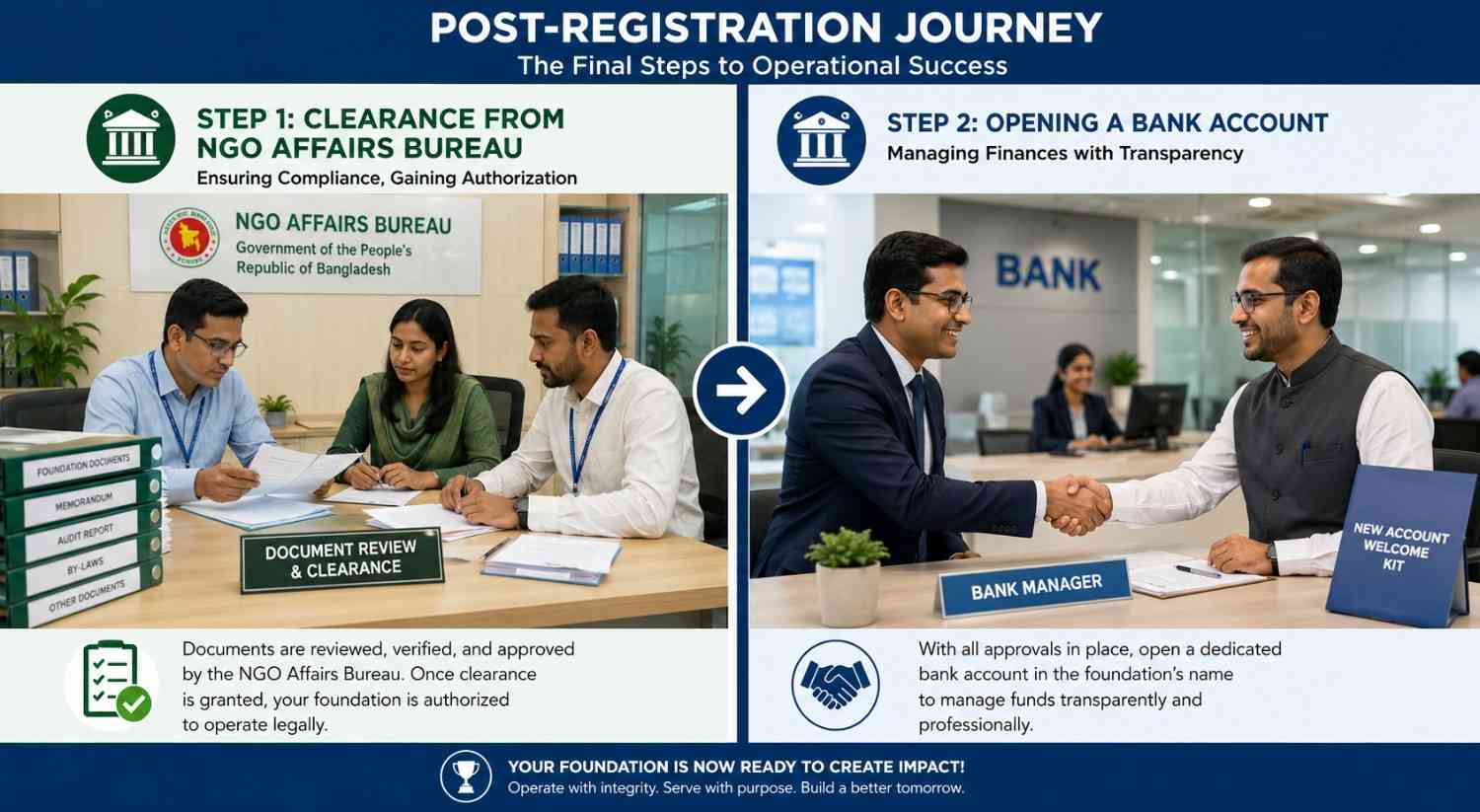
After obtaining the Foundation/Society Registration Certificate from RJSC, your organization becomes a legal entity. However, how to register foundation with

RJSC is just the first step. You may need to register with the NGO Affairs Bureau or the Department of Social Services based on your activities. Also, stay current with your foundation annual return Bangladesh filings.

Why is the RJSC annual return for foundation important for compliance?

Maintaining foundation compliance Bangladesh is ongoing. You must file an RJSC annual return for foundation to report changes and submit audited financial statements. Failure can jeopardize your status and legal foundation registration Bangladesh standing.

Can you use a foundation registration service Bangladesh to handle the paperwork?

Yes, using a professional foundation registration service Bangladesh or RJSC registration services Bangladesh can simplify the process. They handle foundation name clearance Bangladesh to drafting the MOA. This allows you to focus on your mission while they manage the foundation registration procedure Bangladesh.

Creating a formal industry body is the legal foundation for any group aiming to represent collective interests. To gain official recognition and advocacy power, you must meet the specific requirements set by the Registrar of Joint Stock Companies and Firms (RJSC) for startingprocedure of RJSC Trade Organization Registration in Bangladesh step by step RJSC exercises strict regulatory oversight to safeguard the integrity of the local business environment.

Understanding the procedural steps is crucial for your success. This guide offers a detailed overview of the legal framework needed for forming a professional association. We will guide you through the entire process to ensure your application adheres to all regulatory standards.

By the Registrar of Joint Stock Companies and Firms (RJSC) is only legal authority to register the Trade Organization Registration in Bangladesh. If adhering to the RJSC’s clear steps, you will discover how to register a trade organization in Bangladesh efficiently. The proper arrangement helps you avoid common pitfalls and ensures your entity achieves the status it deserves. Let us assist you to ensure securing your future as a renowned industry leader. The Registrar of Joint Stock Companies and Firms is the primary authority generally known (RJSC) an organization of Government of People’s Republic of Bangladesh

Branch Office Registration in Bangladesh
RJSC Company Share Transfer in Bangladesh documentation requirements
×
Enlarged View

The Register of Joint Stock Company and Firms (RJSC) issues legal approval or registration of nonprofit organization and approvals other business incorporation certificate, Like Trade Organization Registration at RJSC, Company’s Annual Return Filling/ Company Schedule X Submission in Bangladesh, Society Registration in Bangladesh, Company Share Transfer in Bangladesh, Branch Office Registration in Bangladesh, Company Winding up in Bangladesh, Foreign Company Registration in Bangladesh, Company Share Allotment/Increase, Partnership Firm Registration in Bangladesh, Liaison Office/ Representative Office Registration in Bangladesh, One Person Company(OPC) registration at RJSC, Joint Venture Company Registration in Bangladesh, RJSC, Certified Copy issue, and others documents which is needed.

Key Takeaways

  • Formal recognition provides your association with essential advocacy power.
  • The Registrar of Joint Stock Companies and Firms oversees all legal filings.
  • Successful formation requires name clearance and drafting specific governing documents.
  • Compliance with the Companies Act 1994 is mandatory for all applicants.
  • Strategic planning helps you avoid delays during the application process.

Understanding Trade Organization Registration in Bangladesh

To give your industry a unified voice, you must first grasp what is trade organization in Bangladesh. This involves legally forming a business association under the watchful eye of the Registrar of Joint Stock Companies and Firms (RJSC).

By registering for trade organization registration in Bangladesh, you establish a body dedicated to representing a specific sector. Unlike regular private companies, these organizations focus on advocacy, policy shaping, and promoting professional standards among their members.

Understanding what is trade organization in Bangladesh, is crucial to ensure your group aligns with national economic objectives. These entities serve as a link between t making circles.

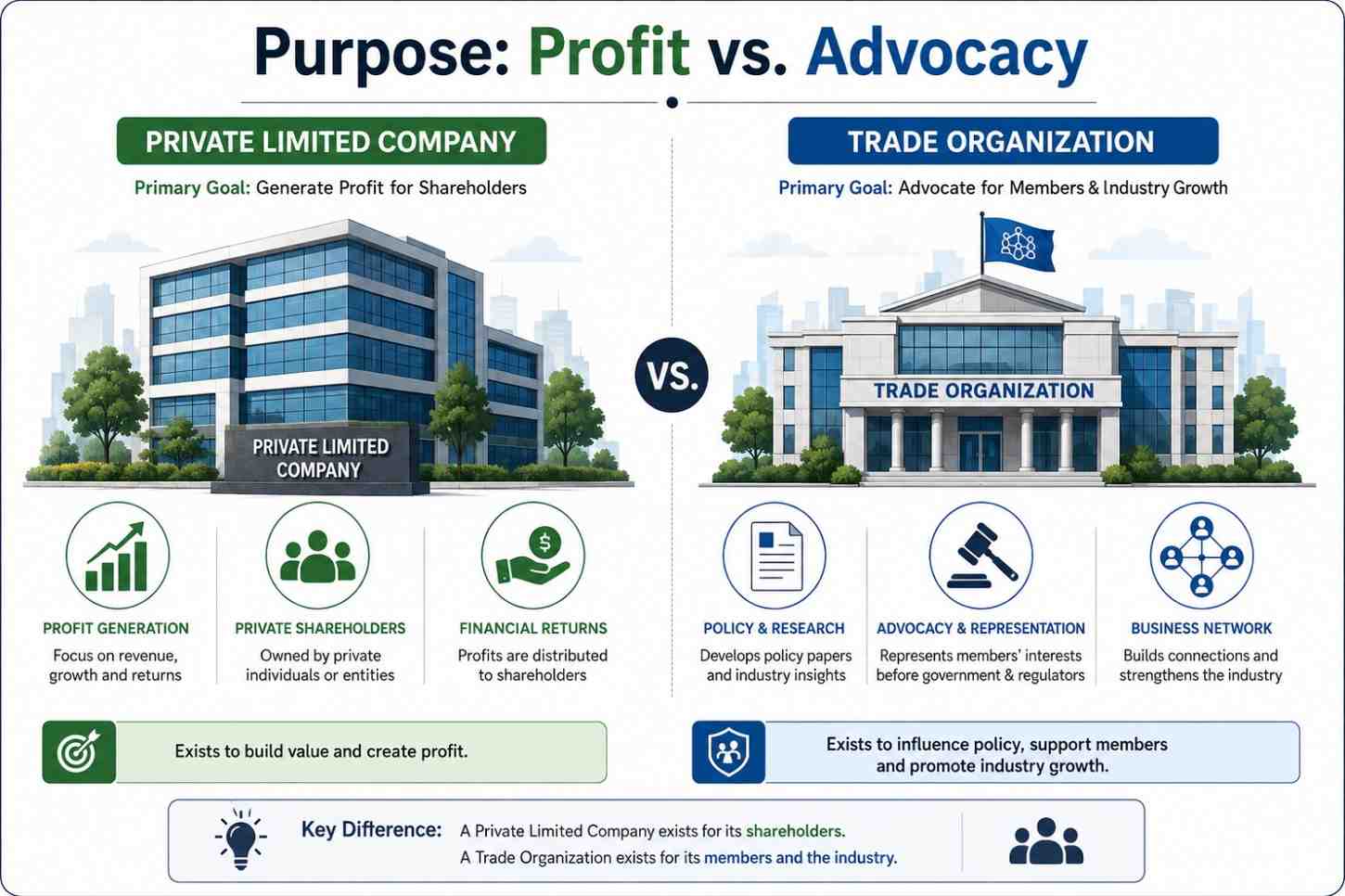
The table below outlines the key differences between a standard business entity and a trade organization. It helps you understand their main roles.

FeaturePrivate CompanyTrade Organization
Primary GoalProfit GenerationIndustry Advocacy
Regulatory BodyRJSCRJSC & Ministry of Commerce
MembershipShareholdersIndustry Stakeholders
Legal StatusCorporate EntityNon-Profit Association

By registering for trade organization registration in Bangladesh, you gain the power to negotiate, lobby, and establish industry standards. This legal status boosts your members’ credibility, enabling them to engage in national economic discussions effectively.

Legal Framework Governing Trade Organizations

The foundation of any professional trade entity in Bangladesh is built on a clear understanding of national statutes. Pursuing trade organization registration Bangladesh means entering a structured environment defined by specific legislative acts. These laws ensure your entity operates with transparency, accountability, and legal legitimacy within the national economy.

The Companies Act 1994 and Trade Organizations

The companies act 1994 trade organization framework is the primary statutory basis for incorporation. This act provides the legal structure for non-profit entities aiming to promote commerce and industry. By registering under this act, your organization gains legal entity status, separate from its members.

This separation is crucial for protecting members from personal liability. It also enables your organization to enter into contracts, hold property, and initiate legal proceedings in its own name. Adhering to the provisions of this act is essential for establishing a credible and sustainable trade body.

Trade Organizations Ordinance 1961 and Subsequent Amendments

Beyond general incorporation, the Trade Organizations Ordinance 1961 acts as a specialized pillar for governance. This ordinance regulates the conduct of trade bodies to ensure they align with the broader public interest and national economic goals. It provides specific rules for managing internal affairs and representing members.

Branch Office Registration in Bangladesh
RJSC Company Share Transfer in Bangladesh documentation requirements
×
Enlarged View

Over the years, various amendments have updated these regulations to reflect changing business community needs. You must stay informed about these updates to maintain full regulatory compliance throughout your organization’s lifecycle. The following table outlines the distinct roles these two legal pillars play in your operational journey.

Legal InstrumentPrimary PurposeKey Focus Area
Companies Act 1994Corporate IncorporationLegal Entity Status
Trade Organizations Ordinance 1961Operational GovernancePublic Interest & Conduct
Subsequent AmendmentsRegulatory UpdatesModern Compliance Standards

The Role of RJSC in Trade Organization Registration Bangladesh

Grasping the regulatory roles of the RJSC is crucial for those aiming to register a trade organization in Bangladesh. The Registrar of Joint Stock Companies and Firms (RJSC) is the primary authority. It acts as the gatekeeper for all formal business entities. Their role ensures that every organization operates within the legal boundaries of the nation.

Regulatory Oversight and Compliance

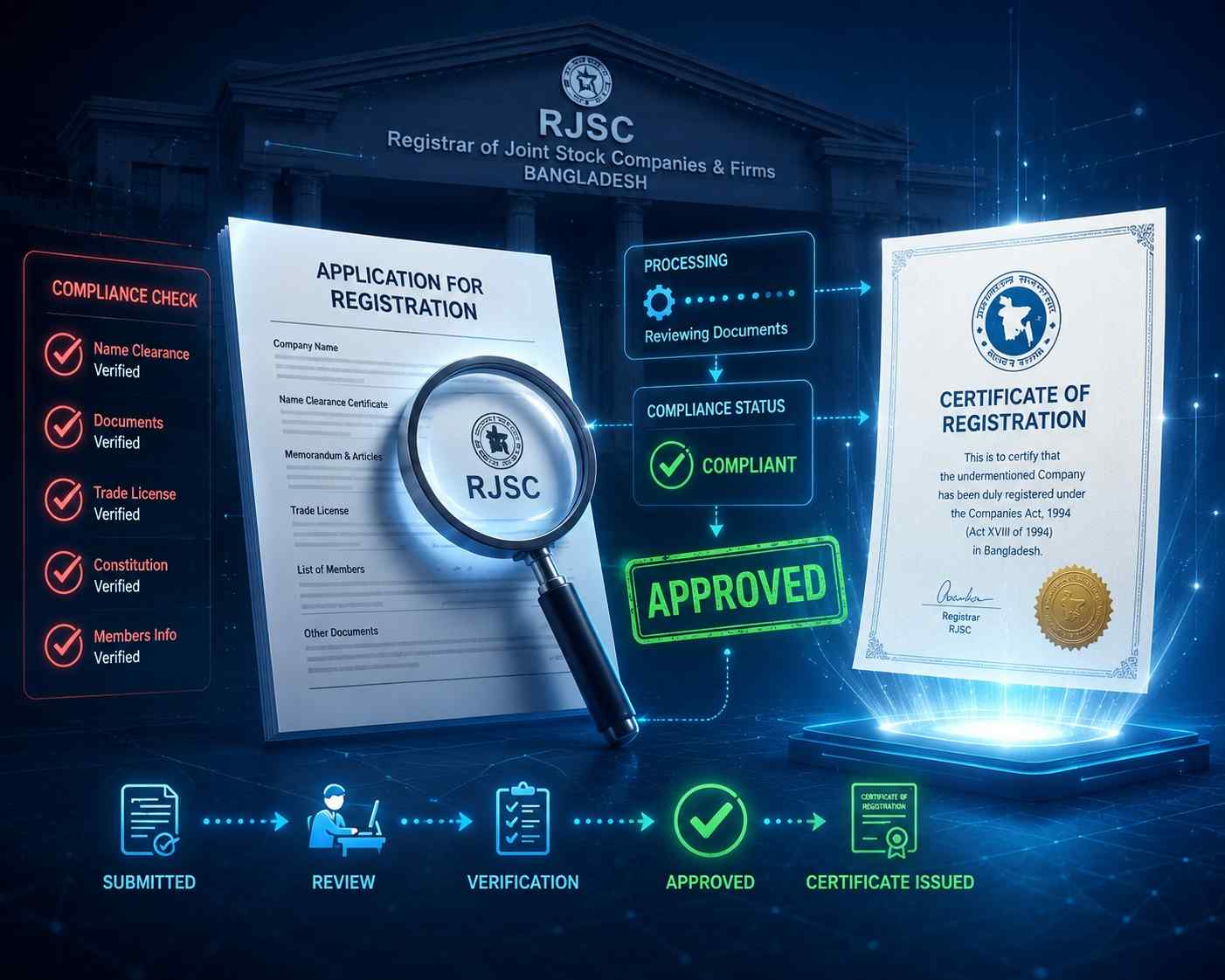
The RJSC exercises strict regulatory oversight to safeguard the integrity of the local business environment. Upon application submission, the agency conducts a detailed review. This verifies the legitimacy of your proposed entity. It ensures your joint stock trade organization in Bangladesh meets all statutory requirements.

Compliance is not just a formality; it’s a critical step in securing your legal standing. The RJSC scrutinizes your governing documents to ensure they reflect your members’ true objectives. By enforcing these standards, the agency prevents fraudulent activities and fosters a transparent marketplace for all.

Processing Applications and Issuing Certificates

The process for RJSC trade organization registration in Bangladeshis systematic and thorough. After submitting your documentation, the agency assesses it against the legal framework. If it meets the criteria, the Trade Organization Registration at RJSC in Bangladesh team proceeds with the approval process.

Upon successful verification, the RJSC issues a formal Trade Organization Certificate in Bangladesh. This document is your official proof of legal status and is vital for your future operations. It’s essential to keep this certificate in a secure location. It’s required for various banking and administrative tasks throughout your organization’s life.

Key Benefits of Trade Organization Registration in Bangladesh

The benefits of trade organization registration in Bangladesh go beyond mere paperwork. It transforms your group into a recognized entity. This allows you to confidently navigate the complex regulatory landscape of the country.

Legal Recognition and Credibility

Formal trade body registration Bangladesh grants your entity essential legal standing. This status serves as a seal of approval. It builds immediate trust with government agencies, financial institutions, and international partners.

Operating as a registered body grants you the authority to enter into binding contracts. You can also represent your members in legal matters. This professional credibility is crucial when seeking partnerships or government grants.

Advocacy and Policy Influence

Completing your Business Association Registration Bangladesh opens the door to high-level advocacy. Registered organizations have the formal platform to engage with policymakers. This allows them to influence national decisions that directly impact their industry.

You can effectively voice your members’ concerns during legislative discussions. This collective influence ensures your sector’s needs are heard at the highest levels of government. It allows you to shape the future of your business environment.

Networking and Business Development Opportunities

Registered organizations gain access to exclusive networking and business development opportunities. These opportunities are unavailable to informal groups. You can facilitate connections between members, industry leaders, and potential investors through organized events and trade missions.

These interactions foster strategic collaborations that drive innovation and growth. By maintaining a formal structure, you create a sustainable ecosystem. Your members can thrive and expand their reach within the competitive Bangladeshi market.

Prerequisites for Forming a Trade Organization

Planning a trade organization formation in Bangladesh requires meeting several essential prerequisites. Proper preparation ensures a smooth application process, avoiding unnecessary delays. By addressing these foundational elements early, you strengthen your case for legal recognition.

Minimum Member Requirements

Understanding the trade organization member requirements in Bangladesh is crucial for compliance. The Registrar of Joint Stock Companies and Firms (RJSC) sets a minimum number of founding members. This ensures the group represents a legitimate collective interest. Verify your group meets these thresholds before submitting paperwork.

Learning how to form a trade organization in Bangladesh reveals that the minimum members for trade organization registration in Bangladesh depend on the association’s nature. A group must show enough support to justify its existence as a representative body. Ensure all founding members are eligible and ready to sign incorporation documents.

Defining the Scope and Objectives

Defining your organization’s scope and objectives is also crucial. These goals form the backbone of your Memorandum of Association. A well-defined mission statement helps regulators understand your role and commitment to ethical business practices.


Branch Office Registration in Bangladesh
RJSC Company Share Transfer in Bangladesh documentation requirements
×
Enlarged View

Strategic planning at this stage prevents future conflicts and clarifies your operational boundaries. Whether your goal is to influence policy or provide networking opportunities, your objectives must be specific, measurable, and achievable. This clarity is essential for a successful joint stock trade organization formation in Bangladesh.

Requirement CategoryKey ConsiderationStrategic Impact
Membership BaseMinimum founding membersEnsures representative legitimacy
Core ObjectivesClear mission statementGuides long-term policy influence
Operational ScopeIndustry-specific focusDefines market authority
Legal FoundationMemorandum of AssociationProvides regulatory compliance

Step One: Name Clearance Process

Securing a name is the foundational step when you learn how to register trade organization in Bangladesh. This initial phase ensures that your chosen identity is distinct and complies with the legal standards set by the Registrar of Joint Stock Companies and Firms (RJSC). Without this approval, you cannot move forward with drafting your constitutional documents.

Selecting a Unique Name

When you begin the trade organization name clearance Bangladesh journey, you must prioritize originality. Your proposed name should not resemble existing entities to avoid confusion or potential legal rejection. Carefully research the current database to ensure your name is truly unique.

It is highly recommended to provide at least three distinct name options during your application. This strategy significantly increases your chances of receiving a quick approval. If your primary choice is already taken, the system can automatically review your secondary or tertiary preferences.

Applying for Name Clearance via RJSC Portal

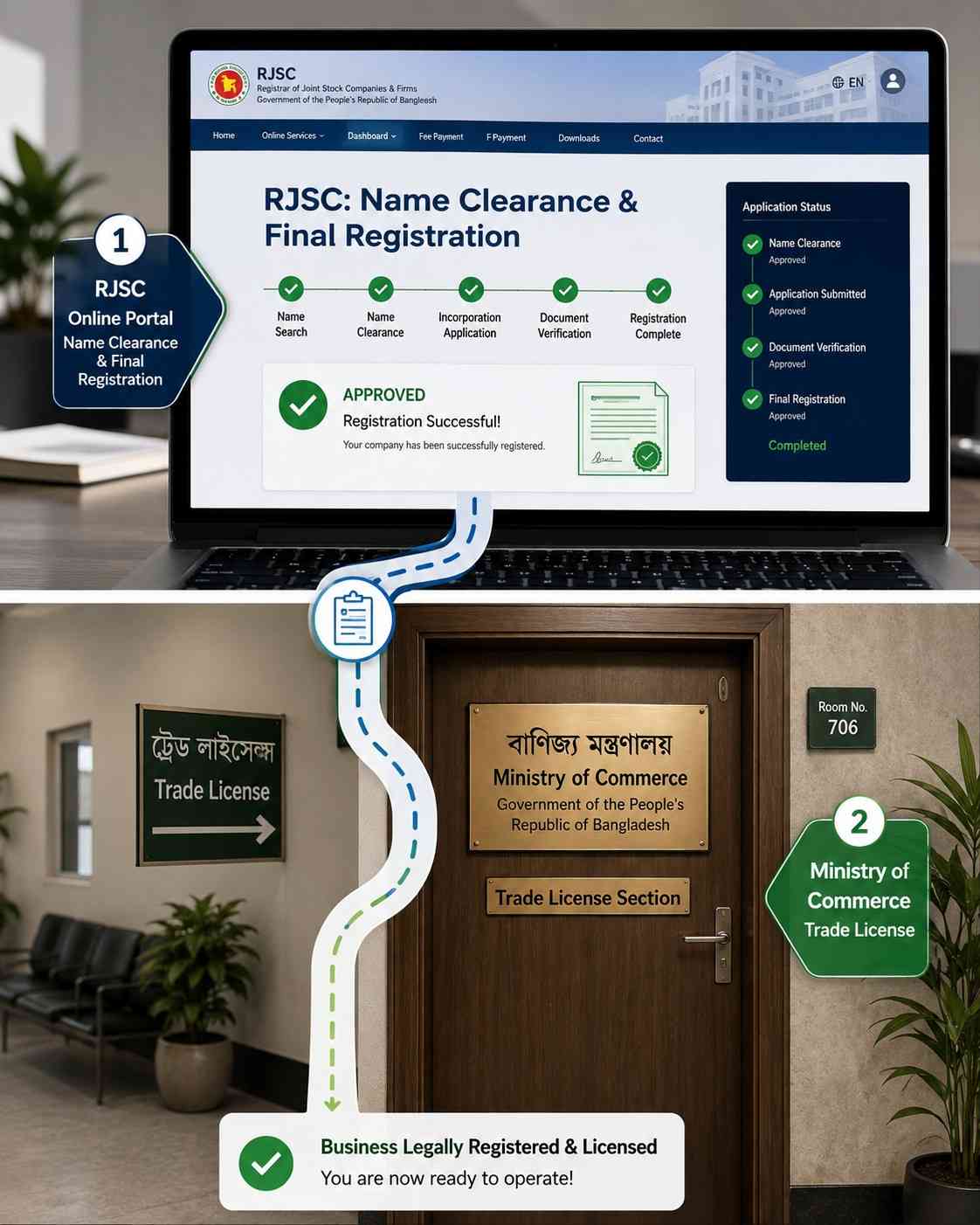
The trade organization name clearance process in Bangladesh is conducted entirely through the official RJSC online portal. You must create an account or log in to initiate the request for your specific entity. The digital interface is designed to streamline your submission and provide real-time status updates.

Once you submit your application, you will be required to pay the prescribed processing fee through the integrated payment gateway. After the RJSC verifies your request, you will receive a clearance certificate if the name meets all regulatory requirements. Keep this document safe, as it serves as a mandatory prerequisite for all subsequent registration stages.

Step Two: Drafting the Memorandum and Articles of Association

Creating a solid foundation requires precise drafting of your internal governance rules. These documents serve as the constitution for your entity, ensuring that all operations align with the Companies Act 1994. By establishing a clear framework, you provide long-term stability for your members and stakeholders.

Structuring the Memorandum of Association

The Memorandum of Association acts as the charter that defines the scope of your organization. It must clearly state your primary objectives, the geographical area of operation, and the liability of your members. Precision in this document is essential to avoid future legal complications during the Trade Organization Registration Process in Bangladesh.

Drafting the Articles of Association

While the memorandum defines your purpose, the trade organization articles of association outline the internal management procedures. This document details how

meetings are conducted, how voting occurs, and how the trade organization governing body makes decisions. You must ensure these rules are practical and tailored to your specific industry needs.

Defining Executive Committee Roles

Your leadership structure must be clearly defined to ensure accountability. You should specify the duties of the president, secretary, and treasurer within the trade organization executive committee. When you clearly document these responsibilities, you minimize internal conflict and promote efficient administration.

Establishing Membership Criteria

Setting transparent standards for entry is vital for maintaining the integrity of your group. You must outline the eligibility requirements, application procedures, and the rights of members within your bylaws. Adhering to standard trade organization executive committee requirements Bangladesh ensures that your leadership remains compliant with national regulations while fostering a professional trade organization governing body.

By carefully crafting your trade organization articles of association, you protect the interests of your members. This proactive approach creates a robust environment for growth and advocacy in the competitive business landscape of Bangladesh.

Step Three: Preparing Required Documentation

Organizing your legal documents is crucial for setting up your trade organization in Bangladesh. Ensuring your files are accurate and complete helps avoid delays in the application process. By focusing on the right trade organization documents Bangladesh, you meet official requirements.

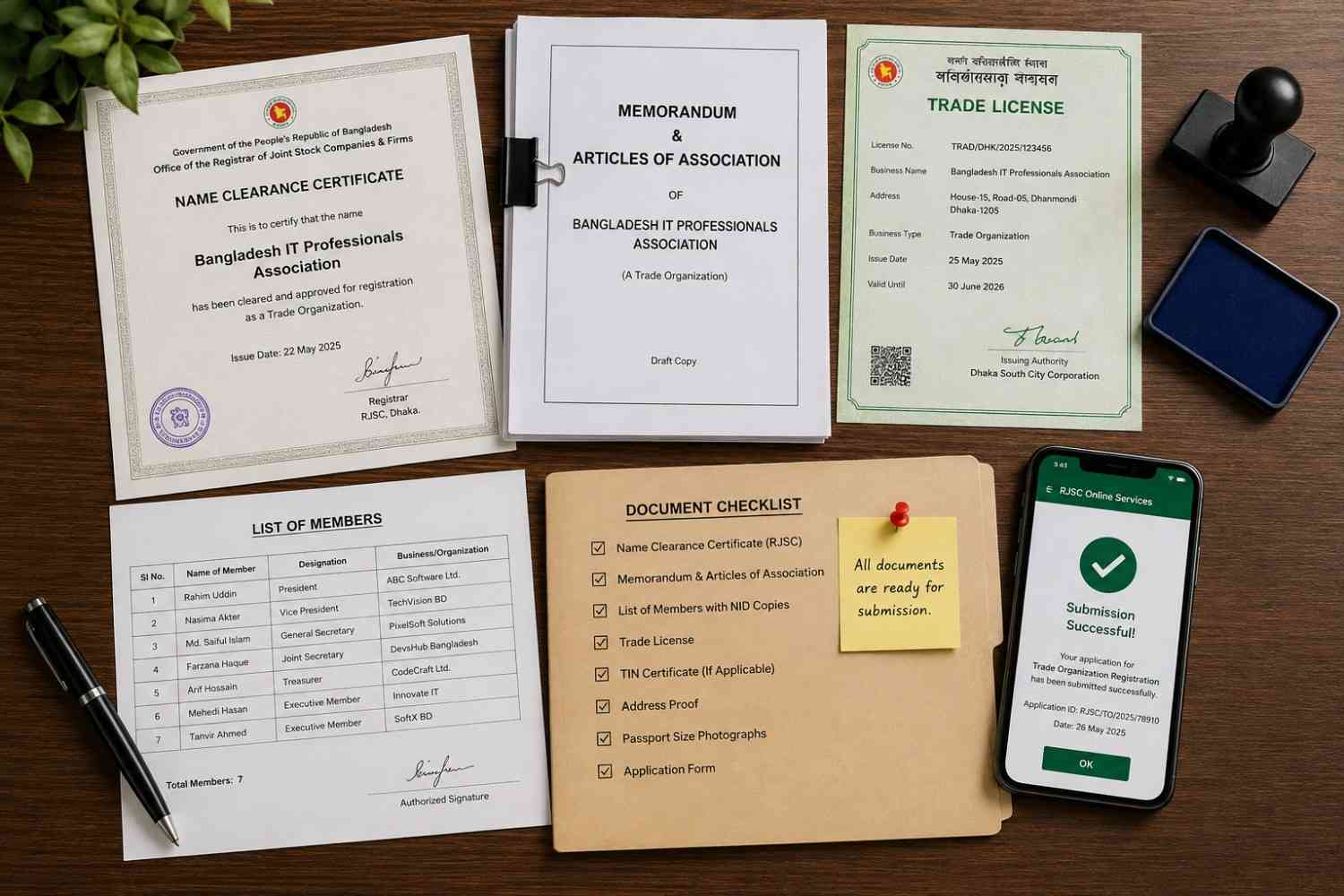
List of Essential Documents for RJSC Submission

First, gather a detailed set of paperwork proving your entity’s legitimacy. Your application’s core includes the signed Memorandum of Association and Articles of Association. These documents outline your operational scope. You’ll also need proof of your registered office address and identification for all founding members.

These documents required for trade organization registration in Bangladesh are the basis of your legal standing. Correctly filling out each form is essential to avoid common errors that can delay the review. Accuracy is crucial when submitting these critical records to the authorities.

Verification and Notarization Requirements

It’s not just about gathering documents; you must also ensure they are formally verified. Many legal documents need notarization to meet the strict trade organization registration requirements RJSC. This step confirms the authenticity of signatures and the accuracy of your application’s information.
Branch Office Registration in Bangladesh
RJSC Company Share Transfer in Bangladesh documentation requirements
×
Enlarged View

Seeking advice from a qualified professional is wise to ensure your documents comply with legal standards. Proper notarization is a protective measure, safeguarding your organization against future compliance issues. These steps show your dedication to transparency and regulatory compliance from the outset.

Step Four: Online Application and Fee Payment

Mastering the online submission system is crucial for a smooth of Trade organization registration in Bangladesh. The Registrar of Joint Stock Companies and Firms (RJSC) has made the process efficient for applicants. You can manage your submission from your office using the digital portal.

Navigating the RJSC Online Registration System

To start, create an account on the RJSC website. Log in and choose the new application option for the trade organization registration process step by step in Bangladesh. You’ll need to enter details about your entity, ensuring all information matches your documents.

Upload digital copies of your Memorandum and Articles of Association. It’s crucial to have clear, correctly formatted files to avoid rejection. After uploading, you’ll receive a tracking number. Save it for checking your joint stock trade organization in Bangladesh status later.

Fee Structure and Payment Methods

Knowing the financial requirements is essential for how to apply for trade organization registration in Bangladesh. The government sets fees based on your organization’s authorized capital and type. Check the current fees on the RJSC portal before submitting.

Payment is made through bank branches or digital payment gateways. After payment confirmation, your application status will update automatically. Getting your trade organization license in Bangladesh requires successful payment verification by authorities.

Registration PhasePrimary ActionEstimated Time
Portal AccessAccount Creation15 Minutes
Data EntryForm Submission1–2 Hours
Fee PaymentBank/Digital TransferSame Day
Final ReviewRJSC VerificationVariable

Always save a digital receipt of your payment. This proof is crucial during the final stages of your trade organization registration in Bangladesh. Carefully following these steps can help you avoid common delays.

Step Five: Review and Approval Timeline

Once you’ve submitted your documents, the Registrar of Joint Stock Companies and Firms (RJSC) begins a detailed verification process. This phase is crucial for the registration of trade organization Bangladesh. Officials scrutinize your materials for precision and legal adherence.

What to Expect During the Processing Period

Applicants frequently ask how long does trade organization registration take in Bangladesh. The trade organization registration in Bangladesh varies. It depends on the complexity of your application and the RJSC’s workload.

The RJSC checks your Memorandum and Articles of Association against legal standards. Keep an eye on your online portal for updates. Staying informed aids in planning your organization’s future while awaiting the certificate.

Handling Queries and Objections from RJSC

Authorities may question or object to your application if they spot discrepancies. Receiving a notification about your trade organization RJSC Bangladesh filing is normal. These steps are part of the regulatory process to ensure legal compliance.

Respond to these queries quickly and professionally to avoid delays. Providing clear evidence or corrected documents can swiftly resolve issues. Open communication with the RJSC is key to securing approval and completing the RJSC Trade Organization Registration in Bangladesh successfully.

If faced with a formal objection, carefully review the feedback from the examiner. Addressing these points accurately keeps your Trade Organization at RJSC  in Bangladesh application on track. A proactive approach during the Joint Stock Trade Organization Registration in Bangladesh ensures a smoother process for your organization.

Post-Registration Compliance and Annual Obligations

After registering your organization, you must adhere to several mandatory steps to keep your status active. It’s crucial to stay on top of regulatory deadlines and maintain financial transparency. Ignoring these obligations can lead to severe penalties or even the loss of your legal standing.

Filing Annual Returns with RJSC

Every registered entity must submit specific documents to the Registrar of Joint Stock Companies and Firms (RJSC) annually. The trade organization annual return submission at RJSC process keeps your leadership and member lists up-to-date in the government database.

Proper Trade Organization Annual Return Filing in Bangladesh requires preparing the necessary forms and submitting them online. It’s essential to keep both digital and physical copies of your submissions. Timely filing helps avoid unnecessary fines and keeps your organization’s profile clean.

Maintaining Audit Requirements

Financial accountability is vital for a successful trade organization. You must follow strict trade organization audit requirements Bangladesh to manage funds transparently and with integrity.

Your organization should hire a qualified auditor to review your financial statements annually. This not only meets legal requirements but also builds trust with your members and stakeholders. Key areas for annual compliance include:

 Annual General Meeting (AGM) minutes and resolutions.

 Updated lists of board members and executive committee details.

 Certified financial statements including balance sheets and income reports.

 Proof of payment for all required government filing fees.

Compliance TaskFrequencyPrimary Goal
Annual Return FilingOnce per yearRegulatory Transparency
Financial AuditOnce per yearFiscal Accountability
AGM DocumentationAnnuallyGovernance Record

Consistency is the key to avoiding regulatory hurdles. By setting up a clear internal calendar for these tasks, you safeguard your organization from unexpected legal issues. Always check the RJSC website for the latest guidelines to ensure your procedures are up-to-date.

Distinguishing Trade Organizations from Other Entities

Understanding the regulatory landscape is crucial. When you seek trade body registration Bangladesh, aligning your structure with your goals is essential. Misidentifying your entity can lead to significant compliance issues later.

Branch Office Registration in Bangladesh
RJSC Company Share Transfer in Bangladesh documentation requirements
×
Enlarged View

Applicants often confuse these structures due to their administrative similarities. However, the legal requirements for Business Association Registration in Bangladesh vary based on the group’s purpose. Grasping these differences is key to establishing a sustainable organization.

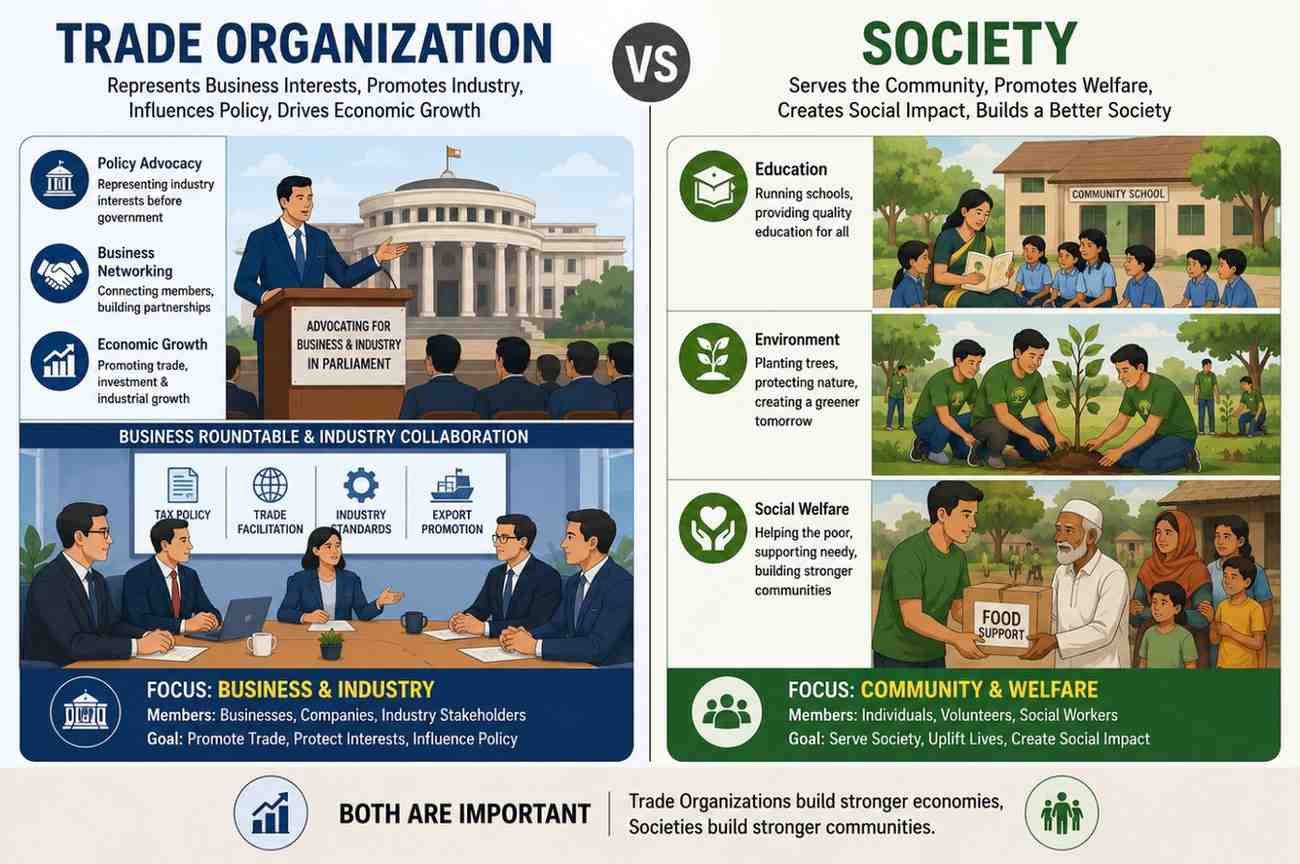
Trade Organization vs Society

The main difference between these entities is their mission. A trade organization focuses on the economic and professional interests of a specific industry. On the other hand, a society aims for charitable, literary, scientific, or social welfare goals.

When comparing trade organization vs society Bangladesh, consider these distinctions:

 Primary Focus: Trade organizations advocate for industry policy, while societies aim for community or social impact.

 Regulatory Act: Trade organizations are governed by specific ordinances, whereas societies often fall under the Societies Registration Act.

 Membership: Trade organizations require members to be engaged in a specific business or trade.

Trade Organization vs Chamber of Commerce

Both entities represent business interests but differ in scope. A trade organization represents a single industry, like textiles or pharmaceuticals. In contrast, a Chamber of Commerce represents various businesses in a specific geographic area.

When comparing trade organization vs chamber of commerce Bangladesh, consider these factors:

FeatureTrade OrganizationChamber of Commerce
ScopeIndustry-specificGeographic/Regional
MembershipSpecific trade playersDiverse business owners
Primary GoalSector-specific advocacyGeneral economic development

Choosing the right path ensures legal recognition. Proper classification enables effective advocacy for members while ensuring compliance. Always verify your goals before finalizing your registration documents.

Common Challenges in the Registration Process

Understanding the common pitfalls in business association formation in Bangladesh is crucial for a successful application. The legal framework is clear, but the administrative journey can be daunting for those new to local requirements. Anticipating these challenges helps prepare your application for a smoother experience.

Addressing Documentation Errors

Many applicants face delays due to minor errors in their Articles of Association or inconsistencies in member data. Precision is vital when drafting these foundational documents. A small typo can trigger a formal query from the Registrar of Joint Stock Companies and Firms (RJSC). Verify that all personal details of your founding members match their national identification cards exactly.

Also, ensure that the objectives listed in your memorandum align perfectly with your organization’s scope. Inconsistencies here often lead to rejection or requests for revisions. Reviewing your paperwork with a legal professional can help you avoid these common mistakes during the trade body registration process in Bangladesh.

Overcoming Regulatory Hurdles

Navigating the regulatory landscape often involves responding to unexpected queries or objections from the authorities. If you receive a notice regarding your application, do not panic; proactive communication is your best tool for resolution. Respond to all RJSC inquiries promptly and provide the specific clarifications requested to keep your file moving forward.

Successful business association formation in Bangladesh requires a persistent approach to compliance. Stay updated on any changes to the regulatory guidelines that might affect your submission. By maintaining organized records and staying engaged with the trade body registration process in Bangladesh, you can effectively overcome hurdles and secure your official certification.

Strategic Steps for Successful Trade Organization Management

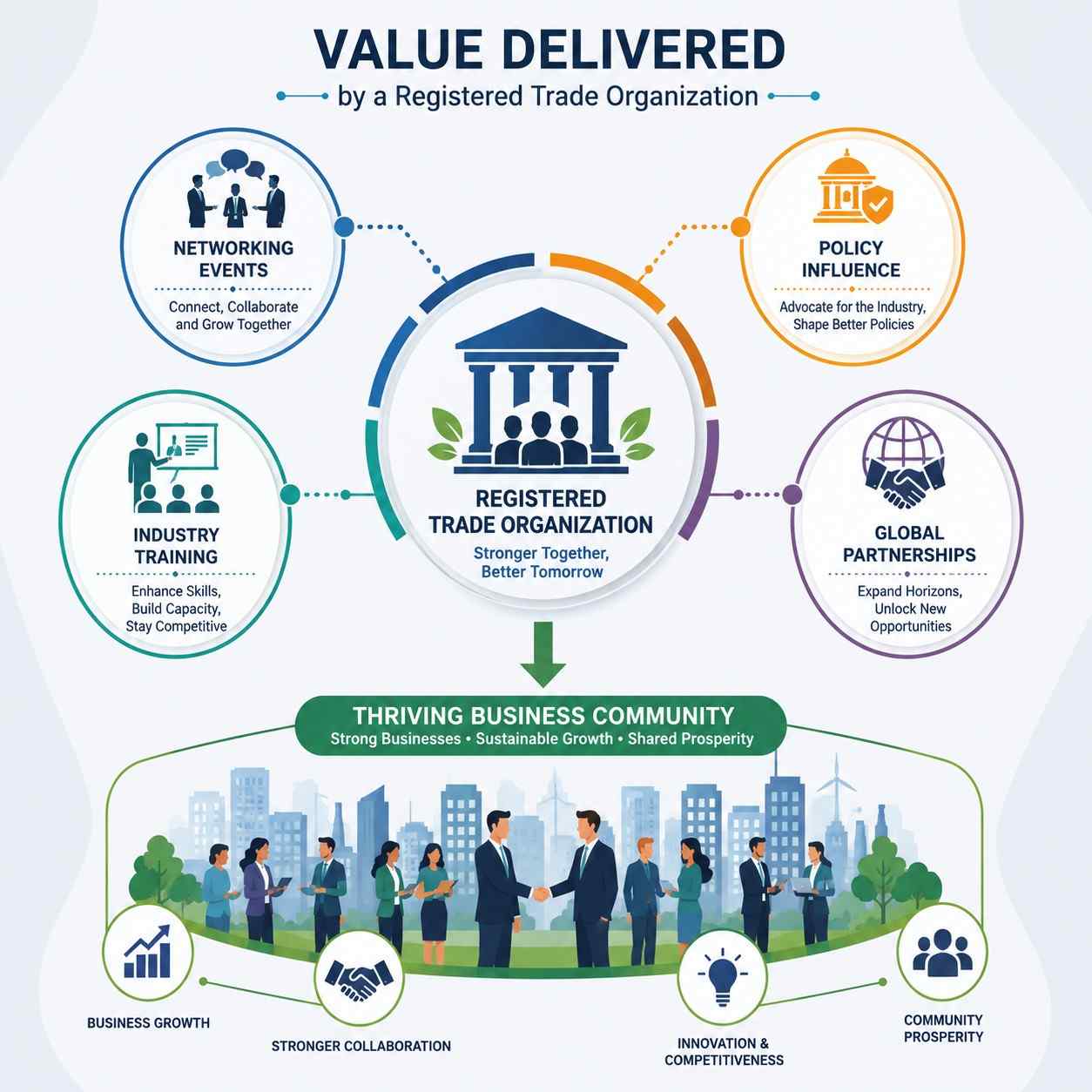
Success in trade organization management goes beyond the initial setup. It demands ongoing engagement to keep members active and content. A successful entity must deliver real value through advocacy and resources.

Your executive committee is crucial in setting the direction for your organization. They must emphasize transparency and clear communication to build trust. Regular meetings ensure your goals align with the evolving needs of the Bangladeshi business world.

Branch Office Registration in Bangladesh
RJSC Company Share Transfer in Bangladesh documentation requirements
×
Enlarged View

Enable your governing body to make decisions based on data, driving growth. Hosting networking events and offering specialized training creates a professional development hub. These actions keep your organization a strong voice in the national economy.

Strive for excellence by staying current with regulatory changes and maintaining high compliance standards. Your commitment to these practices will enhance your reputation as a dependable partner for businesses nationwide. Begin these strategies today to ensure a prosperous future for your members.

FAQ

What is a trade organization in Bangladesh and why is registration necessary?

A trade organization in Bangladesh is a non-profit entity focused on promoting a specific industry or business sector. Trade organization registration in Bangladesh is essential. It gives your association legal status, enabling it to represent members at government levels and enter into contracts. It also provides a credible platform for industry advocacy.

How to register a trade organization in Bangladesh step by step?

The trade organization registration process in Bangladesh starts with obtaining trade organization name clearance through the RJSC online portal. After clearing the name, draft the trade organization articles of association and the Memorandum of Association. Then, apply for a trade organization license from the Ministry of Commerce.

Once you have the license, submit all trade organization documents Bangladesh to the RJSC for final registration. Pay the required fees. The RJSC will then issue the trade organization certificate Bangladesh.

What are the minimum members for trade organization registration Bangladesh?

To start joint stock trade organization formation in Bangladesh, you need a minimum of 20 members. These can be individuals or firms. You must also establish a trade organization governing body with at least 7 to 15 members. This body oversees the association’s daily operations and strategic direction.

Which laws govern trade body registration Bangladesh?

The Companies Act 1994 and the Trade Organizations Ordinance, 1961, govern trade organization registration in Bangladesh. These laws outline the requirements for business association formation, governance structures, and the regulatory powers of the RJSC trade organization registration desk and the Ministry of Commerce.

What are the primary benefits of trade organization registration in Bangladesh?

Registration as a trade organization in Bangladesh brings several benefits. It grants official recognition as a legitimate industry representative. This allows your group to influence national economic policies and resolve trade disputes. It also opens access to international trade networks.

Moreover, business association registration in Bangladesh enhances credibility with financial institutions and government bodies. This includes the National Board of Revenue (NBR) and the Federation of Bangladesh Chambers of Commerce and Industry (FBCCI).

What are the documents required for trade organization registration in Bangladesh?

To register a trade organization in Bangladesh, you need several documents. These include the approved name clearance certificate, the Memorandum and trade organization articles of association, and a list of the trade organization executive committee members. You also need a trade license from the Ministry of Commerce. Proof of the registered office address and identification documents for all founding members are also required. These documents must meet the trade organization registration requirements RJSC.

How long does trade organization registration take in Bangladesh?

The trade organization registration timeline in Bangladesh varies. It depends on how quickly you obtain the license from the Ministry of Commerce. Generally, it

takes three to six months. This includes the trade organization name clearance process Bangladesh, the licensing phase, and the final joint stock trade organization Bangladesh registration at the RJSC.

What is the difference between a trade organization vs society Bangladesh?

The main difference between a trade organization vs society in Bangladesh is their purpose and governing law. Trade organizations are registered under the Companies Act 1994 and the Trade Organizations Ordinance to promote business interests. Societies, on the other hand, are registered under the Societies Registration Act, 1860, for charitable, scientific, or literary purposes.

In a trade organization vs chamber of commerce Bangladesh comparison, a chamber of commerce represents a specific geographic region. A trade organization represents a specific industry sector nationwide.

What are the annual compliance requirements for a registered trade body?

After registering your trade body in Bangladesh, you must fulfill trade organization annual return RJSC requirements. This includes trade organization annual return filing Bangladesh, which requires submitting audited financial statements and an updated list of the executive committee. Adhering to trade organization audit requirements Bangladesh is mandatory for transparency and to maintain your active status in the RJSC trade organization registration database.

How do I apply for trade organization registration Bangladesh online?

To apply for trade organization registration in Bangladesh, use the official RJSC website. The trade organization registration online Bangladesh system allows you to submit your name clearance request and upload digital copies of your trade organization executive committee requirements Bangladesh documentation. You can also pay the registration fees through secured electronic payment gateways.

The Company share allotment in Bangladesh is a primary corporate step for companies looking to increase paid-up capital, bring in new investors, or restructure ownership. When a company issues new shares, it creates fresh ownership stakes that strengthen the firm’s capital base and make it easier to fund growth, bid for larger contracts, or attract strategic partners.

For starting the legal and procedural landscape requires following RJSC rules and relevant statutes closely. By understanding the essentials of company registration in Bangladesh and the acknowledgement of Company share allotment in Bangladesh procedure to submit documents at RJSC in Bangladesh.

Who benefits from a share allotment? Startups seeking growth capital, joint venture companies realigning ownership, and foreign investors injecting funds can all use share allotment to formalize ownership and support strategic plans. For example: a textile firm may increase its paid-up capital to meet the minimum requirements for bidding on a large government contract.

To awareness the mechanics of RJSC company share allotment in Bangladesh helps business leaders to make informed decisions about valuation, dilution, and shareholder rights while preserving long-term corporate stability and growth potentiality of the company.

Branch Office Registration in Bangladesh
RJSC Company Share Transfer in Bangladesh documentation requirements
×
Enlarged View

The RJSC, Registrar of Joint Stock Companies and Firms is only legal authority to register the Company share allotment in Bangladesh. If adhering to the RJSC’s clear steps, you will discover how to register a Company share allotment in Bangladesh efficiently. The proper arrangement helps you avoid common pitfalls and ensures your entity achieves the status it deserves. Let us assist you to ensure securing your future as a renowned industry leader of business society. The Registrar of Joint Stock Companies and Firms is the primary authority generally known (RJSC) an organization of Government of People’s Republic of Bangladesh.

The Register of Joint Stock Company and Firms (RJSC) issues legal approval or registration of nonprofit organization and approvals other business incorporation certificate, Like Foreign Company Share Allotment in Bangladesh, Organization Registration at RJSC, Company’s Annual Return Filling/ Company Schedule X Submission in Bangladesh, Joint Venture Company Share Allotment in Bangladesh, Society Registration in Bangladesh, Company Share Transfer in Bangladesh, Branch Office Registration in Bangladesh, Company Winding up in Bangladesh, Foreign Company Registration in Bangladesh, Company Share Allotment/Increase, Partnership Firm Registration in Bangladesh, Liaison Office/ Representative Office Registration in Bangladesh, Foreign Company Share Transfer in Bangladesh, One Person Company(OPC) registration at RJSC, Joint Venture Company Registration in Bangladesh, RJSC, Joint Venture Company Share Transfer in Bangladesh Certified Copy issue, and others documents which is essential for you.

Key Takeaways

  1. Issuing new shares is a common method to raise capital and strengthen a company’s financial position.
  2. Compliance with RJSC rules and the Companies Act is essential to validate any allotment and protect shareholders’ rights.
  3. Strategic capital increases can attract new investors, improve governance, and enable competitive growth.
  4. Clear documentation—board resolutions, minutes, valuation records—simplifies RJSC registration and future equity changes.
  5. Plan allotments with an eye on dilution, shareholder pre-emptive rights, and the company’s long-term ownership structure.

Understanding the Fundamentals of Company Share Allotment in Bangladesh

Your company’s growth path often begins with a strategic decision to allot new shares. Company share allotment in Bangladesh lets a company raise capital from new or existing investors while preserving the corporate structure created during initial company registration. This mechanism converts available authorized capital into issued shares and, when paid for, into paid-up capital.

By managing share issuance and the register of members carefully, a company positions itself for long- term stability and easier access to investment and credit. Clear documentation and lawful procedures help maintain investor trust and protect ownership rights.

Defining Share Allotment for Limited Companies

Share allotment refers to the formal process by which a limited company issues new shares to existing or new shareholders. It increases the total number of shares and, where payment is received, the company’s paid-up capital. In practice, allotment changes the company’s equity and ownership split and must be recorded in the company’s books.

Quick definitions inline: authorized capital = the maximum share capital allowed by the Memorandum of Association; issued shares = the portion of authorized capital the company has allotted; paid-up capital = the amount actually paid by shareholders for those issued shares.

Who should consider an allotment?

  • Startups requiring fresh investment to scale operations.
  • Joint venture companies adjusting the ownership split between partners.
  • Foreign investors injecting funds that must be formalized through the RJSC process.

Example checklist (high level): board resolution → valuation/pricing decision (par or premium) → allotment and payment → update register of members → file Form XI (and Form XII if non-cash consideration) with RJSC.

The Role of the Board of Directors in Capital Expansion

The board of directors evaluates the need for new capital and authorizes share allotment through formal resolutions. Depending on the company’s Articles of Association and the Companies Act, shareholder approval (EGM/AGM) may also be required for certain increases in capital. After board approval, operational steps—valuation, allotment letters, and filings—follow to complete the process.

Ensure your minutes, resolutions, and allotment records explicitly state the number of shares, the price per share (par value or premium), and whether consideration is cash or non-cash (in which case Form XII and supporting valuations are typically necessary).

Why Businesses Opt for Paid-Up Capital Increases

Firms increase paid-up capital to improve creditworthiness, meet procurement or licensing thresholds, or attract strategic investors who bring capital and expertise. A higher paid-up capital can strengthen the company’s balance sheet and make it easier to secure loans or participate in larger tenders.

When issuing shares at par versus at a premium, document the valuation rationale clearly—this reduces the risk of future disputes and supports the legal filings you will submit to RJSC. For step-by-step filing instructions, see the procedural section below (Step-by-step RJSC filing).

Strategic Advantages of Increasing Your Company Equity

Expanding your company equity is one of the most effective levers for long-term business success in Bangladesh. Increasing capital through a formal RJSC company share allotment in Bangladesh gives your firm the resources to scale operations, improve resilience, and pursue strategic opportunities—while creating a documented trail that reassures banks, investors, and partners.


Branch Office Registration in Bangladesh
RJSC Company Share Transfer in Bangladesh documentation requirements
×
Enlarged View

Strengthening Business Capacity and Market Presence

A higher paid-up capital enables investment in infrastructure, technology, and working capital. These investments let a company meet higher demand, qualify for larger contracts, and strengthen its market position. When you complete an RJSC share allotment in Bangladesh, you also create transparent evidence of that strengthened balance sheet, which can positively influence lender and supplier relationships.

Benefit snapshot (examples):

  • R&D and product development: funding to launch new product lines.
  • Capital expenditure (capex): purchasing equipment to expand production capacity.
  • Tender eligibility: meeting paid-up capital thresholds required in certain public procurement processes.

Leveraging New Equity for Competitive Tactics

Fresh equity provides the financial runway to pursue aggressive growth tactics—regional expansion, strategic acquisitions, or marketing campaigns that capture market share. Because these moves often require upfront capital, allotment gives you the flexibility to act quickly without over-leveraging the company with debt.

Documenting equity changes through RJSC filings ensures your competitive strategy is legally supported and visible to stakeholders. This formalization reduces disputes over ownership and creates a reliable record for future investor due diligence.

Attracting Talent and Expertise Through Shareholding

Using shares as part of compensation or partnership arrangements helps attract senior executives, technical experts, and strategic partners. Equity incentives align key personnel with company performance, creating a culture of ownership that can accelerate growth.

Mini-case example: a mid-sized technology firm issues a 5% stake to a senior CTO in exchange for leadership and product development expertise. The allotment is recorded in the register of members, documented by board resolutions, and filed with RJSC—giving the new director clear rights and protecting existing shareholders from unexpected dilution.

When planning allotments for investors or employees, always document the valuation rationale (par value vs. premium) and consider potential dilution. For practical guidance on preparing resolutions, valuation support, and RJSC filing, proceed to the Preparing and Step-by-step RJSC rules and regulations.

Navigating the Legal Framework for Company Share Allotment Bangladesh

Managing company equity requires a clear understanding of the applicable law and RJSC filing obligations. Before you increase share capital, confirm which statutory steps and filings apply to your company so the allotment is legally valid and your register of members remains accurate.

Compliance with the Companies Act of 1994

The Companies Act, 1994 (as amended) forms the principal legal framework governing share allotment for limited and joint stock companies in Bangladesh. Ensure your board resolutions, shareholders’ approvals (when required), and allotment procedures conform to the Act and to the company’s Memorandum and Articles of Association.

Non- compliance can result in penalties, rejection of RJSC filings, or questions about the validity of the allotment. Where the Act or your articles require shareholder approval (form XI others papers which is essential at RJSC.

RJSC Regulations and Mandatory Filings

The Registrar of Joint Stock Companies and Firms (RJSC) is the authority for registering allotments and updating the public record. Typical filings include the return of allotment (Form XI) and, when shares are issued for non-cash consideration, supplementary forms such as Form XII. Timely and accurate filing with RJSC makes the allotment publicly effective and reduces the risk of administrative delays.

Practical tip: always cross-check the latest RJSC guidance and downloadable form templates on the RJSC portal before submission, and retain proof of payment of any government fees or stamp duties required for the filings.

Distinguishing Between Authorized and Paid-Up Capital

Authorized capital is the ceiling set in your Memorandum of Association for how much share capital the company may issue. Paid-up capital is the actual amount paid by shareholders for issued shares. Before allotting shares, confirm that the number and value of new shares do not exceed the authorized limit; if they do, you must first amend the constitutional documents to raise the authorized capital.


Branch Office Registration in Bangladesh
RJSC Company Share Transfer in Bangladesh documentation requirements
×
Enlarged View

How to amend authorized capital (brief): propose a board resolution → call an EGM/AGM per notice requirements → pass a special resolution to alter the Memorandum/Articles → file the amendment and supporting documents with RJSC.

Legal checklist (quick)

  1. Review Memorandum & Articles for pre-emptive rights and authorized capital limits.
  2. Draft and pass board resolution authorizing allotment; obtain shareholder approval if required.
  3. Prepare valuation support if issuing shares at a premium or for non-cash consideration.
  4. Complete Form XI (return of allotment) and Form XII (if applicable) with consistent details.
  5. Pay required stamp duty and government fees; file with RJSC and retain receipts.

For step-by-step guidance on the forms and filing process, proceed to the procedural section below (Step-by-step RJSC share allotment procedures) where Form XI/Form XII submission, fee payment, and expected timelines are covered in detail.

Preparing for the Share Allotment Process

The journey toward a successful share allotment in Bangladesh starts well before any forms are filed with RJSC. Preparation—good governance, clear documentation, and a robust valuation rationale—is the single most important factor in avoiding delays, disputes, and regulatory rejections.

Organize your internal affairs early so your limited company can meet stakeholder expectations and regulatory requirements efficiently. Below are practical steps, templates, and checklists to help guide this phase.

Conducting a Board Meeting to Approve Capital Increase

Every formal capital expansion begins with a properly convened board meeting. Directors should evaluate the need for additional capital, agree the number and class of shares to be allotted, and record the decision in a formal resolution. Depending on the Articles of Association and the Companies Act, shareholder approval (EGM/AGM) may also be required for certain increases—confirm statutory notice periods and quorum requirements in advance.

Meeting minutes must clearly record the rationale, the total shares to be issued, the price per share, and whether consideration is cash or non-cash. Clear minutes reduce the chance of later disputes over ownership or alleged procedural defects.

Drafting the Necessary Resolutions and Documentation

After board approval, draft concise, accurate resolutions that authorize the allotment. These documents are the core evidence for the limited company share allotment when filing with RJSC. Typical documentation includes the meeting notice, attendance sheet, signed board resolution, and the allotment letter to new shareholders.

Document checklist (essential):

  • Board resolution authorizing allotment (signed)
  • Notice of meeting and proof of dispatch
  • Minutes and attendance record
  • Allotment letters or offer documents
  • Updated register of members template
  • Valuation report (if issuing at premium or non-cash consideration)
  • Bank receipts showing payment for issued shares (for cash consideration)

Valuation of Shares and Pricing Considerations

Determining the fair price for new shares requires professional input. Consider current market value, recent financing rounds, and company prospects. Issuing shares at par may be straightforward, but issuing at a premium or for non-cash consideration typically needs a valuation report or auditor certification to withstand regulatory or shareholder scrutiny.

If shares are allotted for non-cash assets or services, prepare supporting valuation documents and clearly describe the nature of the consideration. This justification will be necessary when completing Form XII and responding to any RJSC queries.

Step-by-Step Guide to RJSC Share Allotment Procedures

The joint stock company share allotment process in Bangladesh follows a clear sequence of internal approvals and RJSC filings. When your company decides to issue new shares, follow a structured checklist to ensure the allotment is legally effective, the register of members is updated, and the public record reflects the new capital structure.
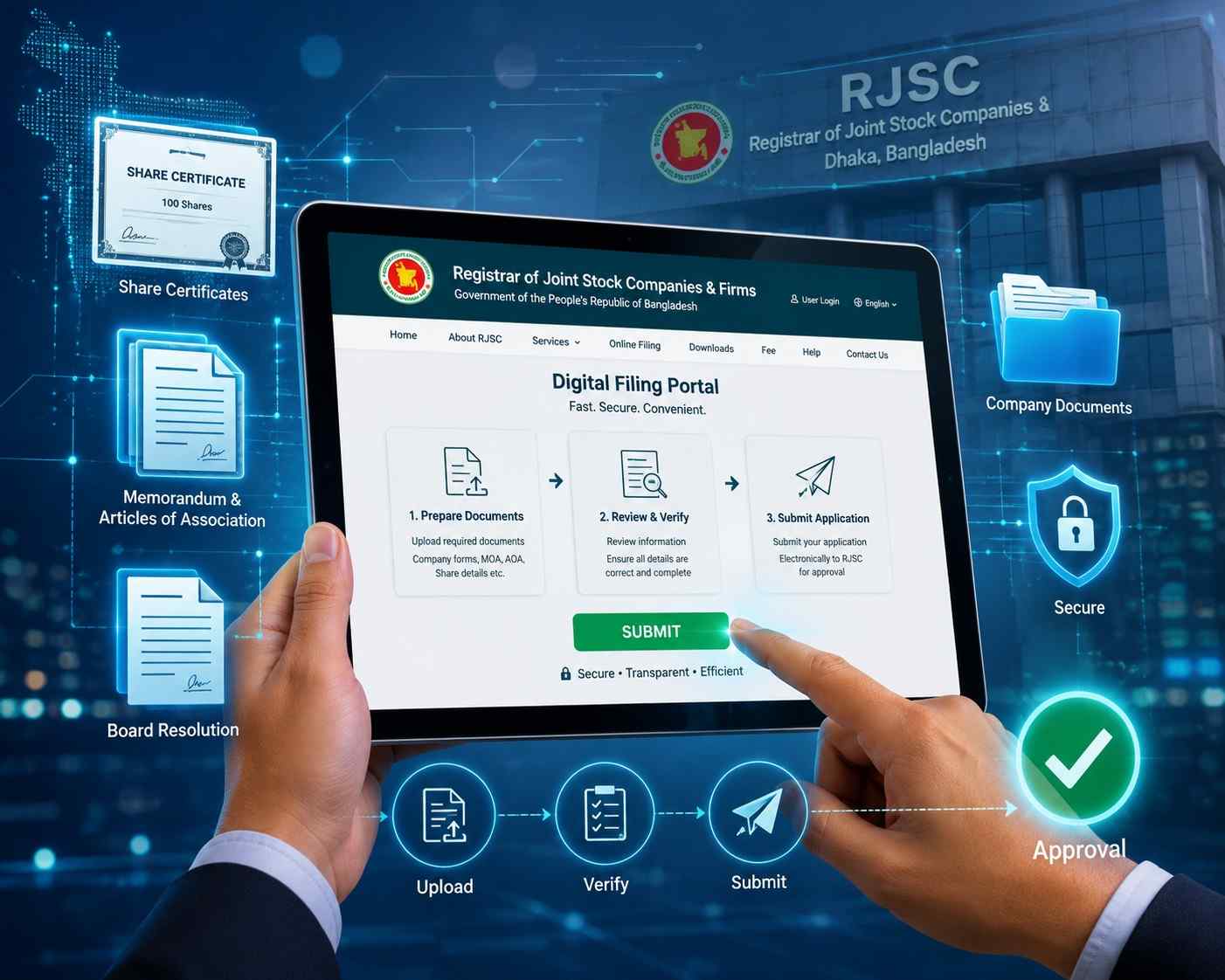

Branch Office Registration in Bangladesh
RJSC Company Share Transfer in Bangladesh documentation requirements
×
Enlarged View

Below is a practical, numbered process you can adapt to your company’s timetable and the complexity of the allotment (cash vs. non-cash consideration).

1.  Internal approvals and documentation

  1. Ensure board resolution(s) authorizing the allotment are passed and recorded.
    1. If required by the Articles or Companies Act, obtain shareholder approval at an EGM/AGM (follow notice and quorum rules).
    1. Prepare allotment letters, updated share register entries, and any valuation reports supporting a premium or non-cash consideration.

2.  Complete statutory forms (Form XI & Form XII)

  • Form XI: the return of allotment — records number and class of shares allotted and identity of allottees. Ensure details match board resolutions and the company’s books.
  • Form XII: required where shares are allotted for non-cash consideration (contracts or assets). Attach valuation reports or auditor confirmations as needed. Accuracy is critical. Common causes of rejection include mismatched shareholder names, incorrect share counts, or inconsistent dates between documents.

3.  Payment of stamp duty and government fees

Pay any applicable stamp duty and RJSC filing fees through the designated banking channels before submission. Fee rates and payment codes may change—verify the current schedule on the RJSC website. Retain all payment receipts and reference numbers; these must accompany your submission and act as proof of fiscal compliance.

4.  Submit application to RJSC and follow up

File Form XI (and Form XII if applicable) with the Registrar, attaching the signed resolutions, minutes, proof of payment, valuation documents (if any), and the updated register of members. Where RJSC offers electronic filing, use the official portal to reduce processing time—otherwise submit physical documents as instructed.

After submission, monitor the application status and be ready to respond promptly if RJSC requests clarifications or additional documents to avoid delays.

5.  Obtain the certified return of allotment

Once RJSC accepts the filing, the Registrar issues a certified return of allotment—this is the official evidence of your company’s capital increase. Store a digital and physical copy securely in your corporate records. Present this certificate to banks, investors, or contracting authorities as proof of your updated paid-up capital and ownership structure.

If shares are issued for assets or services, attach a concise valuation report and an explanatory note to Form XII.

For downloadable checklists, sample Form XI entries and assistance with filing, see the resources in the Step-by-step RJSC filing section or consult a certified filing agent to streamline the application process and reduce the risk of rejection.

Managing Shareholder Rights and Equity Distribution

Effective management of shareholder rights and the company’s equity structure is essential for good corporate governance in any joint stock company in Bangladesh. When issuing new shares, ensure the process is transparent, fair, and aligned with the Articles of Association so stakeholders’ interests and long-term company stability are protected.

Rights of Existing Shareholders in New Allotments

Many companies have pre-emptive rights in their Articles that give existing shareholders the first opportunity to buy new shares and maintain their proportional ownership. Before proceeding with any joint stock share allotment in Bangladesh, review your Articles of Association to determine whether pre-emption applies and, if so, follow the required offer procedure to avoid dilution disputes.

Practical steps (simple flow):

  • Check Articles of Association → Offer new shares to existing shareholders → Record acceptances/declines in writing → Collect payment → Update register of members

→ File Form XI with RJSC.

Appointing New Directors Through Equity Allocation

Allotting shares can be linked to governance changes, such as appointing new directors or strategic partners. When newly allotted shareholders are to become directors, ensure board appointments follow statutory requirements and are documented with appointment letters, board resolutions, and updated director registers. Linking equity to leadership roles helps align interests but must be clearly recorded to avoid future disputes over control or authority.

Handling Share Transfers and Ownership Records

Accurate record-keeping is non-negotiable after a share allotment or any share transfer. Update the register of members promptly to reflect allotments, transfers, and any changes in directors. Every transfer or allotment should be supported by the relevant board resolution, a signed instrument of transfer (if applicable), allotment letters, and payment evidence. Keeping documents consistent prevents legal complications during audits or RJSC queries.

Example (paraphrased AoA clause): “On any issue of new shares, the company shall first offer such shares to existing members in proportion to their holdings unless the members resolve otherwise.” If your Articles lack a clear pre-emptive clause, consider seeking shareholder approval or amending the Articles to avoid ambiguity.

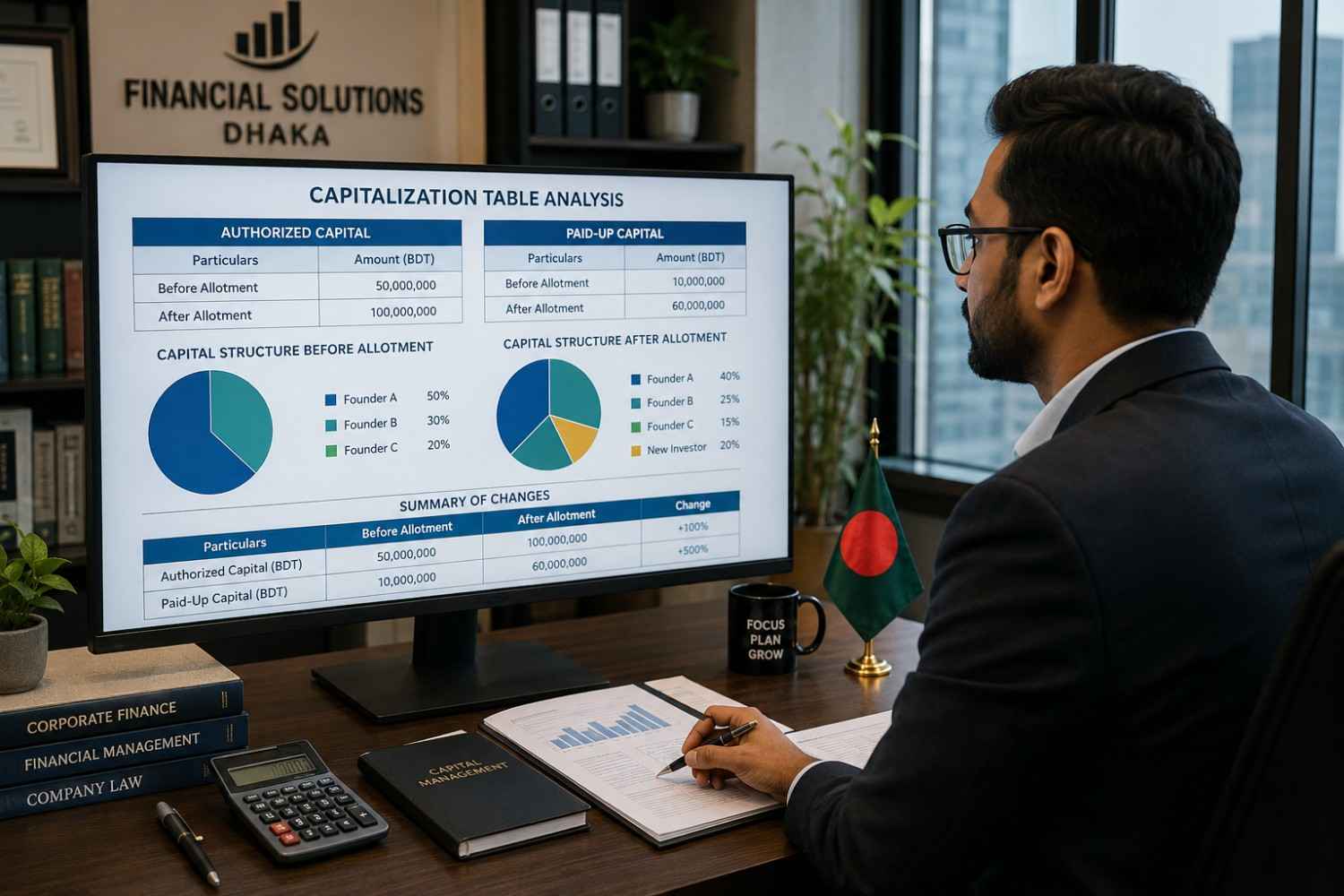
Branch Office Registration in Bangladesh
RJSC Company Share Transfer in Bangladesh documentation requirements
×
Enlarged View

If there is any uncertainty—conflicting shareholder agreements, ambiguous Articles, or a likely dispute—seek legal review before completing the allotment or share transfer to protect the company and its shareholders.

Special Considerations for Foreign and Joint Venture Companies

Foreign and joint venture companies face additional regulatory and documentation requirements when allotting shares in Bangladesh. Cross-border capital movements, foreign-investor protections, and bilateral agreements can affect the timing and acceptability of an allotment, so careful planning and compliance with both local and international standards are essential.

Regulatory Requirements for Foreign Investment

Before completing a foreign company share allotment in Bangladesh and joint venture company allotment in Bangladesh, verify whether approvals from the Bangladesh Investment Development Authority (BIDA) or other government bodies are required. Authorities typically expect documentation evidencing the source of funds and lawful inward remittance. Prepare to submit bank evidence (SWIFT messages or FIRC), investor KYC, and any BIDA application materials so RJSC will recognize the capital infusion.

Foreign investors should also be aware of anti-money laundering and foreign-exchange regulations—confirm current guidance from Bangladesh Bank and BIDA before completing the allotment or filing with RJSC.

Share Allotment in Joint Venture Entities

In joint ventures, the allocation of new shares must respect the original shareholder agreement and any special voting or conversion terms. Coordinate with local partners to document the applied ownership split and reflect it in board resolutions and allotment letters. Clear communication reduces the risk of later disputes and ensures the allotment aligns with agreed governance and profit-sharing arrangements.

Practical tip: if your JV agreement requires consent from local partners for changes in share capital, obtain that consent in writing before passing allotment resolutions to avoid breaches of contract.

Repatriation of Funds and Compliance Reporting

International investors often consider how dividends, sale proceeds, or capital returns will be repatriated. Follow Bangladesh Bank rules on outward remittances and keep meticulous records—bank receipts, tax clearances, and compliance filings—to support lawful repatriation later. Accurate record-keeping also simplifies RJSC review and any post-allotment compliance reporting.

Foreign investor checklist (quick):

  • Confirm BIDA application requirements and thresholds.
  • Prepare any Bangladesh Bank filings required for foreign capital.
  • Ensure shareholder agreements allow the proposed allotment and document partner consents.
  • Retain all payment receipts and compliance reports for future repatriation requests.

For detailed BIDA or Bangladesh Bank procedures, consult the respective official portals or engage a specialist adviser experienced in cross-border investment and RJSC filing to reduce delays and ensure full regulatory compliance.

Common Challenges and Pitfalls in the Share Allotment Process in Bangladesh

Even with strong preparation, companies often face practical hurdles when increasing share capital. Identifying common issues early and applying clear fixes will reduce delays, minimize disputes, and protect the company’s standing with RJSC and other stakeholders.

Red flags and fixes

  1. Missing or inconsistent documentation — Fix: Use a final sign-off checklist before filing to confirm signatures, dates, and identical names across board resolutions, allotment letters, and Form 11.
  2. Financial discrepancies (bank receipts vs. resolutions) — Fix: Reconcile payment receipts, bank statements, and the allotment date; keep audited or accountant-certified records to support valuations.
  3. Conflicting shareholder agreements or Articles — Fix: Review AoA and shareholder contracts early; offer pre-emptive rights where required or obtain waivers in writing to avoid later disputes.

Avoiding delays in RJSC processing

RJSC rejections commonly result from small errors: typos in names, mismatched share counts, or missing payments. Reduce the risk by doing a document consistency check and, if available, using RJSC’s electronic pre-submission tools. Keep a timeline of internal approvals to ensure filings happen promptly and within statutory windows.

Ensuring accuracy in financial documentation

Valuation and financial transparency are frequent triggers for audits or queries. Use professional valuation reports when issuing shares at a premium or for non-cash consideration, and retain supporting accounting schedules. Well-organized financial logs reduce the likelihood of an RJSC or tax authority audit and speed up approvals.

Troubleshooting & escalation

If RJSC requests clarification, respond promptly with clear documentary evidence. Common escalation contacts include the RJSC helpdesk and your filing agent or corporate counsel. Keep a record of all correspondence and payment references to avoid rework.

Ensuring Long-Term Corporate Growth Through Strategic Capital Management

Strategic capital management is central to building a resilient company. Align your equity decisions—share issuances, dilution management, and paid-up capital planning —with the company’s long-term vision to preserve control, attract investors, and support sustainable growth. Whether you handle a local allotment or a Foreign Company Share Allotment in Bangladesh and Joint Venture Company Share Allotment in Bangladesh, sound structure and documentation determine future options.

Regularly review your capitalization table and register of members so you understand current ownership, potential dilution, and who has voting influence. Maintaining clear, compliant financial records and timely RJSC filings strengthens credibility with banks, investors, and partners, and makes future fundraising or share transfers faster and less risky.


Branch Office Registration in Bangladesh
RJSC Company Share Transfer in Bangladesh documentation requirements
×
Enlarged View

Complex arrangements—such as a joint venture company share allotment in Bangladesh—require extra care: ensure shareholder agreements, board resolutions, and regulatory approvals are harmonized and that all parties understand repatriation or profit-sharing implications. Clear communication and precise documentation protect ownership rights and reduce disputes.

Who to involve: corporate secretary for register updates, company auditor or valuation expert for pricing support, and corporate counsel for reviewing Articles, shareholder agreements, and regulatory filings. This cross-functional team reduces errors, speeds approval, and protects your company’s ownership and governance structure.

Take action now: schedule an AoA and cap table review this quarter, prepare your board resolution templates, and download the RJSC Form XI/Form XII checklist. If you anticipate cross-border investment or complex non-cash consideration, consult a specialist adviser to ensure compliance and protect investor interests.

FAQ

1. What does share allotment mean under the laws of Bangladesh?

Share allotment is the legal process through which a company issues new shares to existing or new investors. In Bangladesh, this process is regulated by the Companies Act, 1994, along with applicable corporate regulations. Proper compliance ensures that ownership is legally recognized and the company’s capital structure remains valid.

2. In which situations is an RJSC share allotment required?

A company must complete the share allotment process whenever new shares are issued. This commonly occurs during company formation, when bringing in new shareholders, after receiving investment from local or foreign investors, or when increasing the company’s paid-up capital to support future business expansion.

3. What is the difference between authorized capital and paid-up capital?

Authorized capital represents the maximum amount of share capital a company is permitted to issue under its constitutional documents. Paid-up capital refers to the amount shareholders have actually invested in exchange for issued shares. If additional shares exceed the authorized limit, the company must first obtain approval to increase its authorized capital before proceeding with a new allotment.

4. Which internal approvals should be obtained before filing a share allotment?

Before submitting the application to RJSC, the company should hold a properly convened board meeting and approve the proposed share issue through a board resolution. Depending on the circumstances and the company’s Articles of Association, shareholder approval by special resolution may also be required.

5. Which documents are generally required for filing a share allotment?

Although requirements may vary depending on the transaction, companies typically need to submit:

  • Return of Allotment (Form XV)
  • Board Resolution approving the allotment
  • Updated list of shareholders and directors
  • Proof of payment or bank documentation
  • Any additional supporting documents requested by RJSC

Submitting complete and accurate documents helps avoid unnecessary delays.

6. Are there any additional requirements for foreign investors or joint ventures?

Yes. Where shares are allotted to foreign investors, companies generally need to provide evidence of inward foreign remittance through an authorized bank. Depending on the investment structure, approvals or compliance with Bangladesh Bank, BIDA, or other regulatory authorities may also be necessary before completing the RJSC filing.

7. What mistakes commonly delay or reject a share allotment application?

Many applications face delays because of incomplete documentation, incorrect shareholder information, inaccurate share calculations, or failure to meet statutory filing deadlines. Reviewing all documents carefully before submission significantly reduces the risk of rejection or penalties.

8. Why is proper share allotment important for future fundraising or an IPO?

Maintaining accurate share allotment records creates a transparent ownership history and demonstrates good corporate governance. Investors, financial institutions, and regulators often review these records before major investments, mergers, acquisitions, or a future Initial Public Offering (IPO).

9. What responsibilities does a company have after shares are allotted?

After the allotment is registered, the company should update its Register of Members, issue share certificates where applicable, and maintain accurate statutory records. These records are essential for future audits, compliance reviews, and any subsequent transfer of shares.

10. How can companies make the RJSC share allotment process smoother?

Companies can improve efficiency by preparing documentation in advance, verifying all shareholder information, following statutory deadlines, and obtaining professional legal or corporate secretarial assistance where necessary. A well-organized filing process minimizes delays and supports long-term regulatory compliance.

Starting a non-profit or charitable group requires a formal legal structure to operate effectively. You might wonder, what is society registration in Bangladesh? It is the official process that grants your organization a distinct legal identity under the Societies Registration Act of 1860.

This procedure is managed by the Registrar of Joint Stock Companies and Firms. Completing your RJSC society registration in Bangladesh ensures that your entity gains credibility and the power to enter into contracts. It serves as the bedrock for your future welfare or educational initiatives.

Navigating the RJSC society registration in Bangladesh landscape can feel complex without proper guidance. This comprehensive manual simplifies every step, from name clearance to Joint stock Society Registration in Bangladesh.
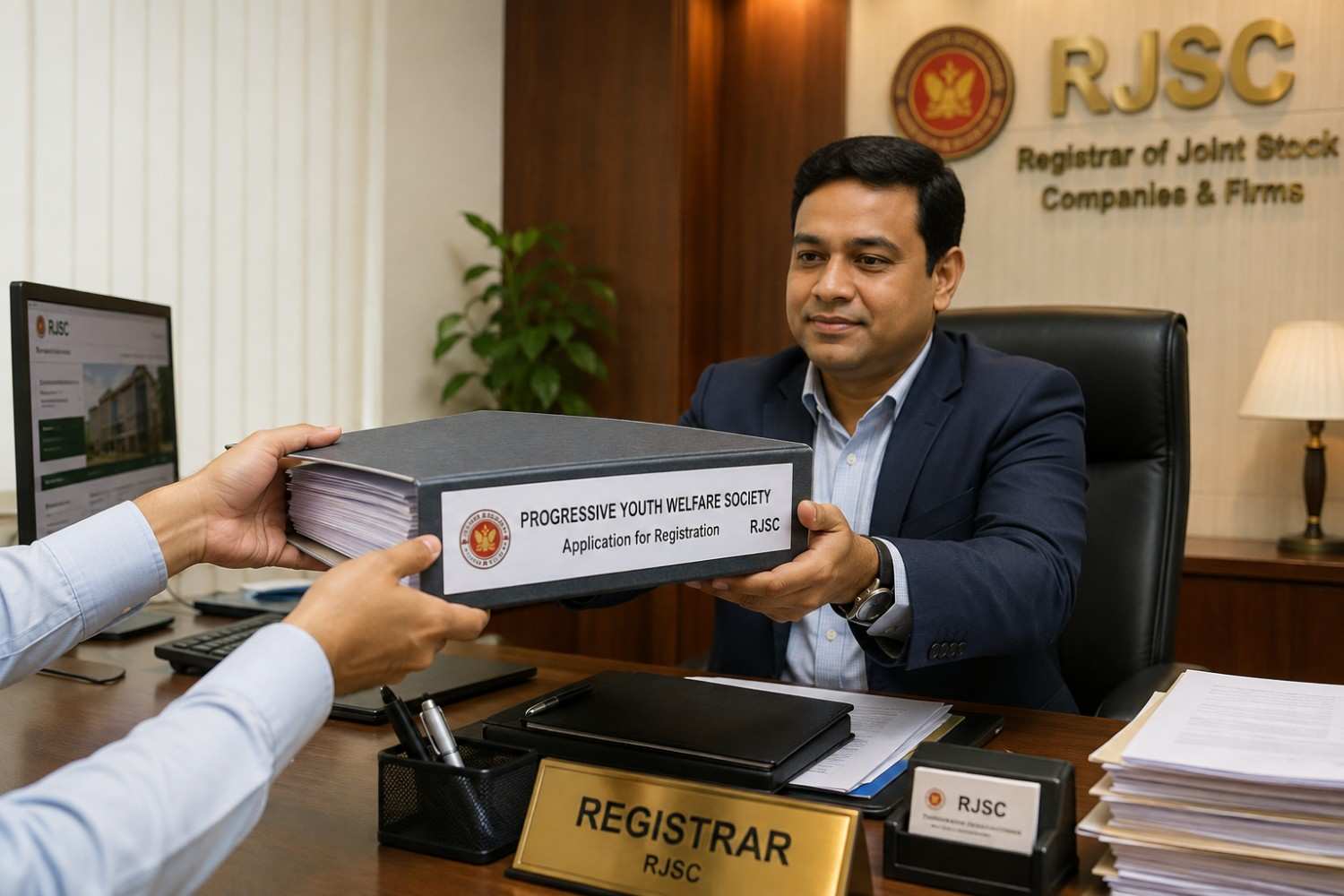

Branch Office Registration in Bangladesh
RJSC Company Share Transfer in Bangladesh documentation requirements
×
Enlarged View

To establish a legitimate entity empowers you to pursue your mission confidently. We demystify the legal complexities, allowing you to concentrate on your core objectives. We’ll guide you through the necessary documentation and filing processes for the needs. This article finds into the key requirements for your organization. We’ll cover everything from primary name clearance to obtaining your final certificate of incorporation from Office of the Registrar of Joint Stock Companies and Firms (RJSC). The Register of Joint Stock Company and Firms is sole authority is mostly known as RJSC a Government organization of Bangladesh

The Register of Joint Stock Company and Firms issues approval or registration of nonprofit organization and approvals other business incorporation certificate, such as Company’s Annual Return Filling/ Company Schedule X Submission in Bangladesh, Society Registration in Bangladesh, Branch Office Registration in Bangladesh, Company Winding up in Bangladesh, Company Share Allotment/Increase, Partnership Firm Registration in Bangladesh, Liaison Office/ Representative Office Registration in Bangladesh, Trade Organization Registration at RJSC, One Person Company(OPC) registration at RJSC, Company Share Transfer in Bangladesh, Foreign Company Registration in Bangladesh, Joint Venture Company Registration in Bangladesh, Certified Copy issue, and many documents.

Key Takeaways

  • Understand the legal necessity of forming a non-profit entity.
  • Identify the role of the Registrar of Joint Stock Companies and Firms.
  • Learn the essential steps for successful name clearance.
  • Discover the required documentation for your formation journey.
  • Gain insights into post-filing obligations and ongoing compliance.

Understanding the Concept of Society Registration in Bangladesh

Starting your community initiative means understanding Society Registration in Bangladesh. Many founders wonder, “What is society registration in Bangladesh?” It’s the legal step to formalize a group for a non-profit goal.

Definition of a Society in the Bangladeshi Context

In Bangladesh, a society is a group formed for literature, science, fine arts, or charity. It’s not about making money. Instead, it’s about social welfare, community development, or cultural preservation.

By registering as a nonprofit organization, you create a legal entity. This entity can own property and make contracts. It gives your mission a solid base, recognized by the government.

Distinguishing Societies from Companies and NGOs

Choosing the right legal form is crucial. Societies, companies, and NGOs differ. Knowing these differences helps decide if registration of society in Bangladesh suits your goals.

The table below outlines key differences to guide your choice:

FeatureSocietyPrivate CompanyNGO (Trust/Foundation)
Primary GoalSocial/CharitableProfit GenerationDevelopment/Aid
Governing LawSocieties Act 1860Companies Act 1994Trust/Foreign Donation Act
OwnershipMembers/TrusteesShareholdersBoard of Trustees
Profit DistributionProhibitedDividends AllowedReinvested in Mission

The society model is ideal for community projects. It has a flexible governance structure perfect for grassroots efforts. By understanding your needs, your organization will stay compliant and effective.

Legal Framework and the Societies Registration Act 1860

Understanding Society Formation in Bangladesh starts with grasping the Societies Registration Act 1860. This law is the foundation for non-profit organizations, outlining the legal framework for their existence. Knowing these legal basics helps you meet government compliance requirements.

Historical Significance of the Societies Registration Act 1860

The Societies Registration Act 1860 was introduced during the colonial era. It aimed to formalize the registration of literary, scientific, and charitable groups. Today, it remains the key for nonprofit organization registration in Bangladesh. Its enduring relevance shows its ability to support social and community development.


Branch Office Registration in Bangladesh
RJSC Company Share Transfer in Bangladesh documentation requirements
×
Enlarged View

A society’s purpose is to advance social, cultural, or charitable causes. This contrasts with a company’s focus on profit. The act provides a unique path for societies, ensuring they stay true to their mission while maintaining legal status.

How the Act Governs Modern Society Formation

Today, the act outlines the rules for your society’s governance and accountability. It mandates the creation of bylaws that detail your organization’s daily operations. This is crucial for understanding the differences between society vs NGO in Bangladesh, as it emphasizes transparency and member conduct.

The law ensures your society enjoys perpetual succession, continuing even with membership changes. By following the Societies Registration Act 1860 in Bangladesh, you safeguard your assets and maintain public accountability. Adherence to these laws is key to earning long-term trust from your stakeholders.

Objectives and Purpose of Forming a Society

Establishing your organization’s purpose is the first step in RJSC society formation in Bangladesh. Before any paperwork, you must know the social or charitable goals your group aims to achieve. This clarity ensures your structure aligns with legal requirements set by the government.

Defining the Mission and Vision of Your Organization

Your mission statement should clearly outline the reason for your existence. It serves as a guiding light for your members and clarifies your commitment to public service. Drafting this under the society’s registration act 1860 should highlight how your activities benefit the community.

A robust vision statement outlines the future impact you aim to make. By setting these goals early, you create a roadmap for growth. This preparation is crucial for society’s registration act 1860 Bangladesh compliance, showing your long-term commitment to your cause.

Common Purposes for Society Formation in Bangladesh

Many groups register to gain formal recognition for their community efforts. If you’re exploring how to society formation in Bangladesh, most successful applications focus on specific, measurable public interests. These initiatives often support national development in several recognized areas.

Common purposes for establishing a registered society include:

  • Educational Advancement: Promoting literacy, vocational training, or specialized skill development programs.
  • Cultural Preservation: Protecting local heritage, arts, and traditional practices through community events.
  • Social Welfare: Providing healthcare support, disaster relief, or assistance to underprivileged populations.
  • Scientific Research: Encouraging innovation and the dissemination of knowledge for the public good.

Choosing a clear, focused purpose enhances credibility with stakeholders and potential donors. It also ensures compliance with regulations throughout your organization’s life. By adhering to these objectives, you forge a lasting legacy of positive change in your community.

Key Benefits of Society Registration in Bangladesh

Understanding the core benefits of society registration in Bangladesh is crucial for any group planning to formalize its operations. By transitioning from an informal group to a registered entity, you gain strategic advantages that support your mission. This move provides the legal framework needed to operate confidently in the local environment.
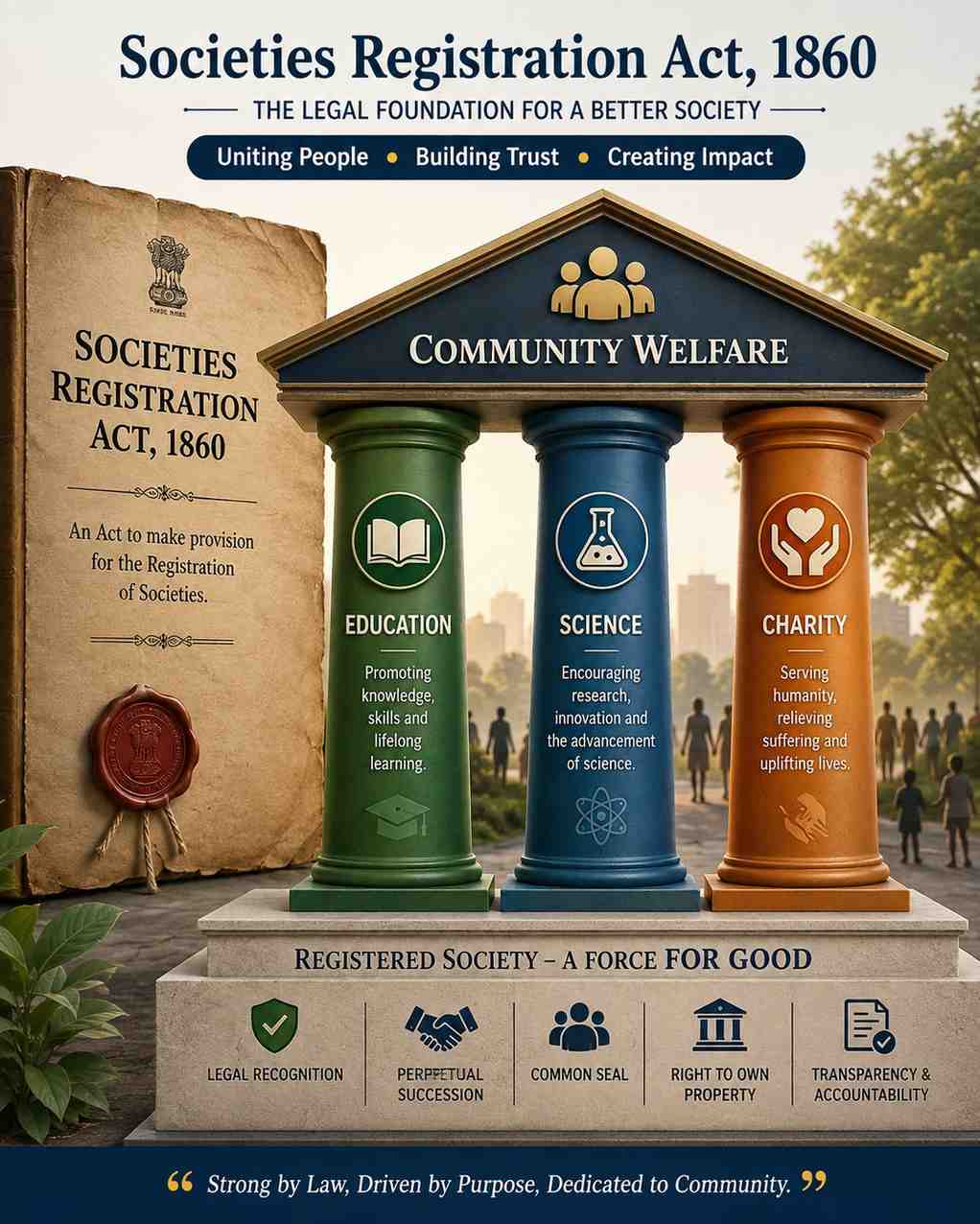

Branch Office Registration in Bangladesh
RJSC Company Share Transfer in Bangladesh documentation requirements
×
Enlarged View

Access to Government Grants and Financial Donations

One of the primary advantages of becoming a registered society is the ability to apply for government grants. Many public funding programs in Bangladesh require legal status before considering applications. Official registration acts as the key to unlock these financial opportunities.

Moreover, registered societies are seen as more reliable for private donations. Donors are more likely to contribute to an organization that has undergone a formal vetting process. This status aids in building a sustainable financial model for your community projects.

Legal Personality and Perpetual Succession

Registration grants your organization a distinct legal personality, separate from its members. This allows your society to enter into contracts, own property, and initiate legal proceedings in its own name. It offers a level of protection that informal group’s lack.

Additionally, you benefit from perpetual succession. This ensures your organization continues to exist, regardless of changes in membership or the departure of founding members. Your mission remains protected and operational over the long term.

Enhancing Credibility with Stakeholders

Official recognition significantly enhances your credibility with stakeholders, including partners, volunteers, and the general public. displaying your registration documents signals that your entity is professional and trustworthy. This transparency is crucial for building lasting relationships within your community.

The following table outlines the key differences between registered and unregistered groups to help you understand the impact of your decision.

FeatureUnregistered GroupRegistered Society
Legal StatusNoneSeparate Legal Entity
Funding AccessLimited to personal fundsGrants and public donations
Operational LifeDependent on membersPerpetual succession
Public TrustLowHigh and professional

By securing this status, you position your organization as a serious player capable of long-term community service. Leveraging these benefits of society registration in Bangladesh will ultimately help you achieve your vision with greater stability and impact.

Minimum Requirements for Society Formation

Before starting the formation process, ensure your organization meets the criteria set by the Registrar of Joint Stock Companies and Firms (RJSC). Adhering to these legal requirements for society registration is crucial to avoid delays or rejection. Proper preparation ensures a smooth path to official recognition.

RequirementCategoryMandatory ThresholdDocumentation Needed
Founding MembersMinimum of 7 personsNID or Passport copies
Governing BodyExecutive CommitteeList of office bearers
Office LocationPhysical address in BDUtility bill or lease deed
Regulatory FilingRJSC SubmissionSigned Memorandum

Minimum Number of Members Required

Learning how to form a society in Bangladesh begins with the membership threshold. You need at least seven founding members to start the registration process. These individuals are the primary signatories for the society’s formation documents.

It’s essential that these members are legally competent to enter into a contract. Meeting these specific society member requirements in Bangladesh is necessary for the initial filing. Without this core group, the application cannot proceed under the current regulatory framework.

Governing Body and Executive Committee Structure

Every registered society must establish a clear internal hierarchy to manage its affairs. The governing body requirements for a society in Bangladesh require an executive committee for day-to-day operations. This committee typically includes a President, Secretary, and Treasurer.
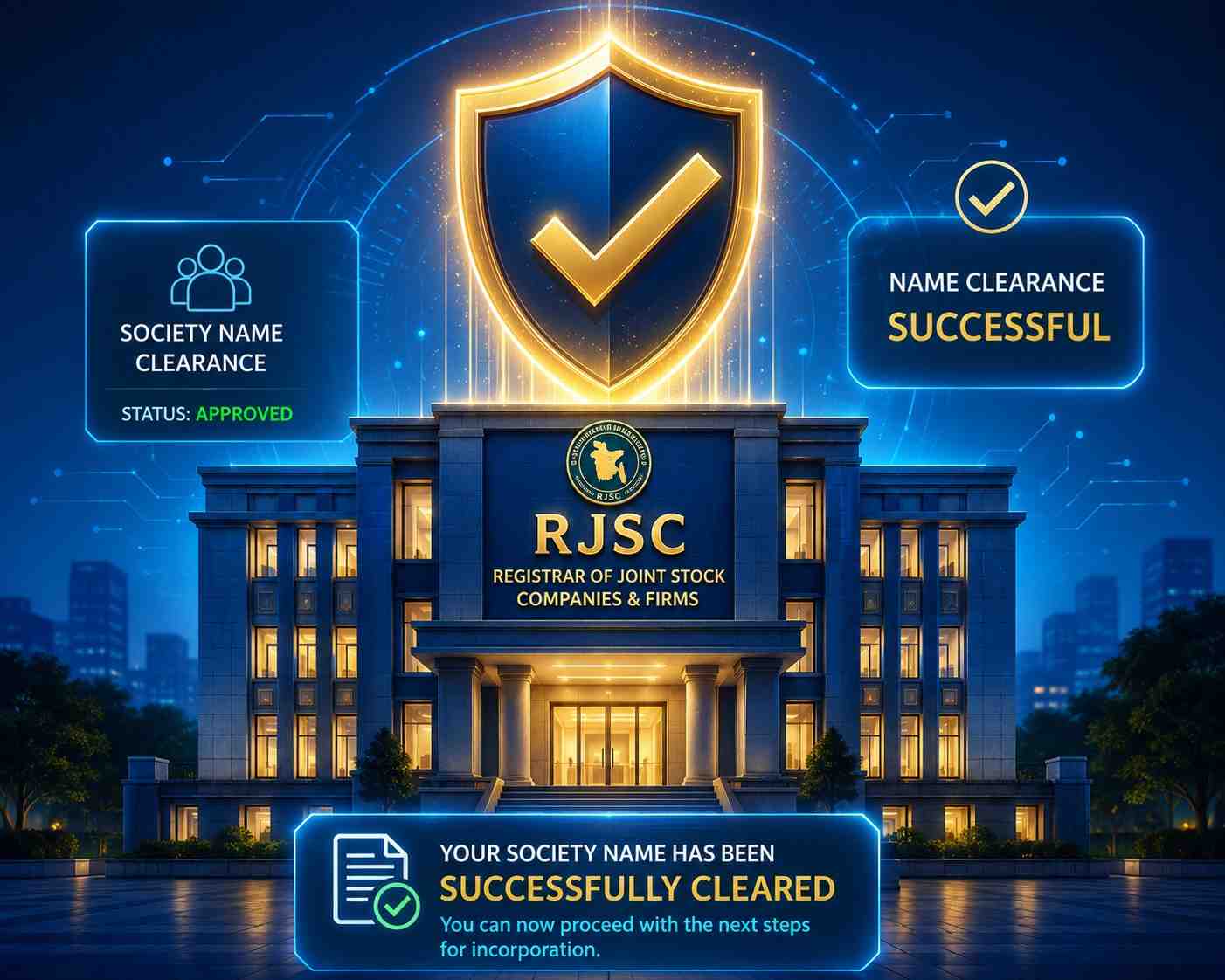

Branch Office Registration in Bangladesh
RJSC Company Share Transfer in Bangladesh documentation requirements
×
Enlarged View

The structure of your committee should be clearly defined in your bylaws to ensure accountability and transparency. By formalizing these roles, you demonstrate to the authorities that your organization is prepared for professional governance. This structure acts as the backbone of your society’s administrative integrity.

Registered Office Address Requirements

A physical presence is a non-negotiable aspect of the society registration requirements in Bangladesh. You must provide a valid, verifiable office address within the country to receive official correspondence. This location serves as the legal domicile for all regulatory communications and statutory filings.

Ensure you have proof of address, such as a utility bill or a rental agreement, ready for submission. Maintaining an accurate and accessible office address is vital for long-term compliance. Below is a summary of the essential criteria you must meet to satisfy the authorities.

Clause TypePurposeLegal Requirement
NameIdentityMust be unique
ObjectivesMissionMust be lawful
GovernanceManagementDefined structure

Drafting the Memorandum of Association

Creating a clear and legally sound Memorandum of Association is crucial for any group seeking official recognition in Bangladesh. This document serves as the constitutional foundation for your organization. It outlines the rules that will govern your operations for years to come. By preparing these society formation documents with precision, you ensure compliance with the Societies Registration Act.

Essential Clauses for the Memorandum of Association

To establish a valid memorandum of association society Bangladesh, specific clauses must be included. These sections provide clarity to the Registrar of Joint Stock Companies and Firms (RJSC) about your structure and intent.

 Name Clause: The unique name chosen for your society.

 Registered Office Clause: The physical location where official records are kept.

 Objects Clause: A detailed list of the primary and secondary goals of the society.

 Governing Body Clause: The names and addresses of the initial executive committee members. The following table summarizes the core components required for your documentation:

Defining the Scope of Activities

Your objectives must clearly align with legal boundaries set by the government. When defining your activities, avoid vague language that could lead to regulatory confusion. Transparency in your mission helps authorities understand your society’s public service intentions.

Ensure that every activity listed is achievable and directly supports your stated vision. If your scope is too broad, you may face delays during the review process. Keep your focus sharp to maintain the integrity of your society formation documents.

Signatories and Witness Requirements

The final validity of your memorandum of association society Bangladesh depends on proper execution. You must have at least seven founding members sign the document to meet the minimum legal threshold. Each signature must be witnessed by a credible individual, such as a notary public or a gazetted officer.

These signatures confirm that the founding members agree to the rules and objectives outlined in the text. Proper attestation is a mandatory step that prevents future disputes regarding the formation of the society. Always verify that all personal details of the signatories match their national identification cards exactly.

Establishing Rules and Regulations for Your Society

Creating a robust set of rules and regulations is essential for the long-term success of your organization in Bangladesh. While the Memorandum of Association outlines your core mission, your internal bylaws provide the necessary framework for daily operations. These documents ensure that your group remains organized, transparent, and fully compliant with its stated objectives.

Drafting Bylaws for Internal Governance

When you develop your society rules and regulations Bangladesh, you must be specific about how decisions are made. Your bylaws should clearly define the roles of your officers and the scope of their authority. This clarity prevents internal confusion and helps maintain a professional environment for all stakeholders involved.
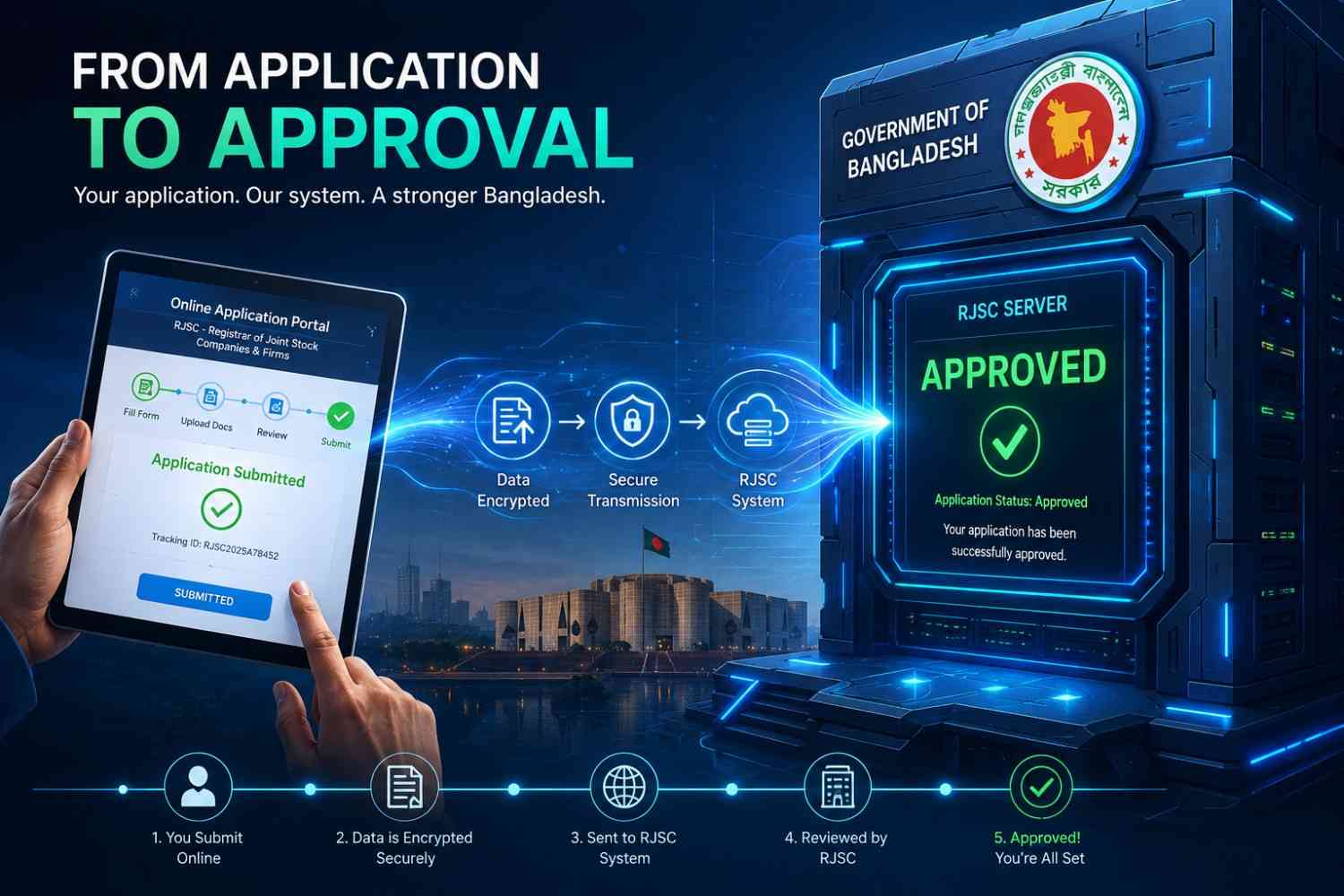
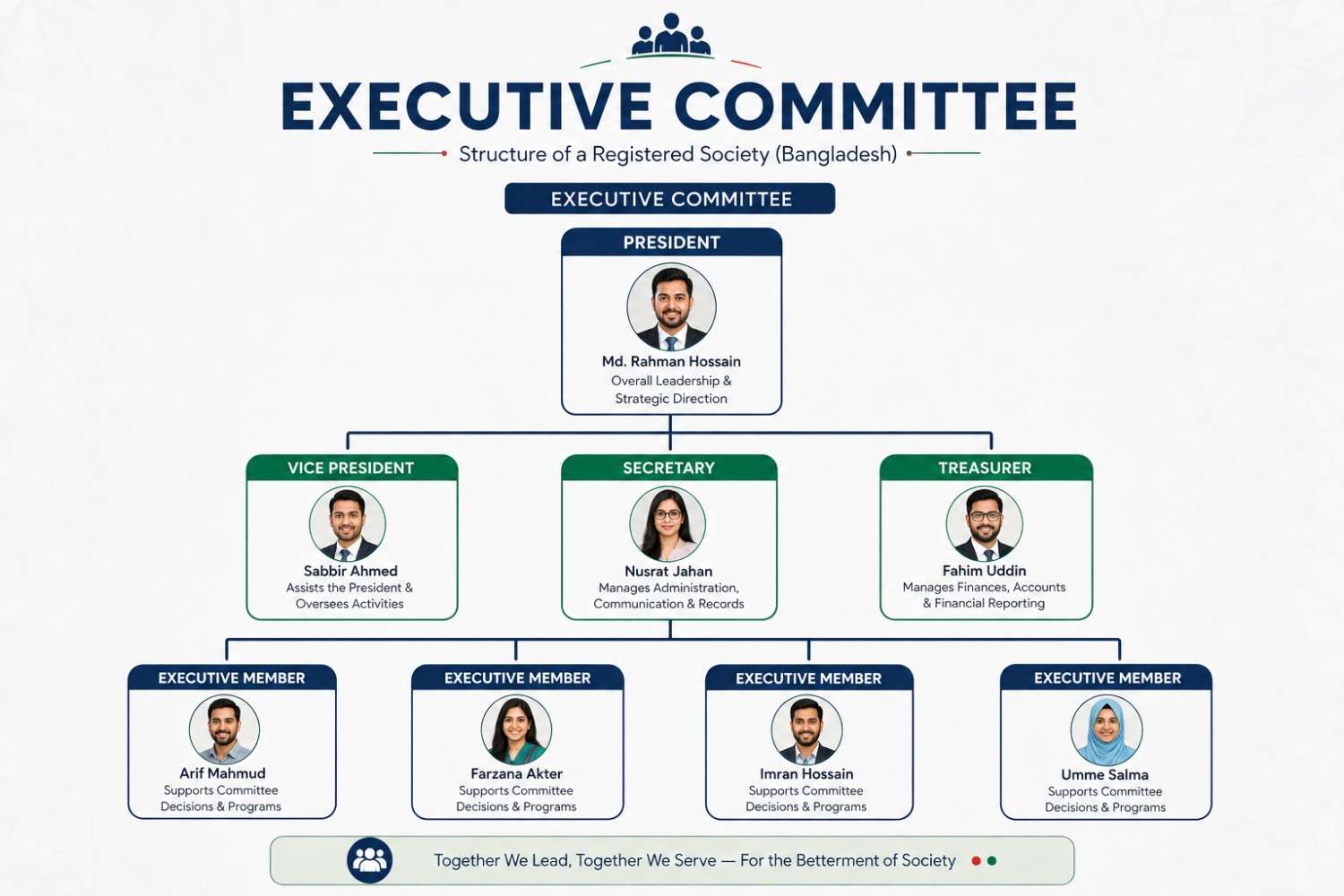
Branch Office Registration in Bangladesh
RJSC Company Share Transfer in Bangladesh documentation requirements
×
Enlarged View

You should also include provisions for regular audits and financial reporting. By establishing these standards early, you build long-term trust with your members and the public. A well-structured document acts as a roadmap for your leadership team to follow during their tenure.

Procedures for Membership and Meetings

Defining clear society member requirements Bangladesh is vital for maintaining the integrity of your organization. Your bylaws must outline the criteria for joining, the process for application, and the rights of each member. This ensures that everyone understands their responsibilities from the very beginning.

Furthermore, you need to establish formal protocols for conducting meetings. This includes setting quorum requirements, notice periods for assemblies, and voting procedures. Consistent meeting protocols allow your society to function smoothly and make democratic decisions without unnecessary delays.

Dispute Resolution and Dissolution Clauses

Every organization should prepare for potential conflicts by including a clear dispute resolution mechanism. Whether it involves disagreements among members or

challenges with the governing body requirements society Bangladesh, having a pre-defined process saves time and resources. You might consider mediation or arbitration as effective ways to resolve internal issues.

Finally, you must include a section on the dissolution of the society. This clause dictates how assets are distributed if the organization ceases operations. Transparency in asset management is a legal necessity that protects your members and ensures compliance with local laws.

Governance ElementPrimary PurposeKey Consideration
Membership RulesDefine eligibilityClear entry criteria
Meeting ProtocolsEnsure orderQuorum and voting
Dispute ResolutionConflict managementMediation steps
Dissolution ClauseAsset protectionLegal distribution

Preparing Necessary Documentation for RJSC Submission

Ensuring your application package is well-organized is crucial to avoid delays with the Registrar of Joint Stock Companies and Firms (RJSC). A meticulously prepared application showcases professionalism and confirms your organization’s compliance with legal requirements for society registration in Bangladesh. Verifying every detail upfront will greatly reduce the effort needed during the review phase.

Registered Office Proof and Address Documents

Every society must provide proof of its physical location in Bangladesh. This is to ensure authorities can contact your organization for official matters. You need to gather clear copies of your registered office proof to meet the society registration requirements Bangladesh.

 A valid rental agreement or lease deed for the office premises.

 Recent utility bills, such as electricity or gas, confirming the address.

 A formal letter of consent from the property owner if the space is provided free of charge.

Identity Verification for Founding Members

The government demands strict identity verification to ensure transparency and security. You must collect specific society formation documents for each founding member. These records verify the legitimacy of those establishing the entity.

Ensure you have high-quality; legible copies of the National Identity (NID) cards for all signatories. You will also need recent passport-sized photographs for each member. Organizing these society registration documents by individual will significantly streamline the verification process.

Compiling the Application Package

Compiling a complete and accurate application package is the most critical step in the registration process. By following a systematic approach, you ensure all documents required for society registration in Bangladesh are present and error-free. This preparation minimizes the risk of receiving queries or objections from the registrar.

Use the following checklist to organize your final submission:

 Memorandum of Association signed by all founding members.

 Bylaws or Rules and Regulations governing internal operations.

 List of the Executive Committee with contact details and NID copies.

 Proof of Address documents as outlined in the previous section.

By double-checking these items against the official society registration requirements RJSC, you position your organization for a successful and timely approval. Maintaining a clean, digital, and physical copy of these files is a best practice for your long-term administrative health.

Navigating the Society Name Clearance Process

The journey of society registration in Bangladesh starts with a crucial step: picking and clearing your organization’s name. Before diving into the paperwork, you must confirm your name is unique and meets government criteria.
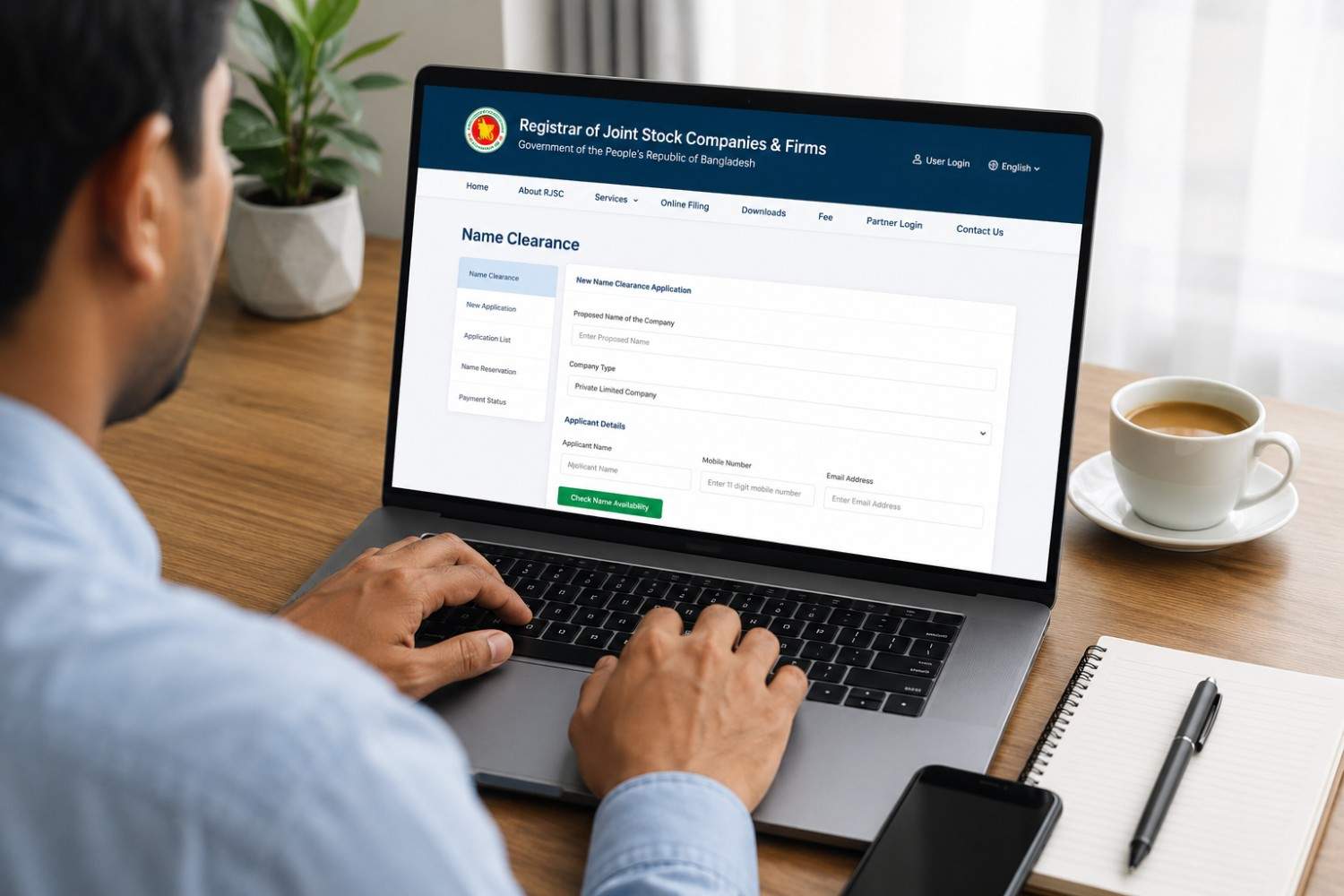

Branch Office Registration in Bangladesh
RJSC Company Share Transfer in Bangladesh documentation requirements
×
Enlarged View

Securing your name early is a vital milestone. It sets you on a path of confidence. By working with the official society registration authority, you prove a legal route for your organization.

Criteria for Selecting a Unique Society Name

When picking a name, ensure it’s not already taken by another entity in the country. A unique name avoids confusion and safeguards your organization’s image.

Steer clear of names that could be seen as offensive, misleading, or imply government backing without permission. Your name should accurately represent your society’s mission and vision to align with regulatory standards.

How to Apply for Name Clearance via RJSC

The society name clearance process Bangladesh mainly happens through the RJSC portal. You’ll need to set up an account, log in, and submit a request for name availability.

At this point, you must pay the necessary fees to start the review. After the society registration at RJSC system reviews your application, you’ll get a notification about its status.

Common Reasons for Name Rejection

Many face hurdles if their name is too close to an existing one. Even slight phonetic similarities can cause a registrar to reject it.

Also, using restricted words or not clearly stating the name’s purpose often leads to delays. Knowing these common issues is key to a smooth society name clearance Bangladesh process.

Step-by-Step Society Registration Process in Bangladesh

Starting your organization requires a deep understanding of the society registration process step by step in Bangladesh. The official portal ensures your application adheres to legal standards. This digital approach has made joint stock society registration in Bangladesh easier than ever.

Initiating the Application on the RJSC Portal

First, create an account on the Registrar of Joint Stock Companies and Firms’ official website. Log in to find the society registration form for new applicants. It’s crucial to enter your organization’s name and goals accurately at this stage.

Wondering how to apply for society registration in Bangladesh? The system will ask you to upload your founding documents. Make sure these are clear and within size limits to avoid delays.

Payment of Registration Fees and Stamp Duty

After filling out the form, the system will calculate your fees. You must pay through the authorized banking channels on the portal. It’s wise to keep a digital copy of your payment receipt.

Stamp duty is a must for registration of society in Bangladesh. Not paying the right amount can reject your application. Always check the current fee on the official website before paying.

Finalizing the Submission and Verification

Before submitting, review your memorandum of association society Bangladesh carefully. This document is the basis of your legal status. Also, check your society rules and regulations Bangladesh to match the Societies Registration Act.

After submitting, the RJSC will verify your application. You’ll get a notification about your application’s status via email or the portal. Patience is key during this time, as officials check for compliance and accuracy.

Managing RJSC Processing and Approval Timelines

After submitting your application, the review and verification phase begins. The society registration authority will scrutinize your files to ensure they meet legal standards. This phase is crucial for those learning how to apply for society registration in Bangladesheffectively.

Understanding the Document Preparation and Submission Time

The approval timeline heavily depends on the accuracy of your initial filing. Errors or missing signatures in your society registration form can extend the processing time. Ensuring your documents are precise is key to a seamless society registration process in Bangladesh.

The RJSC typically needs a few weeks to review your bylaws and membership lists. Plan your organization’s launch and financial activities accordingly. Being proactive during the preparation stage helps avoid delays.

Tracking Your Application Status

The society registration online in Bangladesh has streamlined tracking your application. Log into the official portal to check your file status any time. This transparency allows you to stay updated without office visits.

If your application is pending for too long, contact the office for an update. Regularly checking your dashboard ensures you’re informed of any required actions. Staying organized is crucial for success.

Handling Queries and Objections from the Registrar

It’s common for the registrar to raise queries about your society name clearance in Bangladesh or governance details. If you receive an objection, view it as a normal part of the society name clearance process in Bangladesh. Responding promptly is essential to keep your application on track.

Addressing these queries requires clear and concise documentation. This will resolve the registrar’s concerns. Once all issues are resolved, you’ll be closer to your society registration certificate in Bangladesh. Following the society registration process step by step in Bangladeshwill boost your confidence in navigating regulations.

Post-Registration Compliance and Regulatory Obligations

Securing your official status is just the start. Maintaining compliance is crucial for your success. Getting your society registration certificate in Bangladesh is a big step. But it’s just the beginning of your legal duties.

Ignoring these duties can result in severe penalties. This includes heavy fines or even losing your registration. By focusing on transparency and accuracy, you safeguard your society’s reputation. And you keep the trust of your stakeholders.

Maintaining Statutory Registers

Every registered society must keep accurate statutory registers. These records document your organization’s activities and membership. Ensure these registers are up-to-date and available for inspection.

Your record-keeping should include:

 A detailed list of current members with their contact information.

 Minutes from all general meetings and executive committee meetings.

 Records of financial transactions and annual audits.

 Copies of your bylaws and any amendments.

Reporting Changes in Governing Body Members

Your leadership team’s structure is key to your RJSC society registration in Bangladesh. Notify the authorities immediately when there are changes in your governing body. This ensures your records stay accurate.

Prepare the necessary documents for these changes promptly. Timely reporting avoids delays and keeps your society in good standing. Always check that new members meet your society’s eligibility criteria before submitting the update.

Compliance with Local Regulatory Authorities

Your society must also follow local regulations. This includes filing tax returns and adhering to municipal rules. Keeping up with these duties is crucial for your organization’s long-term success.

Here are some best practices for compliance:

 Use a compliance calendar to track deadlines.

 Perform regular internal audits to spot documentation gaps.

 Seek legal advice if unsure about regulatory changes.

 Keep your RJSC society registration in Bangladesh documents organized.

By following these steps, you keep your society registration certificate in Bangladesh valid and respected. Consistent effort in regulatory duties will help your society grow and fulfill its mission.

Annual Return Filing and Record Keeping Requirements

Ensuring compliance is crucial for your organization’s success in Bangladesh. By focusing on administrative precision, you show a strong commitment to accountability and integrity. Proper management of your society registration documents keeps your entity in good standing with authorities.

Deadlines for Annual Return Filing with RJSC

Registered societies must meet strict deadlines for statutory report submissions. The annual return filing for society at RJSC in Bangladesh process is essential for maintaining visibility with the Registrar of Joint Stock Companies and Firms (RJSC). Missing these deadlines can result in penalties or legal issues for your governing body.

Branch Office Registration in Bangladesh
RJSC Company Share Transfer in Bangladesh documentation requirements
×
Enlarged View

Ensure your society annual return RJSC filings are completed promptly after the annual general meeting. Keeping track of these dates is crucial for maintaining compliance. Always check the current submission portal requirements to avoid delays.

Audit Requirements and Financial Transparency

Financial health is key to trust for non-profits and social organizations. Adhering to society audit requirements Bangladesh ensures transparent and ethical fund management. An independent audit provides stakeholders and government bodies with assurance of accurate financial records.

It’s essential to maintain detailed ledgers and receipts to support your annual financial statements. These documents are the foundation for your audit process. Regular internal reviews help identify discrepancies early, ensuring a clean financial record for your society.

Best Practices for Document Archiving

Effective record organization is as crucial as the filing process itself. When managing documents required for society registration in Bangladesh, implement a systematic archiving strategy. This ensures your society registration documents Bangladesh are accessible during future inspections or audits.

Use both digital and physical storage solutions to protect your vital records from damage or loss. Consistent record keeping enables informed decision-making based on historical data. Following these best practices will protect your organization’s history and support its future growth.

Compliance TaskFrequencyPrimary Objective
Annual Return FilingAnnuallyRegulatory Compliance
Financial AuditAnnuallyFinancial Transparency
Meeting MinutesPer MeetingGovernance Tracking
Membership UpdatesAs NeededRecord Accuracy

Ensuring Long-Term Operational Success for Your Registered Society

Obtaining legal status is just the start for your organization’s journey toward impactful social change. You now have the knowledge to register a society in Bangladesh through the Registrar of Joint Stock Companies and Firms.

Transparency is key to unlocking the full benefits of society registration in Bangladesh. Keeping your society’s annual return RJSC filings up to date is crucial. This action builds trust with donors and government partners, who value accountability.

Following strict audit requirements in Bangladesh ensures your financial health is transparent and secure. View annual return filing for your society in Bangladesh as a key tool for growth, not just a chore.

Consistent compliance protects your reputation and enhances your ability to serve the community. Your dedication to these regulations sets the stage for long-term success. Leverage your registered status to form partnerships that broaden your influence nationwide.

FAQ

What is society registration in Bangladesh and who is the governing authority?

Society registration in Bangladesh is the legal process of creating a non-profit organization under the Societies Registration Act 1860. The Registrar of Joint Stock Companies and Firms (RJSC) oversees this process. It turns a group of individuals into a legal entity. This entity can own property and enter contracts for charitable, scientific, or literary purposes.

How does a society differ from a private limited company or an NGO in Bangladesh?

Societies in Bangladesh are non-profit, unlike companies that aim to make a profit. Societies are registered for social or cultural activities, while NGOs may need extra registration for foreign donations. Knowing these differences is crucial for your organization’s legal and operational strategy.

What are the minimum society member requirements in Bangladesh?

To form a society in Bangladesh, you need at least seven members. These members will be the founding body that signs the Memorandum of Association. You must also set up an executive committee to manage daily operations and ensure transparency.

How do I initiate the society name clearance process in Bangladesh?

Start by applying for name clearance through the RJSC online portal. This ensures your name is unique and doesn’t conflict with existing entities. After approval, you’ll get a name clearance certificate. This certificate is valid for a period, allowing you to proceed with full registration.

What are the essential society registration documents in Bangladesh?

Key documents include the Memorandum of Association, society rules and regulations, and a list of governing body members. You also need proof of a registered office and address documents. Additionally, NID copies of all founding members are required.

Can you explain the society registration process step by step in Bangladesh?

The process starts with name clearance from the RJSC. Then, draft the Memorandum of Association and society rules. Upload these documents to the RJSC portal, pay fees, and submit for digital verification. After review, you’ll receive a society registration certificate.

What are the primary benefits of society registration in Bangladesh?

Society registration gives your organization legal personality and perpetual succession. It also opens doors to government grants and financial donations. This enhances credibility and allows for a dedicated bank account at institutions like any Bank of Bangladesh.

What are the ongoing annual return filing requirements for a society?

You must file annual returns with the RJSC. This includes a list of governing body members and a summary of activities. Annual filings ensure your society remains in good standing with the RJSC.

Are there specific society audit requirements in Bangladesh?

Yes, societies must maintain accurate financial records and undergo regular audits. This transparency is crucial for proving non-profit status and is often required for funding. Proper record keeping and audits build trust with donors and the public.

What is the expected RJSC processing and approval time for society formation?

Processing time varies based on document accuracy. Once documents are submitted and fees paid, review takes several weeks. You can track your application on the RJSC website to address any issues promptly.

Running a business means following local laws closely. A key responsibility for firms registered with the Registrar of Joint Stock Companies and Firms (RJSC) is keeping corporate records up to date. Staying compliant helps avoid fines and keeps your business in good standing with authorities.

The Company Schedule X Submission in Bangladesh is the main way to report important information. This includes details on directors, shareholders, and the company’s.

Grasping the details of this yearly task helps you confidently navigate the regulatory world. Whether you’re starting a new business or managing an existing one, timely documentation is crucial. Let’s delve into how to make your Joint Stock schedule x submission in Bangladesh process smoother.
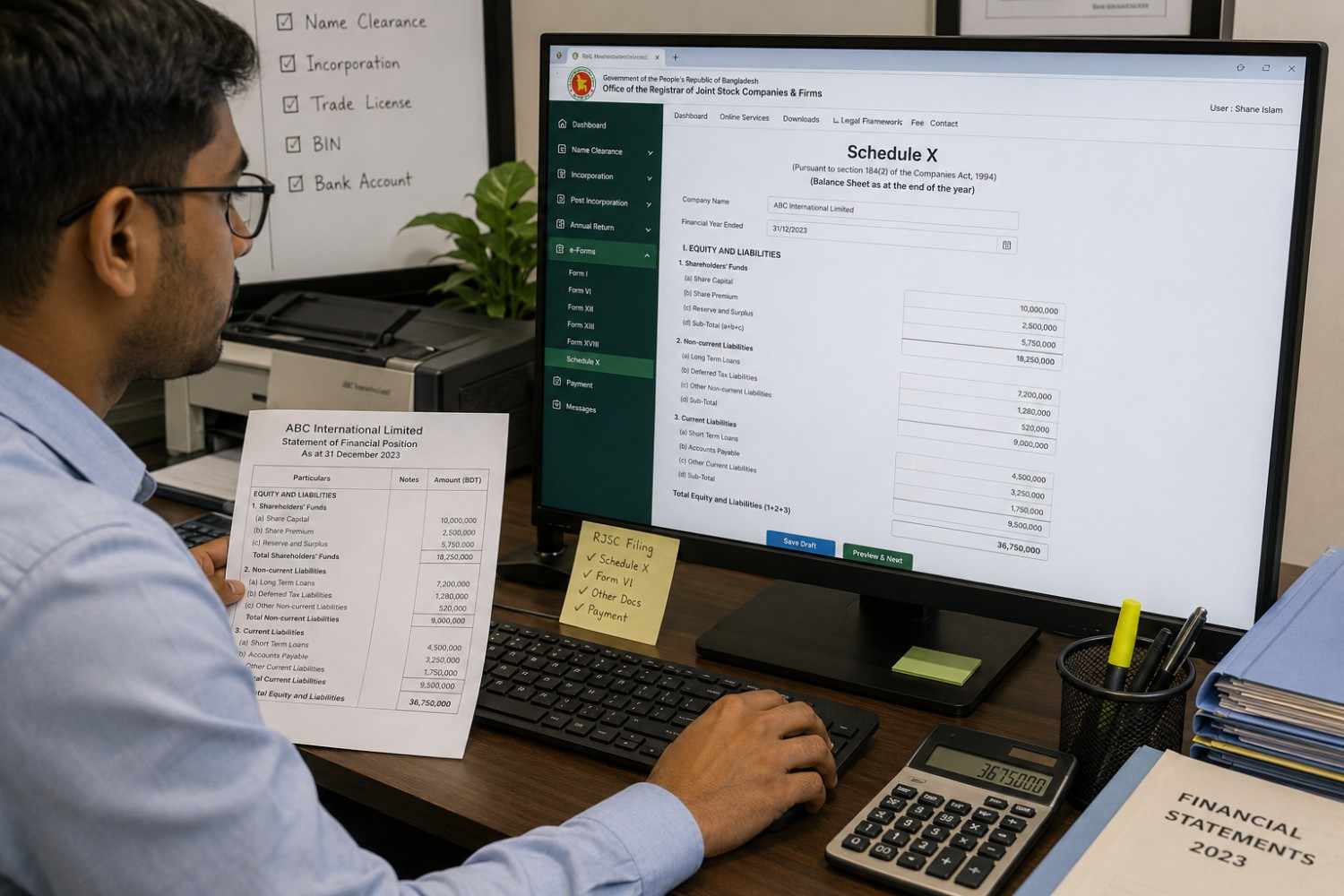
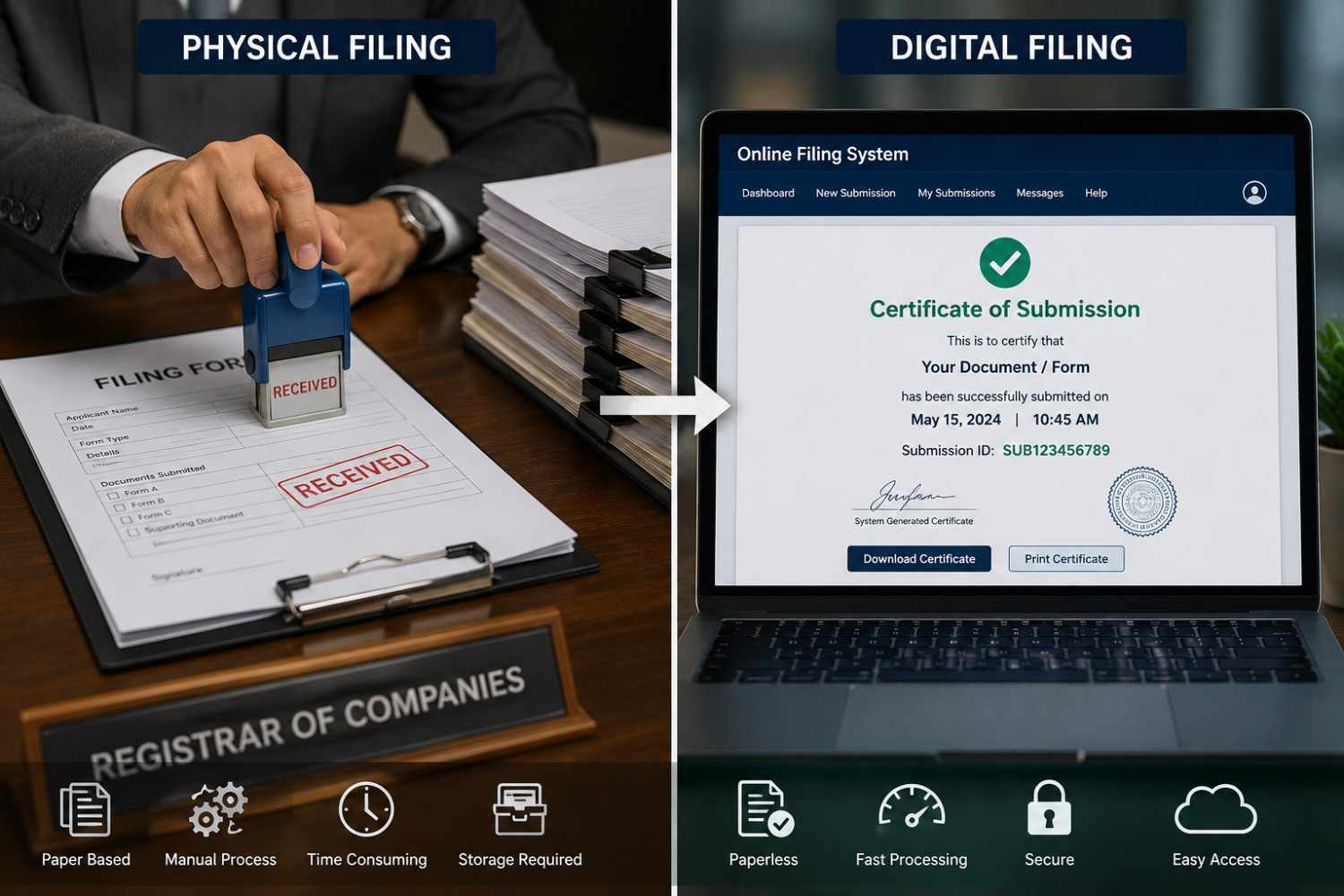
Branch Office Registration in Bangladesh
RJSC Company Share Transfer in Bangladesh documentation requirements
×
Enlarged View

Key Takeaways

  1. Annual returns are mandatory for all entities registered with the RJSC.
  2. This process updates critical data like share capital and director information.
  3. Proper filing protects your business from legal complications and fines.
  4. Transparency in corporate reporting builds trust with your investors.
  5. Timely compliance is essential for maintaining your firm’s legal status.

Understanding the Fundamentals of Company Schedule X Submission in Bangladesh

Understanding your corporate compliance obligations in Bangladesh is essential. Company Schedule X Submission in Bangladesh is crucial for maintaining transparency and legal status. It helps avoid unnecessary administrative challenges.

Defining the Annual Return Requirement

The annual return is a critical snapshot of your company’s status at year-end. Managing Joint stock schedule x submission in Bangladesh requirements means updating the Registrar of Joint Stock Companies and Firms (RJSC) on your entity’s status. It includes key data like share capital, director details, and registered office information.

Regular RJSC Annual Return Filing in Bangladesh keeps your corporate records in order. It’s not just a formality; it’s a cornerstone of corporate governance. An accurate company annual return filing in Bangladesh builds trust among stakeholders and regulators.

Legal Basis Under the Companies Act

The Companies Act of 1994 sets the legal basis for these obligations. It requires all registered companies to submit specific documents for corporate accountability. This applies to both private and public limited companies in the country.

By meeting your Joint Stock Schedule X Submission in Bangladesh obligations, you show your dedication to the law. Not complying can attract regulatory attention and penalties. Proactive compliance is key to protecting your company’s reputation and ongoing operations.

Identifying Entities Required to Submit Schedule X

Figuring out if your company needs to file Schedule X is crucial for staying compliant. Every business in Bangladesh must follow certain rules to ensure openness. Proper identification of your business type is key to meeting the Registrar of Joint Stock Companies and Firms (RJSC) standards.

Private Limited Companies

For those running a private limited company annual return Bangladesh is a must. These are the most prevalent business types in the country. You must submit Schedule X to update your company’s financial and administrative details.

Public Limited Companies

Managing a public limited company annual return Bangladesh comes with stricter rules. These companies need to keep detailed records for the RJSC and their investors. Following schedule x filing requirements Bangladesh ensures your public information is up-to-date and correct.

Exemptions and Special Cases

Not all companies must file, especially those in unique situations. Some new businesses or those going through legal changes might have different filing needs. It’s highly recommended to seek legal advice if your company’s status is changing.

Entity TypeFiling FrequencyPrimary Focus
Private LimitedAnnuallyShareholder & Capital Updates
Public LimitedAnnuallyFinancial & Governance Disclosure
Foreign SubsidiaryAnnuallyLocal Compliance Verification

Determining the Submission Timeline for Annual Returns

Managing your company annual return submission in Bangladesh timeline is crucial for directors in Bangladesh. It keeps your business in good standing with the Registrar of Joint Stock Companies and Firms (RJSC). Proper planning for RJSC annual return filing in Bangladesh helps avoid late fees and legal issues.
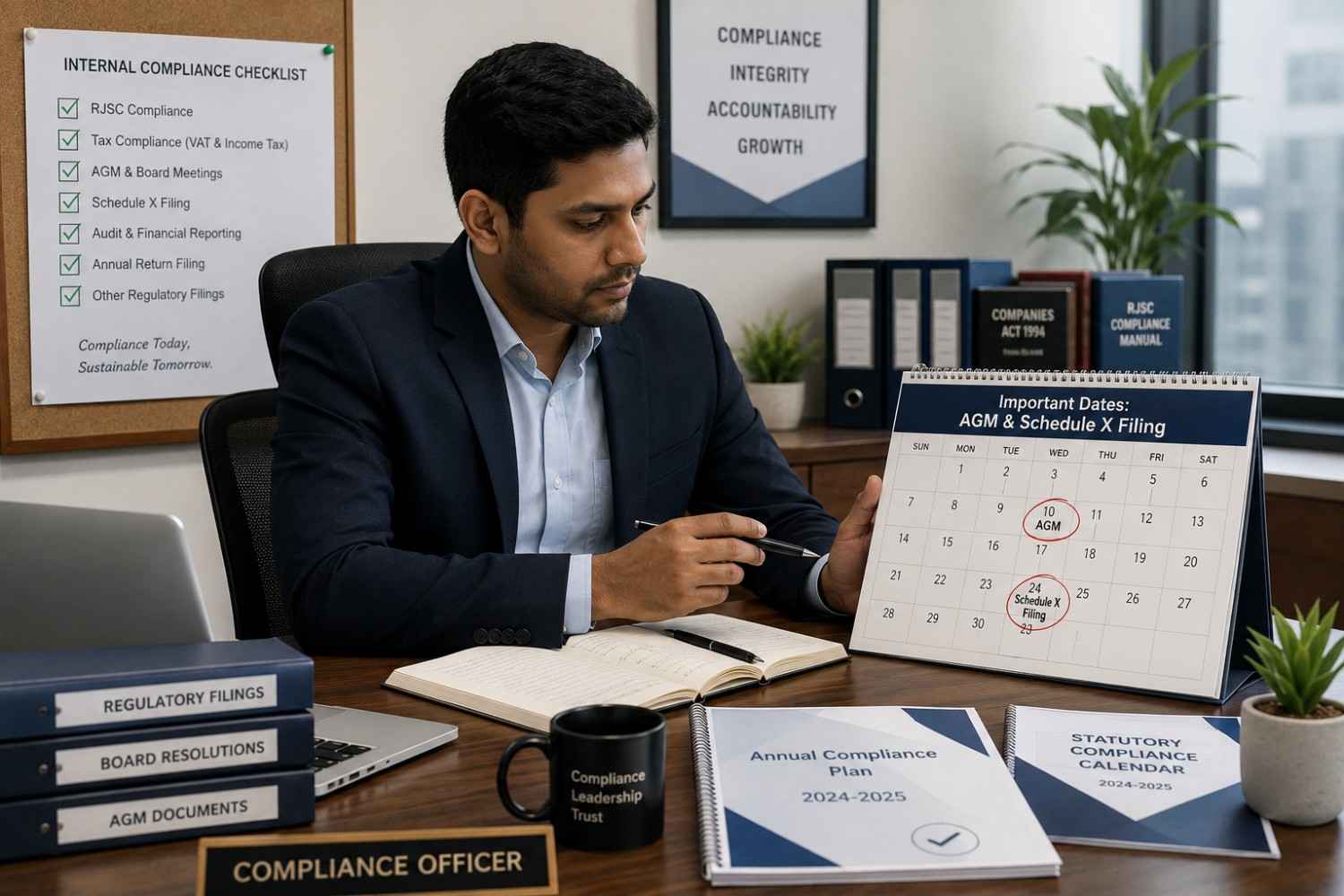
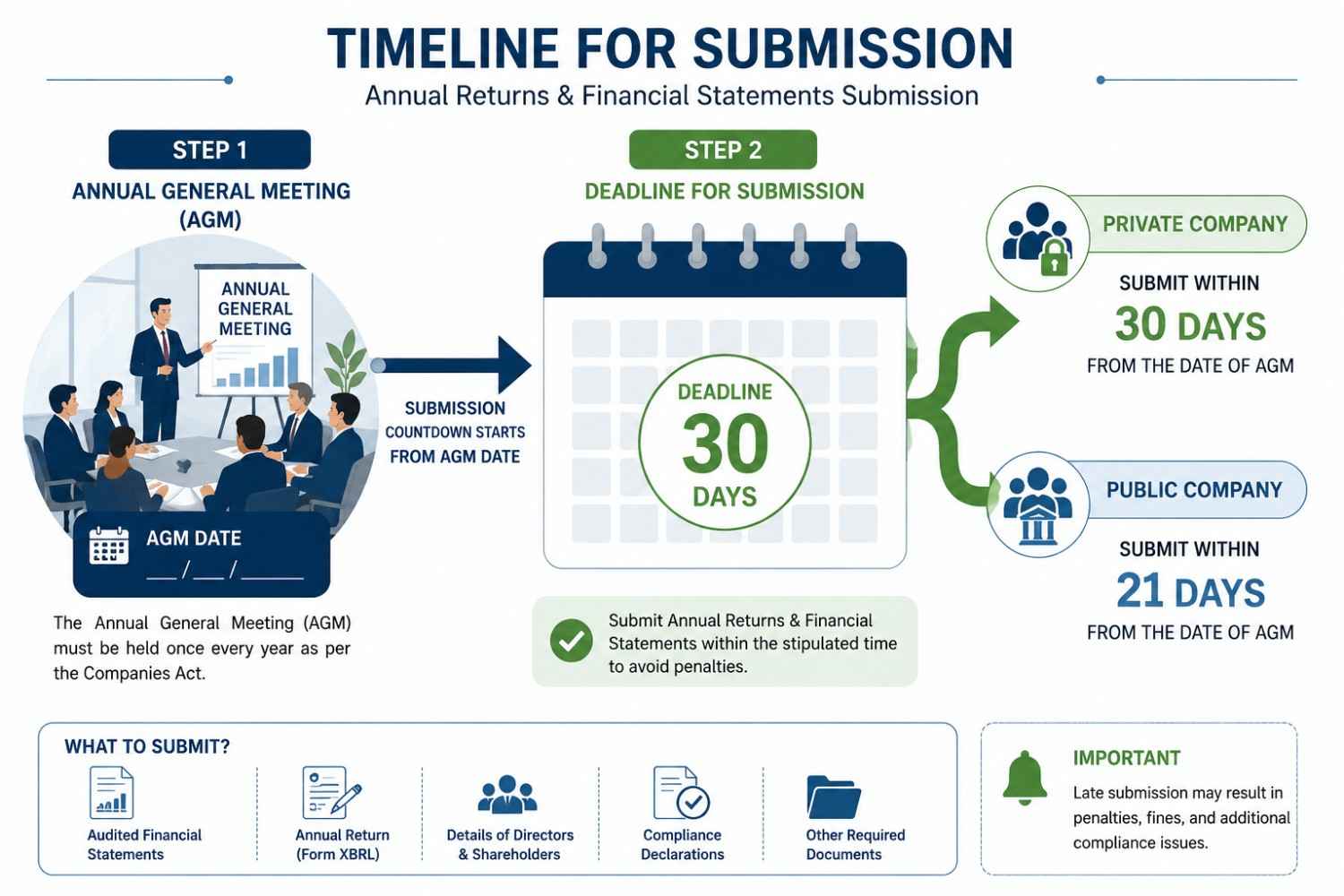
Branch Office Registration in Bangladesh
RJSC Company Share Transfer in Bangladesh documentation requirements
×
Enlarged View

Statutory Deadlines for Filing

The Joint Stock Schedule X Submission in Bangladesh deadline is strictly governed by the Companies Act. After your Annual General Meeting, you have a limited time to meet your regulatory duties. Ensure all documents are ready and submitted on time to avoid penalties.

Missing the RJSC annual return filing in Bangladesh deadline can result in hefty fines for the company and its directors. Treating these dates as non-negotiable is essential. By focusing on Company annual return filing in Bangladesh, you safeguard your shareholders’ interests.

Calculating the Annual General Meeting (AGM) Window

To find your submission dates for company schedule x, first determine your AGM date. The law requires an AGM within 18 months of incorporation and 15 months after the last meeting. After the AGM, you have a 30-day window to file the RJSC annual return filing procedure in Bangladesh.

File the return within 30 days post-AGM. This 30-day period is critical for your Joint stock schedule x submission in Bangladesh. We suggest finalizing financial statements and director reports early to ensure a smooth filing process.

Strategic Preparation of Annual Return Information

A successful Company annual return submission in Bangladesh begins with a well-organized data strategy. Treating this process as a critical administrative task is essential to avoid legal issues. Preparing your documents early ensures your business remains compliant with authorities.

Gathering Financial Statements

Your financial records are the core of your Company annual return filing in Bangladesh. Compile your audited balance sheets, profit and loss accounts, and director reports well before the deadline. Ensure these documents are signed by authorized signatories and auditors for legal validity.

Organizing these files digitally simplifies the upload process. It’s highly recommended to maintain a dedicated folder for the current fiscal year to avoid data loss. Accuracy in these statements is crucial for a seamless compliance experience.

Verifying Registered Office Address

The Registrar of Joint Stock Companies and Firms requires an accurate and current registered office address for every entity. Verify that the address on file matches your latest utility bills or lease agreements. If your company has recently relocated, update these details in your internal records before starting your company schedule x submission checklist.

Address discrepancies often cause delays or rejection of your filing. Take time to cross-check your current office location with previous filings. This verification step helps avoid administrative errors.

Document CategoryRequired ActionVerification Status
Financial StatementsAudit and SignCompleted
Office AddressValidate Utility BillPending
Shareholder ListUpdate RegistryCompleted
Director DetailsConfirm IdentityPending

Updating Company and Director Details for RJSC Records

Ensuring your company’s profile is up-to-date with the RJSC is crucial for maintaining regulatory compliance all year round. As a director, you have a continuous responsibility to accurately reflect any changes within your organization. Neglecting this can cause significant administrative hurdles when filing your company director return Bangladesh documents.

Reporting Changes in Directorship

It’s essential to notify the Registrar of Joint Stock Companies and Firms (RJSC) immediately when there are changes in directorship. Transparency in your corporate governance structure is not just a legal requirement; it also boosts investor confidence. Ensure all appointment or resignation forms are submitted on time to maintain accurate records.

Keeping your company director return Bangladesh profile updated prevents discrepancies during audits. Ignoring these updates can lead to penalties or complications during your annual return filing. Always confirm that your directors’ personal details align with the official government database.

Notifying Changes in Registered Office

Your registered office address is the official point of contact for all legal correspondence. If your business relocates, you must inform the RJSC without delay. This ensures all official notices are delivered promptly, avoiding legal issues.

Updating your address is a simple process that prevents administrative errors. By keeping your contact information current, you show a commitment to professional compliance. The table below highlights the key differences between these two essential filing types.

Update TypePrimary FocusKey DocumentationCompliance Impact
Director ChangeBoard CompositionForm XII / Form 117High (Legal Standing)
Office AddressOfficial CorrespondenceForm VI / Form 117Medium (Communication)
General FilingAnnual ComplianceSchedule XCritical (Annual Status)

Structuring Shareholder and Share Capital Information

Accurate reporting of your company’s equity is vital for regulatory compliance in Bangladesh. When preparing your annual return, ensure that your capital details match official records. A precise schedule x shareholder list Bangladesh is crucial for the Registrar of Joint Stock Companies and Firms (RJSC) to track ownership changes effectively.

Compiling the List of Shareholders

Your list of shareholders must reflect the current status as of your Annual General Meeting date. Include full names, addresses, and the number of shares held by each individual or entity. Transparency in this data prevents future disputes over ownership stakes.


Branch Office Registration in Bangladesh
RJSC Company Share Transfer in Bangladesh documentation requirements
×
Enlarged View

Ensure all share transfers during the reporting period are recorded in your internal registers. If there have been changes in shareholding, these must be clearly shown in your submission. A verified schedule x shareholder information Bangladesh ensures the RJSC has an accurate equity register.

Documenting Authorized and Paid-up Capital

Your submission must clearly differentiate between authorized and paid-up capital. Authorized capital is the maximum share capital allowed by your Memorandum of Association. Paid-up capital shows the actual capital contributed by shareholders.

It is crucial to verify these figures against your financial statements before filing. Any discrepancy in your schedule x share capital information Bangladesh can cause delays or requests for clarification. Consistent records show your commitment to corporate governance and regulatory standards.

Preparing the Required RJSC Forms and Supporting Documents

Managing your Company Annual Return Submission in Bangladesh effectively requires thorough document preparation. Organizing your documents early helps avoid rejection and keeps your business compliant. It’s crucial to understand the Joint stock schedule x submission in Bangladesh for a smooth process.

Essential Forms for Annual Compliance

The core document is the Schedule X form. It’s the official record of your company’s status for the year. You can find the official schedule x form Bangladesh on the RJSC online portal.

You’ll also need to attach certified board resolutions approving the financial statements. These documents confirm that the company’s leadership has reviewed and accepted the annual accounts. Keeping these records up-to-date is essential for your annual return documents Bangladesh.

Supporting Documentation Requirements

To ensure your filing is complete, follow a structured Company schedule x submission in Bangladesh checklist. Having these items ready prevents delays and unnecessary follow-up requests from the registrar. Here is the key schedule x required documents Bangladesh to prepare:

 Audited Financial Statements: A copy of the balance sheet and profit and loss account for the relevant year.

 List of Shareholders: An updated register showing current shareholdings and any transfers made during the year.

 Registered Office Proof: Documentation confirming your current business address, such as a utility bill or lease agreement.

 Director Details: A summary of any changes in the board of directors or their personal particulars.

Always check that the information in these documents matches the data entered into the online system. Consistency is key to avoiding discrepancies that could trigger a compliance audit. By maintaining both digital and physical archives of these files, you safeguard your company against future regulatory inquiries.

Step-by-Step Guide to Completing the Schedule X Form

Understanding the digital interface of the RJSC is crucial for your company’s compliance. Knowing how to submit company schedule x in Bangladesh involves a systematic approach to the official online platform. This structured path ensures your company meets regulatory standards.

Navigating the RJSC Online Portal

The RJSC online portal is the main entry point for your schedule x form Bangladesh submission. Start by logging into your registered corporate account with your verified credentials. Inside the dashboard, find the section for annual returns to start the Company schedule x submission in Bangladesh.

Before filing, ensure you’ve chosen the right company profile. Effective navigation of the portal is key to learning how to submit schedule x in Bangladesh smoothly. Always have a stable internet connection to avoid data loss.

Inputting Data Accurately

Accuracy is crucial when filing your Joint Stock Schedule X Submission in Bangladesh. Compare your internal records with the digital form’s requirements. Adhering to the schedule x submission process in Bangladeshminimizes the chance of rejection.

During the RJSC schedule x filing in Bangladesh, verify all financial and director details. Even minor data entry errors can cause significant delays in the Joint Stock  Schedule X Submission in Bangladesh. The table below highlights the essential data points to prepare before submission.

Data CategoryRequirement DetailsCompliance Goal
Company IdentityVerify RJSC online filing Bangladesh IDEnsure accurate record matching
Financial DataAlign with RJSC annual return filing in BangladeshMaintain fiscal transparency
Director UpdatesValidate RJSC Schedule X filing processUpdate current board status

Executing the Submission of the Annual Return to RJSC

The last step in your compliance journey is submitting your annual return to the Registrar of Joint Stock Companies and Firms. After preparing and verifying your data, you must complete the process to keep your company compliant. Successfully executing this step confirms your company’s compliance for the current fiscal year.

Digital Submission Procedures

Most companies use the RJSC online filing Bangladesh system to simplify their regulatory duties. This digital method is the most efficient way to handle your schedule x form submission. You must log into the official portal and upload your documents following the RJSC Annual Return Submission Process in Bangladesh.

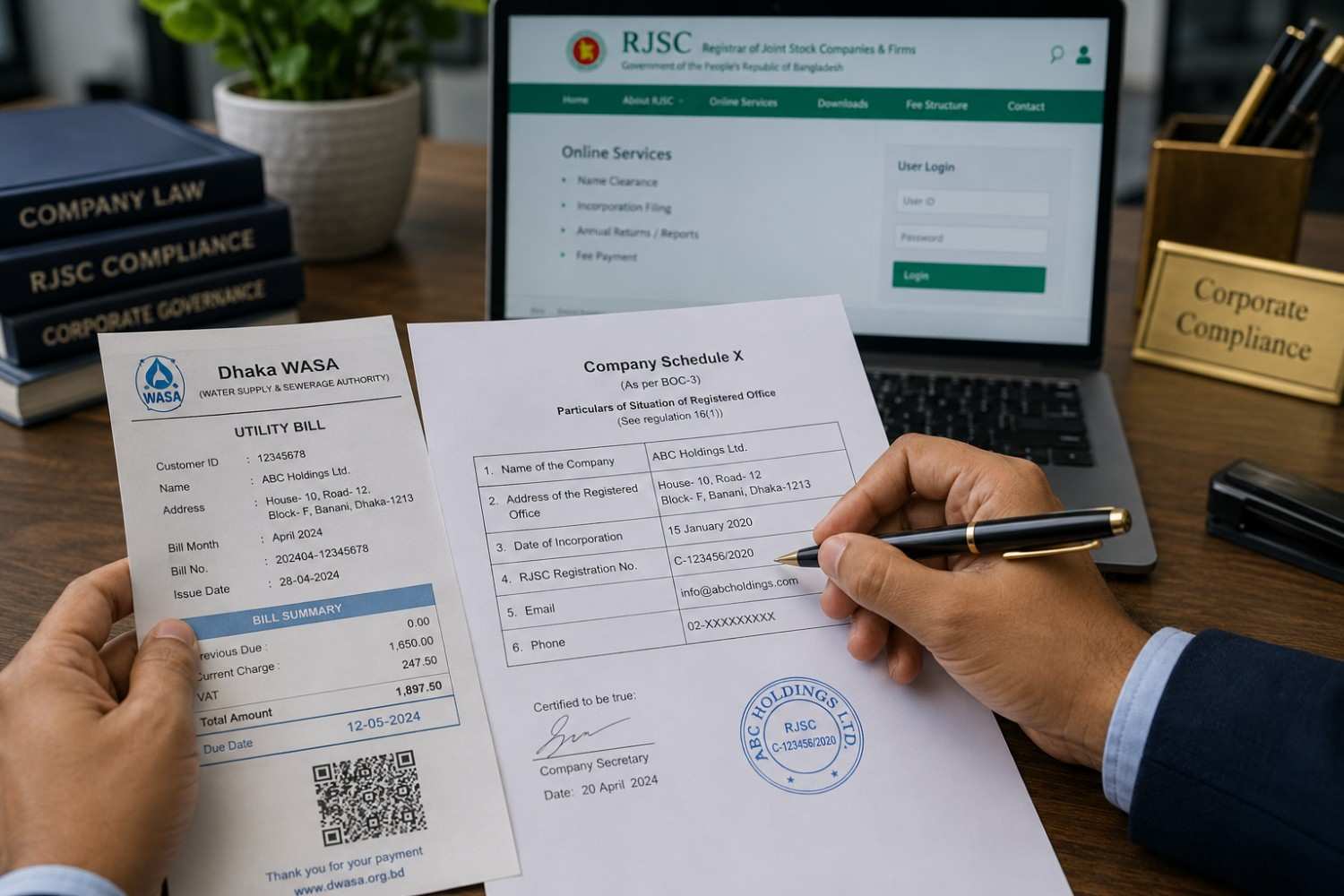
Branch Office Registration in Bangladesh
RJSC Company Share Transfer in Bangladesh documentation requirements
×
Enlarged View

Learning how to submit company schedule x in Bangladesh reveals that the portal demands specific digital signatures. Make sure all uploaded files are clear and match your financial statements. Adhering to the RJSC schedule x filing in Bangladesh correctly prevents common technical errors during the upload phase.

 Log in to the official RJSC web portal using your authorized credentials.

 Navigate to the annual return section to begin the Company schedule x submission in Bangladesh.

 Attach all required financial documents and verify the accuracy of the data entered.

 Submit the form electronically and keep a digital copy of the acknowledgment receipt.

Physical Filing Requirements

While digital methods are preferred, there are specific instances where you might need to understand how to file schedule x in Bangladesh through traditional channels.

If the online system encounters technical issues, or if your specific entity type requires additional verification, physical filing may be necessary. Understanding the Joint Stock Company Schedule X Submission in Bangladesh ensures you are prepared for any scenario.

When performing a Company Schedule X Filing at RJSC, ensure all physical copies are signed by authorized directors. Keep a stamped copy of your submission as proof of compliance. Mastering the RJSC annual return filing in Bangladesh processallows you to manage your corporate responsibilities with confidence and precision.

Managing Applicable Government Fees and Payments

Every company must settle specific government fees to finalize their RJSC annual return filing in Bangladesh. Proper management of these financial obligations is essential for a seamless compliance experience. By staying informed about the costs, you ensure that your business remains in good standing with the regulatory authorities.

Fee Structure for Annual Returns

The schedule x filing fees Bangladesh are determined by the authorized share capital of your company. These costs are mandatory and must be paid in full to avoid any delays in the processing of your documents. You should consult the official fee schedule to identify the exact amount applicable to your specific entity type.

The following table provides a general overview of how these fees are categorized based on capital thresholds. Please note that these figures are subject to periodic updates

Company CategoryCapital RangeApplicable Fee
Small Private LimitedUp to 5 Lakh BDTStandard Rate
Medium Private Limited5 Lakh to 50 Lakh BDTTiered Rate
Large/Public LimitedAbove 50 Lakh BDTMaximum Rate

Payment Methods and Verification

To complete your Company Schedule X Filing at RJSC in Bangladesh, you must utilize the approved payment channels provided by the government. Most users now prefer the online payment gateway, which offers immediate confirmation of your transaction. Alternatively, you may use traditional bank challans if the digital system is unavailable.

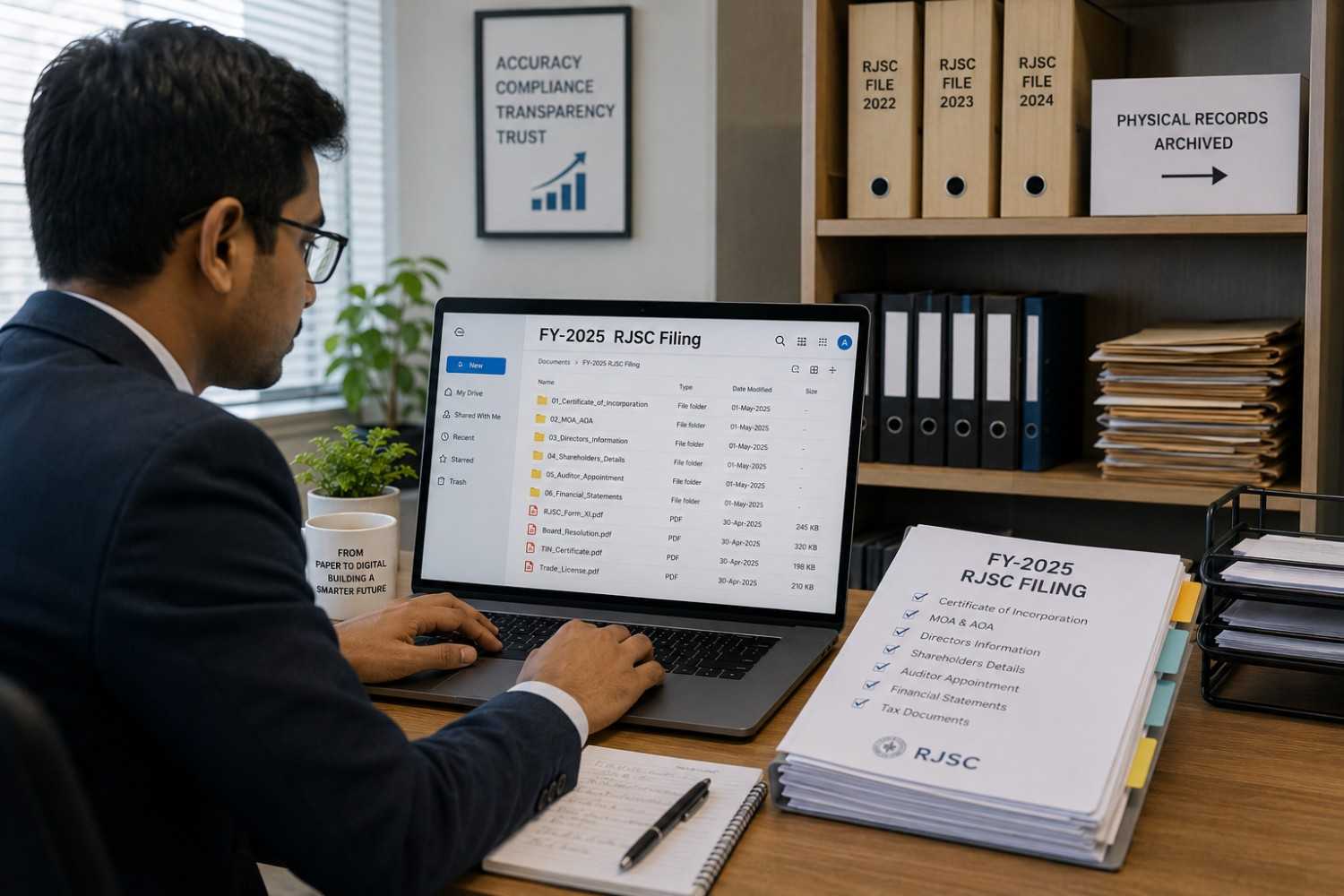
Branch Office Registration in Bangladesh
RJSC Company Share Transfer in Bangladesh documentation requirements
×
Enlarged View

Once you have initiated the payment, it is vital to verify that the funds have been successfully credited to the RJSC account. You can track your payment status through the online portal to ensure your RJSC annual return submission in Bangladesh is officially recorded. Keeping a digital or physical copy of your payment receipt is highly recommended for your internal audit records.

Following these steps ensures that your RJSC annual return filing process remains transparent and efficient. By proactively managing your financial requirements, you simplify the overall RJSC annual return submission in Bangladesh processand prevent unnecessary compliance hurdles.

Reviewing and Correcting Common Submission Errors

Even with meticulous preparation, errors can still occur in your annual return filings. It’s crucial to maintain the legal integrity of your business by ensuring the accuracy of all documents submitted to the Registrar of Joint Stock Companies and Firms (RJSC). Addressing these discrepancies promptly helps avoid future complications with your corporate status.

Identifying Frequent Filing Mistakes

Many companies face issues due to simple data entry errors or outdated information. Common mistakes include mismatched share capital figures, incorrect registered office addresses, or failing to update the list of directors after a board change. These small errors can trigger flags during verification, leading to unnecessary delays.

It’s vital to conduct a thorough internal audit of your records before and after submission. By comparing your internal ledger with the data provided to the RJSC, you can identify inconsistencies early. If discrepancies are found, initiating a schedule x correction Bangladesh process immediately is necessary to avoid penalties.

Procedures for Rectification and Amendments

When an error is identified, the first step is to prepare a formal application for rectification addressed to the RJSC. You must provide supporting evidence, such as board

resolutions or updated financial statements, to justify the requested changes. For complex filings involving significant capital restructuring, hiring a professional schedule x submission consultant Bangladesh is often the most efficient path forward.

A qualified consultant understands the nuances of local corporate law and can navigate the digital portal to ensure your amendments are processed correctly. They help you avoid common pitfalls that lead to rejected applications. The following table outlines how to handle typical filing discrepancies effectively.

Error TypePotential ImpactRecommended Action
Incorrect Share CapitalCompliance violationSubmit revised Form 117 / Schedule X
Outdated Office AddressNotice delivery failureFile Form XII for address change
Director Data MismatchLegal identity issuesUpdate via Form XII and Schedule X
Missing Financial DataIncomplete filing statusResubmit with audited statements

Taking these steps ensures your company remains in good standing. Always keep copies of your rectification requests and any correspondence with the RJSC for your permanent records. Proactive management of your filings is the best way to ensure long-term success in the Bangladeshi market.

Obtaining and Verifying Proof of Submission

Getting formal proof of your RJSC schedule x submission in Bangladesh is crucial for a transparent corporate image. After the Registrar of Joint Stock Companies and Firms (RJSC) processes your filing, you need official proof. This proof is your main evidence of following the rules.

Downloading the Certified Copy

Once your payment and filing are confirmed, you can get your documents from the portal. Go to your company dashboard and find your filing history. Look for the Company annual return submission Bangladeshrecord to download the certified copy. This ensures you have a digital copy of your submission.

If the system shows your filing as pending, wait for the official notice before downloading. Once it’s approved, the certified copy will be ready for you. Make sure the document has the RJSC seal and the correct filing date for your RJSC annual return filing in Bangladesh.

Maintaining Records for Audit Purposes

Keeping your filings organized shows your dedication to corporate transparency. Store both digital and physical copies in a safe place. This protects your company during audits or unexpected government checks.

Organizing your documents helps track your compliance history. It makes it easier for your accountants and legal team. Use the table below to see why keeping certain documents is important for your business.

Document TypeRetention PeriodPrimary Purpose
Certified Schedule XPermanentProof of Compliance
Payment Receipts7 YearsFinancial Audit
Board ResolutionsPermanentCorporate Governance
Annual Return Filing10 YearsRegulatory Review

Navigating the Consequences of Late or Non-Submission

Missing your annual return deadlines can lead to immediate financial and legal issues. Keeping your company compliant in Bangladesh is not optional; it’s a must. It shields your business from unwanted regulatory attention. Failure to meet these standards puts your organization at risk of significant operational challenges.

Penalties and Fines for Non-Compliance

The Registrar of Joint Stock Companies and Firms (RJSC) has strict rules for Company schedule x submission in Bangladesh. If you miss the deadline, you’ll face daily fines that grow over time. These penalties can quickly add up, putting an unnecessary financial strain on your business.

Branch Office Registration in Bangladesh
RJSC Company Share Transfer in Bangladesh documentation requirements
×
Enlarged View

Whether your company is a private limited company annual return in Bangladesh or a public limited company annual return in Bangladesh, the penalties are harsh. The only way to avoid these costs is through consistent RJSC compliance filing in Bangladesh. Ignoring these duties can lead to a cycle of debt, hindering your company’s growth and financial stability.

Legal Implications for Directors

RJSC late filing in Bangladesh can also have severe legal repercussions for directors. Authorities can start legal actions against directors who don’t file on time. This could mean court appearances, damaged professional reputations, and even being barred from future directorships.

It’s crucial to understand that RJSC company compliance in Bangladesh is a non-negotiable duty. Ignoring these responsibilities affects not just the company but also your personal standing as a director. Ensuring timely filings keeps you in good standing with the government and safeguards your business’s long-term interests.

Best Practices for Maintaining Ongoing RJSC Compliance

Proactive corporate governance shields your business from legal pitfalls. Create a dedicated internal calendar to monitor all regulatory deadlines. This habit keeps you in sync with Bangladesh’s submission guidelines all year.

Effective record-keeping is crucial for your operations. You must keep organized digital and physical files for all documents submitted to the Registrar of Joint Stock Companies and Firms. By following these best practices, you create a clear audit trail for your stakeholders.

Many business owners opt for a professional company annual compliance service in Bangladesh to simplify these tasks. Expert support guides you through complex requirements, allowing you to focus on growth strategies. Reliable help ensures your RJSC compliance filing in Bangladesh is precise and flawless.

Consistent attention to detail enhances your reputation with regulatory bodies. Prioritizing RJSC company compliance in Bangladesh shows your dedication to transparency and operational excellence. Mastering the details of company compliance in Bangladesh lays the groundwork for long-term success.

FAQ

What exactly is a Schedule X submission in Bangladesh?

In Bangladesh, a Schedule X submission is the mandatory filing of your company’s annual return with the Registrar of Joint Stock Companies and Firms (RJSC). This form provides a snapshot of your company’s structure. It includes details of directors, shareholders, and capital as of your Annual General Meeting (AGM).

Which businesses entities are required to perform an RJSC annual return submission Bangladesh?

The Companies Act, 1994, mandates compliance for all registered entities. This includes both private and public limited companies. Ensuring RJSC company compliance is crucial for legal standing.

What is the typical company submission timeline for these filings?

Your submission dates for company schedule x are tied to your AGM. Private companies have 30 days, while public companies have 21 days. Staying on track is key to avoid penalties.

Can you provide a schedule x submission checklist for preparation?

To streamline the RJSC annual return filing, prepare essential documents. These include a shareholder list, updated share capital information, AGM minutes, and director details. Being prepared prevents delays.

How to submit schedule x in Bangladesh using the digital portal?

The process is mainly through the RJSC online filing system. Log in, enter your data, upload files, and pay fees online. This ensures a smooth filing process.

What are the current RJSC annual return filing fees Bangladesh?

Fees are based on your company’s authorized capital. The portal will calculate the fee. Verify your payment to confirm compliance.

What are the consequences of an RJSC late filing Bangladesh?

Late filing incurs daily fines and legal risks. It can also label your company as a “defaulter,” limiting future changes and document access.

Is it possible to perform a schedule x correction Bangladesh after the return is filed?

Errors can be corrected with specific procedures. Submit a formal application for rectification. Many use a consultant to avoid errors.

Why should I use a professional company annual compliance service Bangladesh?

Professional services ensure compliance without errors. Experts handle filings, keeping information accurate and on time. This protects your business from legal risks.

What are the best practices for company schedule x submission in Bangladesh?

Maintain organized records, hold AGMs promptly, and verify details regularly. Consistent filings build trust and transparency with regulators and stakeholders.

Expanding into a new market demands meticulous planning and strict adherence to local laws. Navigating the legal landscape is crucial for any foreign entity aiming to establish a permanent presence to establish Branch Office Registration in Bangladesh. It’s essential to ensure all documents meet specific government standards to avoid future complications.

Understanding how to register a branch office in Bangladesh is the first step toward operational success. This process involves multiple regulatory layers that demand precision and patience. By following a structured approach, you can secure your firm’s future within this growing economy.

Branch Office Registration in Bangladesh
RJSC Company Share Transfer in Bangladesh documentation requirements
×
Enlarged View

The RJSC Branch Office Registration in Bangladesh serves as the cornerstone of your legal setup. Working with the Registrar of Joint Stock Companies ensures your business remains fully Whether you are just beginning your journey or refining your strategy, this guide provides the clarity you need. We will walk you through the essential steps for Branch Office Registration in Bangladesh to help you thrive. Let us help you navigate these complexities with ease.

Key Takeaways

  1. Identify the specific legal requirements for foreign entities entering the local market.
  2. Prepare all necessary documentation to satisfy government regulatory bodies.
  3. Engage with the RJSC early to streamline your approval timeline.
  4. Maintain strict compliance to ensure long-term operational stability.
  5. Follow a professional roadmap to mitigate risks during the setup phase.

Understanding the Concept of a Branch Office in Bangladesh

Embarking on a branch office setup in Bangladesh requires a clear understanding of its role. A branch office acts as an extension of your foreign parent company, enabling you to operate locally. It’s perfect for businesses aiming to trade, manufacture, or offer services while keeping a unified brand identity.

Defining the Legal Status of a Branch Office

Choosing Branch Office Registration in Bangladesh means establishing a legal entity that’s not separate from your parent company. The parent company bears full responsibility for the branch’s actions, debts, and obligations. This legal continuity ensures your global brand’s reputation is linked to your local operations.

The branch must operate under the same name and goals as the parent firm. Adhering to local laws during the registration process is crucial. This ensures your activities align with the parent company’s objectives. It also grants you the authority to sign contracts and conduct business transactions directly.

Distinguishing between Branch Office registration in Bangladesh and Liaison Office Registration in Bangladesh

Understanding the differences between branch offices and liaison offices is essential during your Branch office formation in Bangladesh or Liaison office registration in Bangladesh. Both are foreign-owned, but their roles are distinct. A branch office can earn revenue and engage in full-scale commercial activities. In contrast, a liaison office is limited to promotional and communication roles.

Liaison offices cannot generate income or engage in direct sales. If your business aims to trade or provide services actively, a branch office is the better choice. The table below outlines the main differences to aid in your decision-making process.

FeatureBranch OfficeLiaison Office
Commercial ActivityPermittedProhibited
Revenue GenerationAllowedNot Allowed
Primary PurposeBusiness OperationsMarket Research / Liaison
Legal LiabilityParent CompanyParent Company

Eligibility Criteria for Foreign Companies

Foreign companies aiming to enter Bangladesh face strict eligibility criteria. It’s crucial to ensure your organization meets the local authorities’ standards before starting.

Branch Office Registration in Bangladesh
RJSC Company Share Transfer in Bangladesh documentation requirements
×
Enlarged View

Understanding these rules early can save you a lot of time and money.

Requirements for Parent Company Standing

To register a foreign branch office registration in Bangladesh, your parent company must have a solid reputation. You need to provide legal existence proof from your home country, usually through certified incorporation documents. This confirms your company’s legitimacy globally.

Regulatory bodies seek evidence of a stable history. A multinational company branch office in Bangladesh must show it has been active and compliant. This verification ensures your firm is ready for cross-border operations.

Financial and Operational Prerequisites

Your company must also meet financial criteria to support local activities. Every foreign investor branch office in Bangladesh must prove it has enough capital for operations. This financial stability is crucial for the foreign company branch registration in Bangladesh process.

You must also define your business intent and operational scope clearly. Whether for service delivery or project management, your goals must fit the allowed activities for a foreign company branch office registration in Bangladesh. Following these branch office registration requirements keeps your application in line with national investment policies.

The following table outlines the core benchmarks for your Foreign Company Registration in Bangladesh:

Requirement CategoryPrimary FocusDocumentation Needed
Legal StandingCorporate HistoryCertificate of Incorporation
Financial HealthCapital AdequacyAudited Financial Statements
Operational IntentBusiness ScopeBoard Resolution / Work Plan
Compliance StatusRegulatory HistoryGood Standing Certificate

Securing Approval from the Bangladesh Investment Development Authority

Your journey toward establishing a legal presence in Bangladesh starts with securing approval from the Bangladesh Investment Development Authority (BIDA). This government agency is the primary gateway for international firms entering the local market. Obtaining BIDA branch office approval Bangladesh is crucial. It validates your intent to operate within the country’s regulatory framework.

Navigating the BIDA Portal

The modern application process is streamlined through the official BIDA online portal. You must register your company profile on this platform to initiate the formal request for your branch office. Efficiency is key when managing your digital submission. The system requires precise data entry and document uploads.

  • Create a secure user account on the BIDA portal.
  • Complete the online application form with accurate parent company details.
  • Upload all required statutory documents in the specified digital formats.
  • Monitor the status of your BIDA registration for branch office through the dashboard.

Understanding the Role of BIDA in Foreign Investment

BIDA acts as the principal investment promotion agency, tasked with facilitating and regulating foreign business activities. By providing BIDA permission for branch office operations, the authority ensures your business aligns with national economic policies and legal standards. They play a pivotal role in creating a transparent environment for international investors.

Branch Office Registration in Bangladesh
RJSC Company Share Transfer in Bangladesh documentation requirements
×
Enlarged View

Beyond simple approval, BIDA provides ongoing support to help foreign entities navigate the complexities of the local business landscape. Engaging with their guidelines early on will significantly reduce potential delays. Compliance with BIDA regulations is the foundation upon which you will build your long-term operational success in Bangladesh.

Selecting and Reserving Your Branch Office Name

Choosing a unique name is crucial for expanding into the Bangladeshi market. Adhering to the RJSC branch office registration guidelines ensures your name meets local legal standards. This step avoids delays and safeguards your brand’s reputation from the outset.

Guidelines for Name Selection

Ensure your name is distinct from existing entities in the country. The Registrar of Joint Stock Companies and Firms (RJSC) requires names to be unique and not misleading. Choosing a name that reflects your parent company’s identity while adhering to local rules is key for approval.

Steer clear of prohibited words or terms suggesting government ties without proper authorization. Your name should be clear, professional, and recognizable to local audiences. Following these guidelines minimizes the chance of name rejection during the initial review.

Executing the RJSC Name Clearance Process

After deciding on a name, start the RJSC name clearance for branch office registration process on the official online portal. This confirms your name’s availability and reserves it for a period. You’ll need to submit your application online and pay the necessary fees to proceed.

The authorities will assess your application to ensure it complies with all regulations. Upon approval, you’ll receive a Name Clearance Certificate. This document is essential for your registration filings. It proves your name has been vetted and approved by the government.

Preparing Essential Corporate Documentation

Starting a branch office in Bangladesh requires careful document preparation. You must meet the Branch office registration in Bangladesh requirements by providing accurate, verified records. It’s crucial to have all branch office registration documents in Bangladeshready to avoid delays in approval.

Gathering Parent Company Statutory Documents

Your application’s success hinges on your head office’s official records. You’ll need to gather the parent company documents in Bangladesh. This includes the Certificate of Incorporation, Memorandum of Association, and Articles of Association.

Branch Office Registration in Bangladesh
RJSC Company Share Transfer in Bangladesh documentation requirements
×
Enlarged View

These documents must be up-to-date, showing your company’s current status. Accuracy is crucial. Any mismatch can cause your application to be rejected by the authorities.

Legalization and Attestation Requirements for Foreign Documents

Since your company is from abroad, you must deal with foreign document legalization in Bangladesh. This makes your international documents valid for local authorities.

You’ll need to get foreign document attestation in Bangladesh from the embassy or consulate. This step confirms the authenticity of your branch office corporate documents in Bangladesh. Adhering to these steps ensures a strong, professional application.

Drafting the Parent Company Board Resolution

A formal board resolution is the cornerstone for entering the Bangladeshi market. It acts as a legally binding declaration that your parent company has approved a local presence. Drafting a precise branch office board resolution Bangladeshshows clear corporate intent and governance to local authorities.

Key Clauses to Include in the Resolution

Your resolution must have specific, clear language to pass regulatory scrutiny. It should state the decision to open a branch, its location, and business activities. A clause authorizing a representative to sign documents is crucial.

The resolution must also detail the parent company’s financial commitment to the branch. Including these critical clauses ensures your branch office board resolution Bangladesh.

Formalizing the Decision to Establish a Branch

Formalizing your decision requires strict adherence to your company’s bylaws and international standards. After the board passes the resolution, it must be signed, sealed, and notarized. This step is crucial for establishing legitimacy with local regulators.

By maintaining a well-documented branch office board resolution Bangladesh, you provide evidence of corporate authorization. This documentation is key for regulatory filings and long-term compliance. Professional attention to detail will help streamline your registration process.

Submitting the Application for Branch Office Approval

Entering the local market is a significant step for any foreign entity. Once your documents are ready, you must start the formal branch office registration process Bangladesh. This ensures your application reaches the right authorities correctly. It’s crucial to be precise to avoid delays in starting your operations.

Document Submission Protocols

The branch office registration procedure Bangladesh involves uploading your documents online through the BIDA portal. It’s vital to have clear, readable digital copies that match your physical records. Accuracy is crucial here, as any mistakes can cause your application to be rejected.

After submitting online, you might need to send physical copies to the BIDA office. Keeping a detailed checklist of your uploaded documents is essential. This approach helps maintain a professional image with government agencies.

Managing Communication with Regulatory Authorities

To successfully navigate the branch office application process Bangladesh, engaging with regulatory officials is key. Regularly check your application’s status online and respond quickly to any queries. Clear and timely communication can speed up the approval process.

Branch Office Registration in Bangladesh
RJSC Company Share Transfer in Bangladesh documentation requirements
×
Enlarged View

If you’re asked for more information or corrections, respond promptly and accurately. Having a dedicated contact within your team can make these interactions smoother. Below is a table detailing the submission and communication stages.

Submission StagePrimary ActionExpected Outcome
Initial FilingUpload documents to BIDA portalApplication acknowledgment
Review PhaseMonitor status updatesRequest for information
Final ApprovalReceive official notificationIssuance of approval letter

Executing the RJSC Branch Office Registration

The journey from BIDA approval to a fully operational branch office requires completing the RJSC filing requirements. This phase is crucial for establishing your legal presence in the country. It’s essential to ensure all documentation meets the approved investment parameters.

Filing Procedures with the Registrar of Joint Stock Companies and Firms

To start the RJSC branch office registration process, access the official online portal of the Registrar of Joint Stock Companies and Firms (RJSC). You’ll need to upload the BIDA approval letter and certified copies of your parent company’s constitutional documents. Accuracy is paramount during this digital submission to avoid unnecessary delays or rejection of your application.

After uploading the documents, the registrar will review them thoroughly. You might need to provide additional clarifications or notarized translations if your original documents are not in English. Once verified, the registrar will issue the formal registration certificate. This certificate is your primary legal proof of existence in Bangladesh.

Understanding Registration Fees and Timelines

Understanding the RJSC branch office registration procedure Bangladesh requires knowledge of the financial obligations. The government sets specific branch office registration fees based on the authorized capital of the parent company. Prepare these payments through the designated banking channels to ensure your application progresses smoothly.

The time to receive your branch office registration certificate Bangladesh is usually two to four weeks. Proactive management of your application status through the online portal can help anticipate any potential bottlenecks. By staying organized, you ensure your operational launch remains on schedule and fully compliant with local regulations.

Obtaining a Trade License for Your Operations

Getting a branch office trade license in Bangladesh is crucial for your business. It’s the key to legally operate in a specific area. Without it, you could face legal issues or fines from local authorities.

Local Government Requirements

The process for a branch office license Bangladesh is handled by your local City Corporation or Municipality. You must apply to the ward office to meet local zoning and business rules. Each area has its own rules, so check what your local office needs.

Local authorities check your business location and the legitimacy of your foreign company. You’ll need to show proof of your office, like a rental agreement. Keeping in touch with the trade license office helps speed up the process and keeps your business compliant.

Documentation Needed for Trade License Issuance

To get your branch office trade license in Bangladesh, you need a lot of documents. Having them ready can avoid delays. Make sure all documents are clear and, if needed, verified by the right people.

Here’s what you’ll need for your application:

  • RJSC Registration Certificate: Proof of your branch office setup.
  • BIDA Approval Letter: The go-ahead for your foreign branch.
  • Rental Agreement: A notarized copy of your lease or property papers.
  • TIN Certificate: Your Tax Identification Number from the National Board of Revenue.
  • Company Board Resolution: A formal document for the trade license application.

After submitting these documents, the local authority will check your premises. If everything checks out and you pay the fees, you’ll get your license. Remember, you need to renew it every year to keep your business legal.

Securing TIN and VAT Registration

Getting the right tax documents is key for a business in Bangladesh. Every foreign company must follow the National Board of Revenue (NBR) rules to stay legal. Registering your branch office tax registration Bangladesh is crucial to avoid fines and keep operations smooth.

Applying for a Tax Identification Number

Getting a Tax Identification Number (TIN) is your first tax step. This number is vital for all financial dealings, like paying employees and banking. You can apply for the tin registration for branch office Bangladesh online through the NBR portal. This makes it easier for foreign investors.

Branch Office Registration in Bangladesh
RJSC Company Share Transfer in Bangladesh documentation requirements
×
Enlarged View

To apply smoothly, you need certain documents:

  • Certified copy of the BIDA approval letter.
  • Proof of office address in Bangladesh.
  • Authorized signatory details and passport copies.
  • Certificate of Incorporation from the parent company.

Navigating Value Added Tax Compliance

After getting your TIN, you must handle Value Added Tax (VAT) duties. If your branch sells taxable goods or services, you need vat registration for branch office Bangladesh. This involves getting a Business Identification Number (BIN) through the VAT online system.

Effective compliance means keeping detailed records of sales and purchases. You must file VAT returns on time to report your business to the authorities. Being diligent with these filings helps your branch office gain a strong reputation with local regulators and ensures stability in the long run.

Opening a Corporate Bank Account

Setting up a financial base is crucial for your new branch office in Bangladesh. You need a corporate account to manage daily transactions and capital inflows. This step ensures compliance with local laws and keeps operations smooth.

Selecting an Authorized Dealer Bank

Choosing a bank account for branch office Bangladesh means picking an Authorized Dealer (AD) bank. These banks have licenses from the Bangladesh Bank for foreign exchange transactions. It’s highly recommended to work with a bank that’s experienced in supporting foreign businesses.

An experienced AD bank knows the intricacies of international transfers and local reporting. They connect your operations with the central bank, ensuring legal capital remittances. Picking the right bank early saves time and effort.

Required Documentation for Account Opening

To open a bank account for branch office Bangladesh, you need detailed corporate documents. Banks ask for verified copies of your BIDA approval and RJSC registration certificate. These prove your branch’s legal status in the country.

You’ll also need to provide:

  1. A certified copy of the parent company’s Board Resolution for account opening.
  2. Valid identification for all authorized signatories, like passports or national IDs.
  3. The company’s Memorandum and Articles of Association, attested by authorities.
  4. A formal letter of introduction or mandate from the parent company’s head office.

Make sure all foreign documents are legalized or apostilled before submitting. Properly organized paperwork speeds up approval and lets you start financial operations without delay.

Completing Additional Regulatory Registrations

Setting up a branch office in Bangladesh goes beyond basic corporate registration. To ensure a fully compliant workplace, you must tackle various secondary regulatory requirements. These steps are crucial for aligning your business operations with local safety and environmental standards.

Not obtaining these permits can cause operational delays or legal issues. By addressing these needs proactively, you show your commitment to responsible business practices in the country.

Fire License and Environmental Clearance

Obtaining a fire safety certificate from the Fire Service and Civil Defence (FSCD) is a critical step. This license verifies that your office meets essential fire safety standards. You’ll need to provide a detailed floor plan and undergo a facility inspection.

Moreover, you might need an Environmental Clearance Certificate (ECC) from the Department of Environment, depending on your activities. This ensures your office doesn’t harm the local ecosystem. You must classify your business based on environmental risk to know the necessary documentation for clearance.

Industry-Specific Permits and Licenses

Your branch office may require specific authorizations based on your industry. For example, telecommunications businesses need permits from the Bangladesh Telecommunication Regulatory Commission (BTRC). Pharmaceutical or food-related businesses require clearances from the Directorate General of Drug Administration or the Bangladesh Food Safety Authority.

It’s highly recommended to consult with local legal experts to find all relevant permits for your industry. Keeping a detailed list of these registrations is crucial for avoiding renewal issues. Staying organized is a key factor for long-term success in Bangladesh.

Maintaining Ongoing Reporting and Compliance Requirements

Once your office is up and running, the focus shifts to ongoing administrative upkeep. Consistent adherence to local laws is crucial for a stable business presence. Prioritizing branch office compliance Bangladesh is essential to avoid penalties and keep operations smooth.

Annual Return Filing Obligations

Every foreign entity must meet specific filing duties to stay compliant. The branch office annual return filing in Bangladesh is a must, providing the government with updated financial and operational data. You must prepare and submit the RJSC annual return for branch office on time, as per the Registrar of Joint Stock Companies and Firms.

Missing these deadlines can result in hefty fines or legal issues. Keeping accurate financial records throughout the year is crucial. This makes fulfilling your annual obligations easier.

Reporting Changes to BIDA and RJSC

Your business structure may change, and you must inform the relevant authorities. Following branch office reporting requirements Bangladesh keeps your registration up to date. Whether it’s a change in address or authorized representative, timely notification is key.

Moreover, monitoring your BIDA branch office renewal Bangladesh status is vital to keep your investment permission valid. Regular branch office renewal in Bangladesh cycles are essential for maintaining your legal right to operate. Use the table below to track your primary compliance deadlines and requirements.

RequirementRegulatory BodyFrequencyKey Action
Annual ReturnRJSCAnnuallyFile Financial Statements
BIDA RenewalBIDAEvery 3–5 YearsSubmit Renewal Application
Change of AddressRJSC & BIDAAs NeededUpdate Statutory Records
Tax FilingsNBRAnnuallySubmit Income Tax Return

Navigating the Branch Office Registration in Bangladesh Process Successfully

Mastering the branch office registration process in Bangladesh can lead to a seamless market entry. Navigating the branch office registration in Bangladesh demands meticulous planning and a focus on every detail. This is crucial for a successful expansion.

Understanding the regulatory needs and administrative milestones helps you sidestep common delays. Preparation is the cornerstone of your success when interacting with local authorities and government portals.

Key milestones are essential for keeping your business on track. These steps form the foundation of your operations in the local market.

Milestone PhasePrimary ObjectiveKey Authority
Initial ApprovalBIDA ClearanceBIDA
Legal IncorporationRJSC RegistrationRJSC
Operational SetupTax and LicensingNBR / Local City Corporation

A proactive approach to documentation can greatly simplify the branch office registration process. Ensure your parent company records are fully legalized and prepared for submission. This avoids unnecessary delays with regulators.

Remember, Branch office registration in Bangladesh is just the beginning of your compliance journey. Being organized from the start provides the stability needed to focus on your business goals in this dynamic economy.

Ensuring Long-Term Operational Success and Regulatory Adherence

Setting up in the local market demands a steadfast commitment to ongoing compliance. Your ability to adjust to changing business laws is crucial for your venture’s longevity. Professional branch office registration services offer the necessary oversight to ensure your operations meet national standards.

Branch Office Registration in Bangladesh
RJSC Company Share Transfer in Bangladesh documentation requirements
×
Enlarged View

Partnering with a qualified branch office registration consultant in Bangladesh can help manage your ongoing obligations. Expert advice simplifies the complex

requirements that emerge after your initial setup. Reliable legal services for Branch Office Registration in Bangladesh safeguard your interests against the ever-changing regulatory landscape.

Choosing a reputable branch office registration service in Bangladesh allows your team to concentrate on core business growth. Many businesses find that professional company registration services in Bangladesh pave the way for sustainable profitability. A dedicated foreign company registration consultant in Bangladesh ensures

accurate and timely annual filings.

Focus on your long-term objectives by maintaining open communication with the Bangladesh Investment Development Authority and the Registrar of Joint Stock

Companies and Firms. Consistent attention to detail regarding Branch Office Registration in Bangladesh secures your corporate status. Contact industry experts today to strengthen your operational base in this burgeoning economy.

FAQ

What is the primary difference between a branch office and a liaison office for a foreign company branch office Bangladesh?

The key difference is in their activities. A branch office setup in Bangladesh lets your Multinational Company Branch Office Bangladesh do business and earn local income. On the other hand, a liaison office can’t make profits and is only for communication or marketing. Knowing this is crucial for your branch office formation Bangladesh plans.

How do you initiate the branch office registration process in Bangladesh?

To register branch office in Bangladesh, first get BIDA permission for branch office work. After BIDA approves, register with the RJSC branch office registration process to officially set up the entity.

What are the core branch office registration requirements Bangladesh for a parent company?

Your parent company needs to show financial health and a strong track record. The branch office registration documents Bangladesh include audited financials, the parent company’s charter, and a branch office board resolution Bangladesh for setup. These parent company documents Bangladesh must be legalized and attested locally.

Is RJSC name clearance for branch office mandatory?

Yes, getting a unique name is crucial for branch office registration guidelines. You must get RJSC name clearance for branch office to ensure your name is unique and follows local rules. This step is essential for your foreign company branch registration Bangladesh.

What are the current branch office registration fees and timelines?

The branch office registration fees depend on BIDA and RJSC’s costs. The RJSC branch office registration procedure takes weeks, based on your branch office corporate documents Bangladesh and regulatory responses.

Does a foreign branch office registration Bangladesh require a local trade license?

Yes, you need a branch office trade license Bangladesh from local authorities to operate legally. This license is key for your branch office registration process Bangladesh and must be renewed yearly.

How do you manage tax and VAT registration for a branch office?

After getting your branch office registration certificate Bangladesh, register for a Tax Identification Number. Also, handle vat registration for branch office Bangladesh with the National Board of Revenue for tax compliance.

Can you open a bank account for the branch office Bangladesh without a local director?

Yes, foreign entities can open a bank account for branch office Bangladesh. Choose an authorized dealer bank and provide your BIDA approval, RJSC registration, and branch office board resolution Bangladesh. This account is vital for managing funds and remittances.

What are the ongoing branch office reporting requirements Bangladesh?

To keep branch office compliance Bangladesh, fulfill branch office annual return Bangladesh duties. This includes filing an RJSC annual return for branch office and ensuring branch office renewal Bangladesh or BIDA branch office renewal Bangladesh. These branch office reporting requirements Bangladesh keep your business in good standing.

Why should you consider using a branch office registration consultant Bangladesh?

The branch office registration procedure Bangladesh is complex for foreign investor branch office Bangladesh. Using a branch office registration service Bangladesh or foreign company registration consultant Bangladesh offers legal expertise. Professional Company Registration services Bangladesh help to avoid delays and ensure accurate handling of the branch office application process Bangladesh.

Expanding your business into new markets can be a game-changer. To set up a legal entity, grasping the local laws is crucial for success. The journey to enter a market demands a clear plan to meet all legal requirements and setup a RJSC Foreign company Registration in Bangladesh to start smooth business.

The RJSC oversees the process, enabling you to own your business fully. By adhering to legal protocols, you can establish an enterprise with complete control. This guide demystifies the complex steps to build a strong professional presence to establish Joint Stock Foreign Company Registration in Bangladesh.

Whether you seek 100% equity or a partnership, knowing the necessary documents is key. We offer the knowledge you need to proceed with confidence and clarity.

Branch Office Registration in Bangladesh
RJSC Company Share Transfer in Bangladesh documentation requirements
×
Enlarged View

The RJSC acts as the primary authority overseeing all corporate incorporations. By following their structured path, you ensure your firm remains compliant with local laws, How to Register Foreign Company Registration in Bangladeshwithout unnecessary stress. The Registrar of the Joint Stock companies and Firms (RJSC), is the only legal authority in Bangladesh for Company Registration in Bangladesh.

The RJSC gives approval or registration of Foreign Company Registration at RJSC and issues different business incorporation certificate, as like  Company’s Annual Return Filling/ Company Schedule X Submission in Bangladesh, Trade Organization Registration in Bangladesh, Company Share Transfer in Bangladesh, Company Share Allotment/Increase, Company Winding up in Bangladesh, One Person Company (OPC) Registration Bangladesh Partnership Firm Registration in Bangladesh, Branch Office Registration in Bangladesh, Society Registration in Bangladesh, Liaison Office/ Representative Office Registration in Bangladesh, Certified Copy issue, and many more.

Key Takeaways

  1. Achieve 100% ownership of your business entity.
  2. Understand the role of the RJSC in legalizing your operations.
  3. Follow a structured roadmap to ensure regulatory compliance.
  4. Identify the core documentation required for successful filing.
  5. Gain professional insights to navigate the local market landscape.

Understanding Foreign Company Registration in Bangladesh

Planning to expand your operations? Your first step is to understand the rules for How to Register Foreign Company Registration in Bangladesh. Navigating the local corporate landscape demands a clear grasp of the statutory obligations for international entities. Proper preparation ensures your venture remains compliant from the start.

Defining the Legal Framework for Foreign Entities

The Companies Act of 1994 is the primary legislation governing corporate activities. It provides the structure for international firm incorporation, ensuring foreign investors operate under a transparent, regulated system. Adhering to these guidelines is crucial to maintain legal standing in the country.

The legal framework aims to protect both the investor and the local economy. It outlines procedures for filing documents and maintaining corporate records. Following these rules is essential for any business registration in Bangladesh for foreigners seeking long-term stability.

Benefits of Establishing a Presence in the Bangladeshi Market

Bangladesh offers a dynamic environment for global companies looking to scale. It boasts a massive, growing consumer base open to international brands. Additionally, the competitive labor costs significantly optimize operational expenses.

Beyond cost efficiency, Bangladesh’s strategic location serves as a gateway to broader regional trade. Engaging in international firm incorporation here taps into emerging sectors ripe for innovation. The table below highlights why many investors choose this market for expansion.

Strategic FactorMarket AdvantageImpact on Growth
Consumer BaseLarge, young populationHigh demand potential
Labor CostsHighly competitive ratesImproved profit margins
Regulatory EaseClear legal frameworkReduced operational risk
Regional AccessGateway to South AsiaExpanded trade reach

Successfully completing your Foreign Company Registration in Bangladesh is more than a legal requirement. It’s a strategic move positioning your brand for sustainable success. By prioritizing business registration in Bangladesh for foreigners, you unlock the full potential of this vibrant economy.

Eligibility Criteria for 100% Foreign Equity Ownership

Understanding the criteria for 100% foreign equity ownership is crucial for success in Bangladesh. When registering a business, ensure it meets national investment policies. A 100% equity foreign company registration in Bangladesh status offers full control and strategic freedom.

The government encourages foreign direct investment Bangladesh to spur economic growth and technological progress. Meeting these standards positions your venture for success in a competitive market. Proper planning is key to a successful 100% owned foreign company registration in Bangladesh.

Sectors Open to Full Foreign Investment

Most industrial sectors in Bangladesh welcome foreign investment without a local partner. This openness allows for a fully foreign owned company Bangladesh to operate in various high-growth industries. Manufacturing, software development, and renewable energy are particularly attractive to international investors.

The following table outlines key sectors where you can maintain full ownership:

Sector CategoryInvestment PotentialRegulatory Status
Information TechnologyHighFully Open
Textile & ApparelHighFully Open
Renewable EnergyModerateFully Open

Restrictions and Prohibited Industries for Foreigners

While the market is largely open, specific limitations exist for foreign owned company registration in Bangladesh. Certain industries are reserved for the state or require special clearance. Engaging in foreign investment company registration Bangladesh requires verifying your business activity does not fall under these restrictions.

Branch Office Registration in Bangladesh
RJSC Company Share Transfer in Bangladesh documentation requirements
×
Enlarged View

Industries like defense production, nuclear energy, and forest plantations are off-limits for private foreign entities. Always consult with legal experts to confirm if your business requires a joint venture or special permits. Compliance with these boundaries ensures your operations remain secure and legally sound in Bangladesh.

Selecting the Optimal Business Structure for Your Venture

Your journey to international firm incorporation starts with picking a legal structure that matches your long-term goals. The right choice is crucial for your foreign business registration Bangladesh journey. It affects your tax obligations, operational scope, and flexibility in the local market.

Comparing Private Limited Companies vs. Branch Offices

Choosing a fully overseas owned foreign company registration in Bangladesh status often means deciding between a private limited company and a branch office. A private limited company is a separate legal entity, perfect for those aiming for subsidiary company registration Bangladesh. It enables full commercial activities and easy profit repatriation.

A branch office, on the other hand, is an extension of your parent company. It allows commercial operations but lacks the legal separation of a subsidiary. You must consider the tax liability and administrative needs of each before deciding.

Evaluating Liaison Office Options

If your goal is market research or communication, not direct sales, a liaison office might be best. This structure is for coordinating activities between your parent company and local entities. It cannot generate income or engage in commercial transactions.

Opting for a liaison office simplifies your initial setup but limits your ability to scale operations later. Many firms start with a liaison office to test the market before moving to a full subsidiary. The table below highlights the main differences between these structures:

FeaturePrivate Limited CompanyBranch OfficeLiaison Office
Legal StatusSeparate EntityExtension of ParentExtension of Parent
Commercial ActivityFull ScopeLimited ScopeNone (Non-profit)
RepatriationAllowedAllowedNot Applicable

Your choice hinges on your strategic objectives in the region. Whether you aim for a permanent commercial presence or a simple representative hub, picking the right structure ensures compliance and success in the long run.

Securing Name Clearance from the RJSC

The journey of RJSC Foreign Company Registration in Bangladesh starts with securing name clearance. This step is crucial to ensure your business name is unique and follows local laws. Navigating this phase correctly is key for a seamless joint Stock Foreign Company Registration in Bangladesh process.

Guidelines for Choosing a Compliant Business Name

When picking a name, it must not clash with existing ones. The Registrar of Joint Stock Companies and Firms (RJSC) has strict rules to avoid market confusion. Your name should stand out and steer clear of terms that suggest government ties or restricted sectors.

Adhering to the RJSC foreign company registration procedure is crucial for success. Prepare at least three name options, in order of preference. This approach boosts your approval chances if your first choice is taken.

The Online Application Process for Name Reservation

The RJSC registration for foreign company is managed online. You need to create an account on the official website to start your request. After logging in, you’ll enter your proposed names and pay the processing fee electronically.

After submitting, the authorities check your application against naming standards. Getting foreign company name clearance Bangladesh is essential for moving forward with your incorporation documents. Once cleared, the approval is valid for a set period, allowing you to advance with your business setup.

CriteriaRequirementStatus
UniquenessMust not match existing namesMandatory
LanguageEnglish or Bengali scriptMandatory
Restricted WordsAvoid “National” or “Government”Strictly Prohibited
RJSC Company Registration Bangladesh Online PortalSubmissionRequired

Compiling Essential Company Documents for Incorporation

Successfully navigating foreign company incorporation in Bangladesh requires meticulous attention to your foundational legal documents. These records serve as the blueprint for your business operations. They ensure your entity aligns with local regulatory standards. By preparing these files early, you create a solid base for your future growth in the region.

The accuracy of your foreign company registration documents in Bangladesh directly impacts the speed of your approval. You must ensure that every detail reflects your actual business intentions and governance structure. This level of diligence prevents unnecessary delays during the review process by the Registrar of Joint Stock Companies and Firms (RJSC).

Drafting the Memorandum and Articles of Association

Your foreign company memorandum and articles in Bangladesh act as the constitution of your business. The Memorandum of Association defines your company’s objectives and the scope of its activities. Meanwhile, the Articles of Association outline the internal rules, management procedures, and the rights of your shareholders.

It is vital to customize these documents to reflect your specific operational goals. Generic templates often fail to address the unique needs of foreign investors, which can lead to compliance issues later. You should work with legal experts to ensure these documents are both compliant and functional for your long-term strategy.

Requirements for Shareholder and Director Information

Transparency is a core requirement for any foreign company documents in Bangladesh. You must provide clear, verified information regarding all shareholders and directors involved in the venture. This includes full names, residential addresses, nationalities, and professional backgrounds for every individual or corporate entity.

Branch Office Registration in Bangladesh
RJSC Company Share Transfer in Bangladesh documentation requirements
×
Enlarged View

The following table summarizes the essential documentation needed to maintain regulatory transparency during your setup:

Document TypePurposeKey Requirement
Memorandum of AssociationDefines business scopeMust list authorized capital
Articles of AssociationInternal governanceMust detail voting rights
Director ProfilesRegulatory transparencyPassport copies and photos
Shareholder DetailsOwnership verificationEquity distribution ratios

Properly organizing these records is a fundamental step for Joint Stock Company Registration in Bangladesh. When you provide complete and accurate data, you demonstrate your commitment to local laws. This professional approach builds trust with authorities and facilitates a smoother entry into the market.

Preparing Corporate Documentation for the Parent Company

Setting up a subsidiary in Bangladesh demands thorough preparation of your parent company’s legal documents. It’s crucial to have all records up-to-date for a seamless market entry. Managing these foreign company corporate documents Bangladesh effectively is key for any kinks of business expanding its reach.

Board Resolutions for Foreign Investment

A formal board resolution is vital to authorize your expansion into the region. This document proves your parent company’s leadership has approved the foreign company board resolution Bangladesh process. It must detail the investment intent and name authorized signatories for registration.

Your resolution needs to be precise to meet local standards. It should clearly state the investment amount and the subsidiary’s planned activities. Clear and concise language in this document is crucial to avoid delays.

Certificates of Incorporation from the Home Country

Providing a certified copy of your parent company’s Certificate of Incorporation is essential. This document confirms your entity’s legal existence and standing in its home jurisdiction. Without it, authorities cannot validate your investment how to register foreign company registration in Bangladesh application.

To ensure a smooth application process, keep the following checklist ready:

  • Certified Certificate of Incorporation from the home country.
  • Board Resolution authorizing the investment and naming local representatives.
  • Memorandum and Articles of Association of the parent entity.
  • Valid identification documents for all authorized signatories.

Organizing these files early boosts your chances of a successful parent Foreign Company Registration in Bangladesh. Always verify that all documents are properly attested to meet foreign investment in Bangladesh legal standards.

Navigating Attestation and Certification Requirements

Starting a company in Bangladesh requires validating your corporate records. You must ensure all foreign company corporate documents Bangladesh adhere to legal standards. This step is crucial for foreign company registration in Bangladeshsuccess.

The Role of the Bangladesh Embassy in Document Verification

The Bangladesh Embassy is key in verifying your international documents. You need to submit your foreign company documents Bangladesh to the embassy in your home country. This ensures your records are legally recognized locally.

You’ll also need to present a certified foreign company board resolution Bangladesh. Embassy officials check these to confirm your parent entity’s authorization. Proper coordination with embassy staff is vital to avoid delays.

Notarization and Apostille Procedures

Before embassy submission, your documents must be notarized in your home country. This verifies the signatories’ identities and the corporate seals’ validity. After notarization, an apostille is often required for international use.

Branch Office Registration in Bangladesh
RJSC Company Share Transfer in Bangladesh documentation requirements
×
Enlarged View

Handling these foreign company registration documents Bangladesh with care is essential. Correctly completing the foreign documents attestation Bangladesh process safeguards your investment. Attention to these technical details will help you enter the Bangladeshi market smoothly.

Drafting the Foreign Company Registration Application

Your journey toward establishing a corporate presence begins with the accurate completion of statutory forms. Precision is the most vital element when you prepare your filings for the Registrar of Joint Stock Companies and Firms (RJSC). By aligning your internal records with official requirements, you ensure a seamless path for your foreign company registration Bangladesh.

Completing Form IX and Form XII

Form IX and Form XII serve as the backbone of your submission. Form IX provides the RJSC with essential details regarding the consent of directors to act in their official capacity. You must ensure that every director listed matches the information provided in your foreign company memorandum and articles Bangladesh.

Form XII is equally critical, as it declares the location of your registered office. Providing an accurate address is mandatory for all legal correspondence. Any discrepancy between these forms and your supporting documents can lead to unnecessary delays in your foreign company incorporation Bangladesh.

Ensuring Accuracy in Capital Contribution Declarations

Declaring your capital contribution requires absolute clarity to satisfy regulatory standards. You must clearly state the authorized and paid-up capital in your application to reflect the financial commitment of your shareholders. Transparency in these figures helps build trust with local authorities and simplifies the verification process.

Always double-check that the capital amounts mentioned in your board resolutions match the figures in your statutory forms. Maintaining consistency across all

documents is a hallmark of a professional foreign company incorporation Bangladesh strategy. Use the following table to organize your documentation requirements effectively.

Document TypePrimary PurposeKey Requirement
Form IXDirector ConsentValid Identification
Form XIIOffice LocationProof of Address
Capital DeclarationFinancial ProofBank Certification
MemorandumLegal StructureShareholder Details

By following these steps, you minimize the risk of administrative hurdles. A well-prepared application is the best way to expedite your foreign company registration Bangladesh and begin your operations without further complications.

Submitting Your Application to the RJSC

You’re now ready to move from preparing documents to submitting them to the RJSC. This step is crucial for any joint stock foreign company registration in Bangladesh. It officially registers your business in the government database. Adhering to the RJSC registration for foreign company guidelines ensures a smooth review process.

Utilizing the Online Portal for Submission

To register Joint Stock Foreign Company in Bangladesh, you must use the official RJSC online portal. This platform simplifies the Foreign Company Registration Procedure in Bangladesh by allowing document uploads directly. After submitting, you’ll receive a tracking number to monitor your RJSC company registration in Bangladesh.

The portal offers real-time updates on your application status. If the registrar needs more information or corrections, you’ll get notifications through your account. Keeping consistent communication through this portal ensures your application stays active and compliant.

Managing Registration Fees and Government Charges

When planning your finances, it’s important to consider the foreign company registration fees Bangladesh. These costs depend on your authorized capital and entity structure. You must pay these fees through the RJSC system’s integrated banking channels to complete your joint stock company registration in Bangladesh.

After verifying payment, the authorities will review your documents. Upon approval, you’ll receive your foreign company registration certificate Bangladesh. This document is essential for proving your entity’s existence and is required for all future operations.

Process StepAction RequiredExpected Outcome
Portal SubmissionUpload all verified documentsApplication Tracking ID
Fee PaymentPay via authorized bankPayment Confirmation Receipt
Final ReviewWait for registrar approvalRegistration Certificate

Securing BIDA Registration and Regulatory Approvals

After establishing your entity, securing official clearance is crucial for market entry. The Bangladesh Investment Development Authority (BIDA) is key in promoting foreign direct investment Bangladesh. Working with BIDA ensures your business meets national economic objectives and benefits from operational advantages.

The Role of the Bangladesh Investment Development Authority

BIDA is central in facilitating international capital entry. By getting Bida registration for foreign company status, you receive formal approval. This approval simplifies interactions with government departments, crucial for expatriate work permits and fiscal incentives.

Branch Office Registration in Bangladesh
RJSC Company Share Transfer in Bangladesh documentation requirements
×
Enlarged View

The authority provides a framework for Bida approval for foreign investment Bangladesh. It ensures your business complies with local laws. Without this clearance, repatriating profits or hiring foreign experts becomes challenging.

Documentation Required for BIDA Clearance

To start your foreign investor BIDA registration, you need detailed documents proving your company’s legitimacy. These include your incorporation certificate, memorandum of association, and proof of initial capital. Accurate and attested documents are essential for a successful application.

The table below lists the key documents for your submission:

Document TypePurposeStatus
Incorporation CertificateLegal IdentityMandatory
Board ResolutionInvestment ApprovalMandatory
Project ProfileOperational ScopeRequired

Keeping records clear and organized speeds up the review process. By managing these requirements well, your firm is set for stability and growth in the Bangladeshi market.

Finalizing Tax and VAT Registrations

After getting your foreign company registration certificate in Bangladesh, securing your tax and VAT registrations is crucial. These steps ensure your business complies with the National Board of Revenue (NBR) laws. Ignoring these requirements can cause administrative problems or penalties.

Obtaining a Tax Identification Number (TIN)

For any new business, the first step is TIN registration for foreign company in Bangladesh. This number is key for all tax filings and payments. You need to apply online through the NBR portal to get your TIN.

Make sure your corporate documents are ready for upload. This includes the Memorandum of Association and incorporation certificate. Accuracy is critical for your business’s legal status. With your TIN, you can meet your annual tax duties and stay transparent with local authorities.

Registering for Business Identification Number (BIN) for VAT

For indirect tax compliance, you need to register for VAT registration for foreign company in Bangladesh. The Business Identification Number (BIN) is crucial for businesses selling goods or services subject to VAT. This registration is vital for foreign company tax registration in Bangladesh.

To register, you must submit your business and trade license details to the VAT department. Keeping your records up-to-date ensures smooth operations and avoids regulatory issues. Below is a summary of the key differences between these two essential registrations.

Registration TypePrimary PurposeGoverning AuthorityKey Benefit
TINIncome Tax FilingNational Board of RevenueLegal Tax Compliance
BINVAT CollectionVAT DepartmentOperational Eligibility
Trade LicenseBusiness PermissionLocal MunicipalityRight to Operate

Establishing a Corporate Bank Account

After registering your entity, setting up a corporate bank account is the next step. This account is the foundation for your financial management. It allows for handling local capital and international transfers efficiently. A dedicated account is crucial for maintaining your business’s operational integrity in Bangladesh.

Selecting a Bank for Foreign Currency Transactions

Consider the bank’s ability to handle currency conversions smoothly. A bank with a strong foreign exchange desk can help manage market risks. Make sure the branch understands the regulatory needs for foreign-owned entities.

KYC Requirements for Foreign Directors

To meet local banking regulations, strict Know Your Customer (KYC) protocols must be followed. These procedures verify the identity of beneficial owners and directors. You’ll need to provide notarized passports, proof of address, and detailed corporate documentation to the bank.

Banks in Bangladesh usually ask for:

  • Certified copies of the Certificate of Incorporation and Memorandum of Association.
  • Board resolutions for account opening and signatory designation.
  • Proof of identity and address for foreign directors and signatories.
  • Tax Identification Number (TIN) and business licenses.

Keeping accurate and up-to-date records is crucial for a smooth approval. Preparing these documents in advance can speed up account activation. Always check with your bank’s relationship manager to meet all compliance needs before submission.

Acquiring Trade Licenses and Operational Permits

Starting a business in Bangladesh is more than just registering. You need specific local licenses to legally open your doors. These permits ensure your facility meets municipal regulations and safety standards. This step is crucial for your foreign business registration Bangladesh strategy.

Applying for a Trade License from Local Authorities

A trade license is essential for any business in a city corporation or municipality. You must apply to the local ward office or city corporation authority where your office is.

Branch Office Registration in Bangladesh
RJSC Company Share Transfer in Bangladesh documentation requirements
×
Enlarged View

Securing this document is key to getting a valid Trade license for foreign company Bangladesh.

The application requires your incorporation documents, rent agreement, and tax ID. Local authorities check if your business fits zoning laws. After approval, renew this license yearly to keep your legal standing.

Fire Safety and Environmental Clearance Certificates

Ensuring safety and environmental compliance is crucial. You need a Fire Safety Certificate from the Fire Service and Civil Defence department. This involves inspecting your facility for fire suppression systems.

You might also need an Environmental Clearance Certificate from the Department of Environment, depending on your industry. These permits show your commitment to operational safety and following regulations. Working closely with local agencies ensures your Trade license for foreign company Bangladesh stays valid and your premises comply with national standards.

Maintaining Ongoing Corporate and Regulatory Compliance

Your journey does not end with registration; it continues with diligent adherence to corporate governance standards. Foreign company compliance Bangladesh is a critical pillar that ensures your business remains in good standing with local authorities. By staying proactive, you protect your investment and foster trust with regulators.

Filing Annual Returns with the RJSC

Every entity must fulfill its statutory obligations to the Registrar of Joint Stock Companies and Firms (RJSC). Preparing your RJSC annual return for foreign company involves submitting updated financial statements and lists of shareholders. Failure to file these documents on time can lead to penalties or even the striking off of your company name.

Maintaining an accurate foreign company annual return submission in Bangladesh is essential for transparency. You should keep detailed records of all board meetings and changes in directorship throughout the fiscal year. This preparation makes the annual filing process much smoother and prevents administrative delays.

Reporting Requirements for BIDA and Tax Authorities

Beyond the RJSC, you must manage your foreign company BIDA registration Bangladesh status through periodic reporting. Proper Bida registration for foreign

company ensures that your operational activities align with the initial Bida approval for foreign investment Bangladesh. As a foreign investor BIDA registration holder, you are expected to provide updates on capital inflow and employment statistics.

Tax compliance is equally vital for your Bangladesh investment registration. You must ensure that your foreign company tax registration Bangladesh is current, including the timely renewal of your TIN registration for foreign company Bangladesh. Additionally, maintaining your VAT registration for foreign company Bangladesh requires regular filing of monthly or quarterly returns to the National Board of Revenue.

Consistent adherence to these reporting cycles is vital for the long-term success of your venture. By integrating these tasks into your annual calendar, you minimize risks and maintain a healthy relationship with the government. Staying updated on changing regulations will help your business thrive in the competitive Bangladeshi market.

Common Challenges in the Registration Process

Entering the regulatory landscape of Bangladesh can be daunting. If you’re pondering howto register a foreign company in Bangladesh, be prepared for a journey that requires meticulous attention and patience. Many investors opt for the expertise of seasoned company formation consultants in Bangladesh to ensure a seamless market entry.

A seasoned foreign investment consultant Bangladesh can steer you clear of common obstacles. By engaging a professional foreign company registration consultant Bangladesh, you can dodge the pitfalls of local red tape. These specialists keep you on track with deadlines and ensure your documents comply with legal requirements.

Addressing Delays in Document Processing

Delays in verifying international documents are a common issue. Proper foreign document attestation Bangladesh is essential, as any errors can halt your application for extended periods. It’s crucial to have all board resolutions and certificates from your home country correctly notarized and authenticated by the relevant embassy.

Moreover, RJSC name clearance for foreign company applications may face unexpected scrutiny. If your proposed name is too close to existing ones, you might need to begin again. Obtaining foreign company name clearance Bangladesh early is a critical step that demands thorough research and strategic planning.

Overcoming Language and Administrative Barriers

Language barriers and local administrative complexities often perplex international teams. Maintaining foreign company compliance Bangladesh necessitates a profound grasp of local laws and reporting schedules. You must be meticulous about your RJSC annual return for foreign company submissions to avoid fines and maintain legal standing.

Branch Office Registration in Bangladesh
RJSC Company Share Transfer in Bangladesh documentation requirements
×
Enlarged View

Effective management of your foreign company annual return filing in Bangladesh obligations hinges on organization. Collaborating with local experts grants you access to insights that simplify intricate processes. The following table details how to effectively tackle these common challenges.

ChallengeImpactRecommended Solution
High registration costsBudget strainReview foreign company registration fees Bangladesh early
Complex documentationProcessing delaysHire a foreign company registration service Bangladesh
Licensing hurdlesOperational lagSecure your trade license for foreign company Bangladesh promptly

Strategic Steps for Long-Term Business Success in Bangladesh

To establish a lasting business in Bangladesh, you must stay ahead of regulatory changes and market shifts. Prioritizing ongoing compliance is crucial to safeguard your assets and reputation. Engaging with professional company formation consultants in Bangladesh ensures your operations meet local laws.

Expert advice is key to confidently navigating the Bangladeshi business terrain. A dedicated foreign company registration consultant in Bangladesh offers the foresight to manage annual filings and tax obligations. These specialists help your business stay adaptable in an ever-changing economic landscape.

Opting for a trusted foreign company registration service in Bangladesh frees you to concentrate on growth strategies. You tap into local expertise, avoiding costly administrative mistakes. This partnership is essential for maintaining compliance status.

A seasoned foreign investment consultant in Bangladesh bridges your goals with local regulatory needs. Their insights enable you to adapt to new policies while maintaining operational efficiency. This ensures you maintain a competitive edge through informed decision-making.

Effective company registration for foreign investors in Bangladesh lays the groundwork for future growth. Integrating these strategic practices into your daily operations builds lasting value. Connect with industry experts today to solidify your presence in this emerging market.

FAQ

How do I begin the foreign company registration process in Bangladesh?

To start the foreign company registration in Bangladesh, first get RJSC name clearance for foreign company through the Registrar of Joint Stock Companies and Firms online portal. This step confirms your name is unique and meets local laws. Next, submit the necessary documents and parent company records for foreign company incorporation in Bangladesh.

Is it possible for an international firm to have 100% foreign equity ownership?

Yes, Bangladesh’s legal framework permits 100% foreign equity in most sectors. A fully foreign-owned company offers full control, yet you must follow the Companies Act of 1994 during registration.

What are the primary documents required for foreign company registration at RJSC?

You need several documents for foreign company registration in Bangladesh. These include the foreign company memorandum and articles, outlining your business’s scope and rules. Also, a foreign company board resolution from the parent entity and certified incorporation documents are required. All documents must be attested by the relevant embassy to be valid.

What is the difference between a subsidiary and a branch office for foreign investors?

Registering a subsidiary creates a separate entity with limited liability for the parent. A branch office is an extension of the parent, with more restricted operations. Many prefer registering as a private limited company to access local tax benefits and broader market access.

Why is BIDA registration for foreign company operations necessary?

BIDA registration is crucial for facilitating foreign direct investment in Bangladesh. It’s needed for work permits, repatriating profits, and accessing industrial utilities. This step is essential for your foreign business registration journey.

How do I handle tax and VAT registration for my international firm?

After RJSC registration, you must register for tax and VAT to get a Tax Identification Number (TIN) and Business Identification Number (BIN). These are mandatory for fulfilling your fiscal duties to the National Board of Revenue.

Are there specific foreign company registration fees in Bangladesh?

Yes, fees are based on your company’s authorized capital. You’ll pay for registration, stamp duties, and name clearance. Consulting a service provider can help estimate your total investment.

What are the ongoing compliance requirements for foreign companies in Bangladesh?

To stay legal, ensure consistent compliance. This includes filing annual returns, maintaining a valid trade license, and submitting tax and VAT returns. Failure can result in penalties or deregistration.

Can a foreign investor open a local corporate bank account?

Yes, opening a local corporate bank account is part of business registration for foreigners. You’ll need to provide registration documents and meet KYC requirements. This account is crucial for managing funds and expenses.

Should I hire a foreign investment consultant in Bangladesh?

Yes, hiring a consultant is recommended to navigate complex procedures and language barriers. Professional consultants ensure efficient registration and compliance with RJSC standards.

Closing a business entity in Bangladesh requires strict adherence to legal mandates under the 1994 Act. Whether it’s a voluntary exit or a court-ordered closure, navigating the liquidation process demands precision. This is to avoid future liabilities.

Proper documentation and timely filings with the Registrar of Joint Stock Companies and Firms (RJSC) are crucial for a smooth transition. This guide simplifies the complete Company winding up in Bangladesh

The Joint Stock Company Registration in Bangladesh authority is generally known as RJSC. The RJSC gives approval. Winding up, Disillusion  or registration of Company Registration in Bangladesh and issues different business incorporation certificate, such as Society Registration in Bangladesh, Company’s Annual Return Filling/ Company Schedule X Submission in Bangladesh, Company Share Transfer in Bangladesh, Company Share Allotment/Increase, Company Winding up in Bangladesh, Certified Copy issue, Partnership Firm Registration in Bangladesh, Branch Office Registration in Bangladesh, Liaison Office/ Representative Office Registration in Bangladesh, Nonprofit organization and others.

Key Takeaways

  • Understand the legal framework governing business dissolution under the 1994 Act.
  • Distinguish between voluntary and compulsory exit paths for your organization.
  • Learn the critical role of the RJSC in finalizing your corporate status.
  • Identify the mandatory documents needed to avoid penalties during the transition.
  • Discover how to manage shareholder resolutions and creditor obligations effectively.

Understanding the Legal Framework for Company Winding up in Bangladesh

When planning to close your business, it’s crucial to understand the legal framework for Company winding up in Bangladesh. The Companies Act, 1994, is the primary legislation governing this process. It outlines the mandatory procedures for lawful dissolution.

Branch Office Registration in Bangladesh
RJSC Company Share Transfer in Bangladesh documentation requirements
×
Enlarged View

It’s essential to ensure all actions during liquidation comply with the Registrar of Joint Stock Companies and Firms (RJSC) rules. Non-compliance can result in severe legal consequences and financial penalties. Adhering to the companies act winding upprotocols safeguards the company and its stakeholders from legal disputes.

There are specific paths for closing a business, depending on the circumstances. Whether it’s a decision by shareholders or a court order, the legal obligations are strict.

Type of Winding UpPrimary DriverLegal Basis
Members’ VoluntaryShareholdersCompanies Act, 1994
Creditors’ VoluntaryInsolvencyCompanies Act, 1994
Compulsory LiquidationCourt OrderCompanies Act, 1994

Directors and liquidators have significant responsibilities during the Company winding up in Bangladesh. They must maintain transparency and provide accurate financial records to authorities. By strictly following the companies act winding up guidelines, you ensure compliance with national regulations.

Distinguishing Between Winding Up and Strike Off Procedures

It’s crucial to grasp the difference between winding up and strike off in Bangladesh for a seamless exit. These procedures cater to different scenarios based on a company’s financial and operational status. Selecting the incorrect method can result in legal hurdles or administrative delays.

Winding up is a detailed, formal process aimed at liquidating assets to settle debts. It’s overseen by the court or managed by company members to ensure all creditors are paid. This is a rigorous legal step for companies with substantial assets or liabilities that need to be cleared before dissolution.

On the other hand, a company strike off in Bangladesh is a less complex administrative action. It involves the Registrar of Joint Stock Companies and Firms (RJSC). If your business has ceased operations and has no debts, you should look into alternatives to winding up a company in Bangladesh. Striking off is quicker and less expensive than liquidation. Yet, it’s vital to confirm all statutory filings are current before applying for this administrative removal.

FeatureWinding UpStrike Off
Primary GoalAsset LiquidationAdministrative Removal
ComplexityHigh (Formal)Low (Simplified)
SuitabilityActive/Debtor CompaniesDormant/No-Asset Companies
Legal OversightCourt or LiquidatorRJSC Registrar

Voluntary Winding Up of Joint Stock Companies

Planning to cease operations? It’s crucial to understand the difference between voluntary and creditor-led liquidation for a smooth exit. The voluntary winding up of joint stock Company in Bangladesh is a formal process. It allows shareholders to close a business when it’s no longer needed or profitable. This process is governed by the Companies Act, ensuring all legal and financial obligations are handled transparently.

Branch Office Registration in Bangladesh
RJSC Company Share Transfer in Bangladesh documentation requirements
×
Enlarged View

Choosing the right path depends on your company’s financial health. Whether solvent or facing liquidity challenges, the law offers a structured framework. This protects your interests and those of your stakeholders. Proper planning is the foundation of a successful business closure.

Initiating the Members Voluntary Winding Up

A shareholders voluntary winding up is only possible if the company is fully solvent. It must be able to pay its debts in full within a specified period. First, hold a board meeting to approve the proposal. Then, pass a special resolution at an Extraordinary General Meeting to confirm the owners’ consensus to dissolve the entity.

After the resolution, file a formal declaration of solvency with the Registrar of Joint Stock Companies and Firms (RJSC). This document guarantees the company has no outstanding liabilities. Once filed, the voluntary winding up in Bangladesh process begins under a liquidator appointed by the members.

Creditors Voluntary Winding Up in Requirements

When a company cannot meet its financial obligations, it must undergo a creditors’ voluntary winding up. In this scenario, the liquidation process shifts from shareholders to creditors. This ensures assets are distributed fairly. This path is necessary when the company is insolvent and cannot pay its debts in full.

Convene a meeting of creditors to present a full statement of the company’s financial position. During this meeting, creditors can nominate a liquidator. This shareholders voluntary winding up alternative prioritizes the rights of those owed money. It ensures a fair and equitable distribution of remaining funds.

Following these requirements is critical to avoid legal complications during the voluntary winding up Bangladesh. By adhering to statutory guidelines, you protect directors from liability. This ensures the dissolution is recognized as valid by all regulatory authorities.

Compulsory Winding Up by the Court

Understanding the judicial path to liquidation is crucial for stakeholders facing insolvency or severe internal disputes. Unlike voluntary procedures, compulsory winding up in Bangladesh is a legal process initiated by the High Court Division of the Supreme Court. This ensures entities failing to meet their obligations are dissolved under strict judicial oversight.

Grounds for Court-Ordered Liquidation

There are specific grounds for winding up a company in Bangladesh that trigger court intervention. The most common reason is the inability of a company to pay its debts as they fall due. Financial insolvency is a primary indicator that the businesses can no longer function effectively.

Beyond insolvency, the court may order liquidation if the company fails to file statutory documents with the Registrar of Joint Stock Companies (RJSC) for a prolonged period. Furthermore, the court retains the power to dissolve an entity if it deems it just and equitable to do so. This often occurs during intense internal shareholder disputes that paralyze company operations.

The Petition Process for Compulsory Winding Up

The process begins when a creditor, shareholder, or the company itself files a formal petition with the High Court. You must provide comprehensive evidence to support the claim for liquidation. Once the petition is filed, the court reviews the merits of the case before issuing a winding-up order.

The following table outlines the key differences between voluntary and compulsory liquidation procedures to help you distinguish between these two paths.

FeatureVoluntary Winding UpCompulsory Winding Up
InitiatorShareholders or CreditorsHigh Court Division
Primary TriggerStrategic Business DecisionInsolvency or Legal Dispute
Judicial OversightMinimalExtensive and Mandatory
ControlManaged by LiquidatorCourt-Appointed Official

Navigating this legal landscape requires professional guidance to ensure all procedural steps are followed correctly. Failure to comply with court directives during this phase can lead to severe legal consequences for the company directors. Always prioritize transparency when dealing with the High Court to facilitate a smoother dissolution process.

Specific Procedures for Foreign Company Winding Up in Bangladesh

Managing a foreign company winding up in Bangladesh demands adherence to a legal framework. This process differs from dissolving a local entity, requiring attention to both international and domestic laws. Following the foreign company winding up procedure in Bangladeshsafeguards your company from future legal issues.

Regulatory Compliance with BIDA

Notify the Bangladesh Investment Development Authority (BIDA) about your decision to cease operations. You must submit formal documentation to confirm the end of your business activities. This BIDA foreign company winding up process ensures the government is informed of your status change.

Branch Office Registration in Bangladesh
RJSC Company Share Transfer in Bangladesh documentation requirements
×
Enlarged View

Notifying BIDA is crucial to avoid penalties and complications during your exit. Keep detailed records of all correspondence with the authority. Transparency during this phase is vital for your company’s reputation in the region.

Repatriation of Assets and Final Tax Clearance

After addressing regulatory requirements, focus on the financial aspects of your departure. Obtain a final tax clearance certificate from the National Board of Revenue (NBR). This document confirms that all local tax obligations have been met.

With tax clearance in hand, you can proceed with the repatriation of assets to your home country. This involves coordination with authorized dealer banks to comply with foreign exchange regulations. By following this foreign company winding up procedure in Bangladesh, you ensure legal and efficient capital transfer.

Winding Up of a Branch Office in Bangladesh

Winding up a branch office in Bangladesh requires meticulous attention to both operational and administrative details. You must follow a structured path to ensure a legal and efficient exit from the local market. This process demands proactive coordination with government bodies to avoid penalties.

Closing Operations and Notifying Authorities

The first step involves formally stopping all business activities. You must notify the Registrar of Joint Stock Companies and Firms (RJSC) and the Bangladesh Investment Development Authority (BIDA) about your closure plans. Not doing so can lead to legal issues.

You need to return all operational permits and licenses. It’s essential to keep in touch with regulatory bodies during this time. Here are some steps to help you notify them:

 Draft a formal board resolution authorizing the closure of the branch.

 Submit official notices to the RJSC about stopping business.

 Request cancellation of your BIDA registration and work permits for foreign staff.

 Notify the local trade license authority to end your business operations.

Settling Local Liabilities and Tax Obligations

Before dissolving, you must settle all financial commitments in the country. This includes paying employee salaries, severance packages, and vendor invoices. Paying these debts on time prevents labor disputes or contract breaches.

Tax compliance is crucial during this phase. Ensure all corporate tax filings are current and obtain a final tax clearance certificate from the National Board of Revenue. Without this, authorities might block asset repatriation.

Finally, settle your bank accounts and ensure all local creditors are paid. After fulfilling financial obligations, close your corporate bank accounts. Keeping detailed records of these settlements will help during the final audit.

Liquidation Protocols for Joint Venture Companies

When your joint venture comes to an end, the dissolution process is mainly guided by your initial agreement. Unlike regular corporations, these partnerships rely onspecific contracts that outline how to exit the market in Bangladesh. Careful navigation of these documents is crucial for a smooth transition and to avoid legal issues.

Branch Office Registration in Bangladesh
RJSC Company Share Transfer in Bangladesh documentation requirements
×
Enlarged View

Reviewing the Joint Venture Agreement

Begin by thoroughly examining the original joint venture agreement. This document is your legal blueprint for dissolution, detailing specific exit clauses to follow. It outlines how to liquidate assets and settle debts among partners.

Ignoring these terms can cause delays or even legal disputes. Make sure to check the following in your agreement:

 Specific triggers that start the winding up process.

 Methods for valuing assets before distribution.

 Procedures for transferring intellectual property or shared technology.

 Defined timelines for notifying all stakeholders involved.

Resolving Shareholder Disputes During Liquidation

Disagreements among partners are common during a business’s final stages. When interests clash, the winding up of a joint venture company in Bangladesh can stall. It’s vital to address these issues promptly to avoid legal entanglements.

If talks fail, professional mediation or legal action might be necessary. An independent third party can bring objectivity and keep the process moving. Proactive communication is key to resolving disputes, ensuring alignment with legal requirements of the Registrar of Joint Stock Companies and Firms (RJSC).

Essential Documentation Required for Formal Dissolution

The journey to formally close a business in Bangladesh starts with collecting specific documents. It’s crucial to prepare the right paperwork for the company dissolution Bangladesh process. Ensuring the accuracy of each document is vital to avoid delays with the Registrar of Joint Stock Companies and Firms (RJSC).

Starting to organize your winding up documents Bangladesh early can save a lot of time and effort. A well-organized file shows your commitment to following the rules and being transparent. This preparation is key for a smooth transition during your joint stock dissolution.

Statutory Forms for RJSC Submission

To start, you need to submit the correct RJSC winding up from Bangladesh to the authorities. These forms are the official notice of your plan to dissolve the company. Not filing these documents correctly can cause legal issues or have your application rejected.

The RJSC Company Winding up Bangladesh process heavily relies on these standardized forms. Make sure all details, like company registration numbers and director information, match your records. Keeping copies of every form submitted is a good practice for your records.

Financial Statements and Audit Requirements

Along with statutory forms, you must provide audited financial statements that show the company’s final state. These documents required for company winding up in Bangladesh need to be done by a certified professional. They give a clear view of your assets and liabilities before any distribution.

Branch Office Registration in Bangladesh
RJSC Company Share Transfer in Bangladesh documentation requirements
×
Enlarged View

The audit ensures fairness in the liquidation process by accounting for all creditors. You must present these statements to the RJSC to show that the company has paid its debts. The table below lists the essential items you need for your submission.

Document CategoryDescriptionPurpose
Statutory FormsRJSC prescribed formsOfficial notification
Financial ReportsAudited balance sheetsAsset verification
Board ResolutionsSigned meeting minutesLegal authorization
Tax ClearancesNBR certificatesLiability settlement

Board Resolution and Shareholder Approval Requirements

Getting formal approval from your board and shareholders is a critical milestone in the liquidation journey. Before you can proceed with any external filings, you must establish a clear mandate for dissolution through a formal winding up board resolution. This internal authorization serves as the legal foundation for all subsequent actions taken by your appointed liquidator.

Drafting the Special Resolution

The special resolution is a formal document that clearly states the company’s intent to cease operations. You must ensure that this document is drafted with precision to meet the standards set by the Registrar of Joint Stock Companies and Firms (RJSC). A well-prepared winding up board resolution will explicitly authorize the commencement of the liquidation process and the appointment of a qualified liquidator.

Your resolution should clearly outline the effective date of the closure and the scope of authority granted to the liquidator. It is essential to maintain a copy of this document in your statutory books, as it will be required for future regulatory submissions. Clear documentation at this stage prevents potential delays during the final dissolution phase.

Conducting Extraordinary General Meetings

To finalize the decision, you must convene an Extraordinary General Meeting (EGM) where shareholders can formally vote on the proposal. This meeting ensures that all stakeholders are fully informed and have the opportunity to voice their support for the company’s closure. During the EGM, you must strictly adhere to the company’s

Articles of Association regarding notice periods and quorum requirements.

When organizing your EGM, keep the following requirements in mind to ensure full compliance:

 Proper Notice: Provide all shareholders with the required statutory notice period before the meeting date.

 Quorum Verification: Ensure that the minimum number of members required by your bylaws is present to validate the vote.

 Voting Records: Maintain accurate minutes of the meeting, including the total number of votes cast in favor of the winding up board resolution.

 Attendance Register: Keep a signed list of all shareholders who attended the meeting to prove transparency.

Once the resolution is passed, the minutes of the EGM must be signed by the chairperson and filed with the RJSC. This step solidifies the transition from an active

business to a company in liquidation. By following these procedural steps, you protect your company from future legal challenges and ensure a smooth exit from the market.

Appointing a Liquidator and Defining Their Responsibilities

Choosing a qualified liquidator is the first step in a fair company wind-down. This role is crucial in the company winding up procedure to ensure fairness for all stakeholders. An outside professional brings integrity and compliance with local laws.

Qualifications and Selection of the Liquidator

It’s vital to pick someone with the right skills for complex financial and legal tasks. Usually, a chartered accountant or a highly experienced legal expert is the best choice. They should know the company winding up procedure in Bangladesh well to prevent delays.

When selecting your liquidator, check their history in corporate insolvency. It’s key that they are completely independent from your company’s past management. This neutrality ensures fairness for all creditors and shareholders.

Powers and Duties of the Liquidator

The liquidator has a lot of power to manage your company’s remaining affairs. Their main job is to realize company assets through sales or settlements. This money is then used to pay off debts in an orderly fashion.

They also handle paying off legitimate creditor claims in the right order. After debts are paid, they manage the final distribution of any leftover money to shareholders. By following the company winding up procedure Bangladesh closely, the liquidator ensures a legal and complete business exit.

Managing the Settlement of Debts and Asset Distribution

As you enter the liquidation phase, your main task is to settle debts and distribute assets fairly. This stage is highly regulated, demanding full transparency to prevent accusations of mismanagement or favoritism.

Branch Office Registration in Bangladesh
RJSC Company Share Transfer in Bangladesh documentation requirements
×
Enlarged View

Adhering to a detailed financial plan ensures fairness for all parties under the law. It’s crucial to document every transaction accurately. This step helps safeguard your company against potential legal challenges.

Prioritizing Creditor Claims

Following a strict legal order is essential when paying off debts. Ignoring this order can result in severe penalties for the liquidator and directors. The payment order typically follows this sequence:

 Secured Creditors: These creditors have a claim on specific assets and are first in line for payment.

 Liquidation Expenses: Costs related to the winding-up process, including professional fees, must be paid promptly.

 Preferential Creditors: This group includes employee wages and certain government taxes that are owed.

 Unsecured Creditors: These creditors receive payment from any remaining funds after higher-priority claims are settled.

It’s crucial to confirm the legitimacy of each claim before disbursing funds. If there’s not enough money for all unsecured creditors, they are paid proportionally.

Realizing Company Assets

The liquidator must convert the company’s assets into cash. This process demands a strategic approach to maximize the best possible market value for all assets. To effectively sell your company’s assets, follow these steps:

 Perform a thorough audit to identify all physical and intangible assets, such as equipment, machinery, and inventory.

 Assess the value of intellectual property, including trademarks, patents, and brand assets.

 Use professional appraisers to determine accurate values for high-value assets.

 Use public auctions or private sales to ensure transparency in the sales process.

After selling the assets, the funds must be placed in a dedicated liquidation account. Keeping these funds separate is vital for maintaining accurate financial records during dissolution.

Navigating the RJSC Filing and Final Dissolution Process

Bringing your business to a close in Bangladesh requires a crucial step with the Registrar of Joint Stock Companies and Firms (RJSC). This marks the end of the RJSC company liquidation process Bangladesh, securing your exit’s legal status. It’s vital to adhere to the steps for winding up a company in Bangladesh to sidestep future legal issues or fines.

Submission of Final Accounts

To conclude the Joint Stock Company Winding up Process in Bangladesh, you must submit your final financial statements. These documents prove that all debts are cleared and no financial obligations remain. Presenting these to the RJSC is crucial for showing compliance with local laws.

You also need to issue a company winding up notice to the public and stakeholders. This notice informs creditors and others about the company’s closure. Issuing this notice is a mandatory requirement to safeguard your directors from future claims.

Obtaining the Certificate of Dissolution

After the RJSC checks your documents and confirms compliance, they’ll process your request for RJSC company closure. This step ensures your business has met all legal requirements. Once approved, the registrar will issue a certificate of dissolution.

Getting this certificate is the last step, marking your company as a dissolved company Bangladesh. This document legally confirms your company’s dissolution. By carefully following the company winding up process step by step Bangladesh, you ensure a smooth exit from the business register.

Estimated Costs and Timelines for Joint Stock Liquidation

Deciding to close your business means understanding the costs and time involved. A joint stock company winding up in Bangladesh requires careful planning to avoid financial surprises. Knowing the regulatory expenses and administrative timelines is crucial for a smooth transition.

Government Fees and Filing Costs

The Registrar of Joint Stock Companies and Firms (RJSC) charges specific fees for dissolving your entity. These fees are based on your company’s authorized capital and the number of statutory filings. It is important to note that missing these payments can cause delays in getting your final clearance.

Additionally, publishing notices in local newspapers is mandatory. These notices inform potential creditors and stakeholders. Budgeting for these costs early ensures you stay compliant throughout the joint stock company winding up process.

Professional Fees and Expected Duration

Professional help is often needed to handle the complexities of liquidation. You’ll need to pay for legal counsel and a qualified liquidator. The cost of company winding up in Bangladesh depends on the complexity of your financial records and outstanding liabilities.

The duration of this process varies widely. Simple cases might wrap up in months, but complex ones could take over a year. Patience and professional guidance are key to managing these expectations.

Expense CategoryEstimated Cost RangeTypical Duration
Government Filing FeesLow to Moderate1–3 Months
Professional/Legal FeesModerate to High6–12 Months
Public Notice CostsFixed/Nominal1 Month
Total Estimated ProcessVariable6–18 Months

Common Challenges and Legal Hurdles in the Winding Up Process

To exit the market successfully, you must proactively address potential legal roadblocks during the winding up process. The decision to close a business is strategic, but the execution in Bangladesh is often complex. Careful preparation is key to avoiding unexpected delays that could hinder your final dissolution.

Dealing with Outstanding Tax Liabilities

One major hurdle is the National Board of Revenue (NBR). Clearing all outstanding tax arrears is a mandatory step, often the most time-consuming. Ensure all historical tax filings are accurate and settled to avoid prolonged audits.

Ignoring these accounts can lead to frozen assets or legal injunctions that block your entity’s closure. It’s crucial to work with tax professionals early for a thorough audit of liabilities. This ensures you obtain the necessary tax clearance certificates for final liquidation.

Managing Employee Severance and Labor Disputes

Managing the human resources aspect of liquidation is critical to your success. You must manage employee severance payments according to the Bangladesh Labour Act to ensure compliance. Any error in calculating terminal benefits can quickly lead to costly disputes or litigation.

Branch Office Registration in Bangladesh
RJSC Company Share Transfer in Bangladesh documentation requirements
×
Enlarged View

Transparent communication with your workforce is essential to maintain a professional reputation during the wind-down. Clear timelines and fair compensation packages reduce the risk of grievances. Prioritizing these obligations protects your company from unnecessary legal exposure as you finalize your exit.

Challenge CategoryPrimary RiskMitigation StrategyImpact Level
Tax ComplianceUnpaid NBR arrearsConduct pre-liquidation auditHigh
Labor RelationsSeverance disputesFollow Labour Act guidelinesHigh
AdministrativeIncomplete documentationMaintain organized recordsMedium
LegalThird-party litigationClear all outstanding debtsMedium

Strategic Considerations for Finalizing Your Business Exit

Executing a clean exit demands meticulous attention to detail and a clear grasp of your legal obligations. Closing a business in Bangladesh requires balancing regulatory needs with the protection of your corporate assets. This balance is crucial for a smooth transition.

Transparency with the Registrar of Joint Stock Companies and Firms is paramount to avoid future penalties. Understanding the process of winding up a company in Bangladesh gives you the confidence and precision needed for a successful exit.

Many stakeholders wonder if they can skip certain tax clearances during this time. However, full compliance is essential for a valid dissolution. Consulting with legal experts ensures all documents meet government standards.

Do you have questions about filing deadlines or asset distribution? Reach out to professional advisors who specialize in corporate law. Proper planning today can prevent significant legal headaches tomorrow.

FAQ

What exactly does the process for company winding up in Bangladesh involve?

The company winding up in Bangladesh is a formal legal process under the Companies Act, 1994. It involves closing the company’s affairs, liquidating assets, and settling debts. After these steps, the Registrar of Joint Stock Companies and Firms (RJSC) removes the company’s name from the register.

What is the primary difference between winding up and strike off in Bangladesh?

The winding up process is complex and used when assets and liabilities need to be managed. On the other hand, strike off is simpler and used for companies with no assets or debts. This difference highlights the financial state and complexity of the business.

What are the legal grounds for winding up a company in Bangladesh by a court order?

The High Court may order compulsory winding up if a company cannot pay its debts or fails to hold statutory meetings. It can also dissolve a company if it’s “just and equitable.” These reasons often involve internal conflicts or non-compliance with regulations.

How do you initiate a shareholders’ voluntary winding up?

To start a shareholders’ voluntary winding up, directors must pass a winding up board resolution and a solvency declaration. An Extraordinary General Meeting (EGM) is then convened to pass a special resolution. This resolution appoints a liquidator to oversee the joint stock winding up process.

What is the specific foreign company winding up procedure in Bangladesh?

The foreign company winding up procedure in Bangladesh requires coordination with the Bangladesh Investment Development Authority (BIDA). You must obtain a final tax clearance certificate from the National Board of Revenue (NBR). You also need to comply with regulations for repatriation of assets to your home country.

What essential winding up documents in Bangladesh must be submitted to the RJSC?

You need to submit several winding up documents in Bangladesh to the RJSC. These include the RJSC winding up form, notice of liquidator appointment, audited final accounts, and a special resolution from shareholders. Accurate documentation is crucial for obtaining the certificate of dissolution.

What is the estimated cost of company winding up in Bangladesh?

The cost of company winding up in Bangladesh varies based on the company’s size and liquidation complexity. Costs include RJSC government filing fees, liquidator fees, legal counsel, and company winding up notice publication in local newspapers.

Are there any viable alternatives to winding up a company in Bangladesh?

If you want to avoid the winding up process in Bangladesh, consider alternatives like company strike off for inactive businesses or restructuring through a merger. These options are available if your company meets specific financial and operational criteria.

How long does the joint stock winding up in Bangladesh typically take?

The joint stock winding up in Bangladesh can take six months to over a year. The time frame depends on settling local liabilities, resolving labor disputes, and receiving final clearances from the NBR and BIDA.

What are the duties of the liquidator during the company liquidation process in Bangladesh?

The liquidator, appointed after the appointment of a liquidator, manages the company’s assets. Their main duties include realizing asset value, prioritizing creditor claims, and distributing any surplus to shareholders according to the law.

Forming a business partnership allows local and foreign investors to pool their resources, expertise, and capital. This model is a strong strategy for entering South Asia’s expanding market. To ensure your entity is legally protected, you must navigate the Joint Venture Company Registration in Bangladesh process.

Compliance with the Registrar of Joint Stock Companies (RJSC) is crucial for your success. By following a step-by-step guide for joint venture registration, you can sidestep common issues and delays. Whether you seek a RJSC joint venture company registration in Bangladesh or handle the filing yourself, grasping the regulatory landscape is essential.

Branch Office Registration in Bangladesh
RJSC Company Share Transfer in Bangladesh documentation requirements
×
Enlarged View

This article delves into the key requirements for your firm. We’ll cover everything from initial name clearance to obtaining your final certificate of incorporation.  Joint Stock Company Registration in Bangladesh sole authority is mostly known as RJSC. Office of the Registrar of Joint Stock Companies and Firms (RJSC) is an organization of Government of People’s Republic of Bangladesh. The RJSC gives approval or registration of nonprofit organization and issues other business incorporation certificate, as like Company’s Annual Return Filling/ Company Schedule X Submission in Bangladesh, Society Registration in Bangladesh, Company Share Transfer in Bangladesh, Company Winding up in Bangladesh, Company Share Allotment/Increase, Partnership Firm Registration in Bangladesh, Certified Copy issue, Branch Office Registration in Bangladesh, Liaison Office/ Representative Office Registration in Bangladesh, Trade Organization Registration at RJSC and so on.

Let us guide

Key Takeaways

  • Understand the legal framework for combining local and foreign capital.
  • Learn the importance of RJSC compliance for long-term business stability.
  • Follow a clear, structured path from name clearance to final incorporation.
  • Identify the necessary documentation required for successful filing.
  • Discover how professional guidance can streamline your market entry.

Understanding the Joint Venture Landscape in Bangladesh

International investors often partner with local firms to tackle Bangladesh’s unique economic terrain. This partnership helps bypass entry hurdles and speeds up market entry. It’s a key strategy for many global brands in the joint venture company formation Bangladesh space.

Defining a Joint Venture Company

In Bangladesh, a joint venture is a strategic partnership where parties combine resources for a commercial goal. It forms a new, independent legal entity to pursue a shared objective while keeping individual identities. This setup allows for the pooling of capital, technology, and human resources under one management.

Grasping these basics is crucial for your joint venture company formation process. Defining the partnership’s scope and duration ensures all parties stay on the same page. This is essential for the venture’s long-term success.

Benefits of Forming a Joint Venture

Forming a joint venture offers several key advantages that boost your competitive standing. A major benefit is the sharing of financial and operational risks among partners. This makes handling large projects more feasible and less risky for each firm.

Moreover, you get instant access to invaluable local expertise and established distribution networks. Navigating local regulations becomes easier with a local partner’s experience. This partnership is vital for success, allowing you to concentrate on growth while your partner handles local intricacies.

Strategic Planning for Business Structure and Ownership

Strategic planning is crucial when starting a new venture in Bangladesh. Before filing documents, you must outline your partnership’s core framework for stability. This step is essential for a successful joint venture company formation Bangladesh process.

Determining the Ownership Ratio

Equity distribution between local and foreign partners needs transparency and foresight. Document the capital each contributes and their share percentages. This clarity avoids disputes and makes your joint venture company in Bangladesh legally secure.

Branch Office Registration in Bangladesh
RJSC Company Share Transfer in Bangladesh documentation requirements
×
Enlarged View

Consider your business’s long-term goals when setting ownership ratios. Balanced ownership fosters better decision-making and shared responsibility. Your agreement should reflect each partner’s actual contribution to the project.

Selecting the Right Business Entity Type

Choosing the right legal structure affects your tax and liability. In Bangladesh, the private limited company is favored for joint ventures. It offers legal protection and a professional framework.

The table below compares common business entities to aid your decision:

Entity TypeLiability StatusOwnership FlexibilityBest For
Private Limited CompanyLimitedHighJoint Ventures
Public Limited CompanyLimitedVery HighLarge Scale Projects
Partnership FirmUnlimitedModerateSmall Businesses

Choosing the right entity requires reviewing your business goals. Ensure your structure meets local laws and supports growth. Proper planning at this stage saves time and resources during registration.

Navigating the RJSC Name Clearance Process

Your journey to business registration starts with picking a name that meets the rules. This step is crucial and must be done before you can start the RJSC joint venture registration process. Getting your name cleared early gives your business a unique identity and ensures you follow local laws.

Criteria for Selecting a Suitable Company Name

The Registrar of Joint Stock Companies and Firms (RJSC) has strict rules to keep the corporate world in order. To get your joint venture company name clearance Bangladesh right, your name must be unique and not too similar to others. You should also make sure it doesn’t step on any trademarks or intellectual property rights.

It’s highly recommended to check if your name is available on the RJSC website before applying. A name that’s both descriptive and professional can help you avoid getting rejected later.

Applying for Name Clearance via the RJSC Portal

After deciding on a name, you need to apply online through the official portal. This online RJSC joint venture company registration procedure makes getting approval easier for everyone. You’ll need to sign up, log in, and find the name clearance section to submit your application.

After you apply, RJSC officials will check your name against their database. If it’s okay, you’ll get a clearance certificate. This is key for moving forward with your RJSC name clearance for joint venture. Keeping this paperwork in order helps keep your registration process smooth and on time.

Drafting Essential Legal Documentation

Creating precise legal documents is crucial to safeguard your partnership and maintain transparency from the start. These documents lay the groundwork for a solid legal framework in Bangladesh. It’s essential to focus on every detail to ensure all parties are on the same page regarding the company’s future.

Structuring the Joint Venture Agreement

The joint venture agreement Bangladesh is the core contract between partners. It outlines the rights, obligations, and dispute resolution mechanisms for your collaboration. It’s vital to clearly define decision-making processes and profit distribution to prevent future disputes.

It’s advisable to include clauses on exit strategies and non-compete agreements. These clauses safeguard your interests in case of environmental changes or a partner’s withdrawal. A well-drafted agreement ensures smooth daily operations by providing necessary clarity.

Drafting the Memorandum and Articles of Association

Preparing the joint venture company in Bangladesh is also necessary. These documents form the constitutional foundation of your company and are required for registration. They outline the company’s business scope and management rules.

Branch Office Registration in Bangladesh
RJSC Company Share Transfer in Bangladesh documentation requirements
×
Enlarged View

The Memorandum of Association details the company’s objectives, while the Articles of Association cover internal regulations. It’s crucial to ensure these documents adhere to local laws for a successful incorporation. The table below highlights the main differences between these critical documents.

Document TypePrimary PurposeKey Focus Area
Joint Venture AgreementPartner RelationshipRights and Dispute Resolution
Memorandum of AssociationExternal ScopeCompany Objectives and Capital
Articles of AssociationInternal GovernanceManagement and Voting Rules

Managing Documentation for Joint Venture Partners

Successfully navigating the documentation phase is crucial for any foreign local joint venture company in Bangladesh. It’s vital to organize your legal records meticulously to fulfill all company registration requirements in Bangladesh. This ensures your application progresses smoothly through the regulatory process, avoiding any unnecessary delays.

Required Documents for Local Partners

Local partners must present specific identification and business credentials to meet joint venture registration in Bangladesh. You need to gather copies of the National Identity (NID) cards for all proposed joint venture directors in Bangladesh. Also, provide the company’s valid Trade License, Tax Identification Number (TIN), and a certified copy of the Board Resolution authorizing the investment.

Required Documents for Foreign Partners

For a joint venture with foreign investor in Bangladesh, the documentation standards are strict. You must submit notarized copies of the foreign partner’s passport and their home country’s Certificate of Incorporation. Company registration for foreign investors in Bangladesh also demands a formal Board Resolution from the parent company, attested by the local embassy or consulate.

Document TypeLocal PartnerForeign Partner
IdentificationNID CardPassport Copy
Business ProofTrade LicenseCertificate of Incorporation
AuthorizationBoard ResolutionNotarized Board Resolution
Tax RecordsTIN CertificateTax Residency Certificate

Defining Share Capital and Shareholding Structure

Understanding capital structures is crucial for your business’s financial foundation. When you form a joint venture company in Bangladesh, your financial organization impacts your legal status and operational capabilities. Proper planning at this stage is key to avoiding legal issues and ensuring compliance with local laws.

Determining Authorized and Paid-up Capital

It’s important to differentiate between authorized and paid-up capital for a balanced financial statement. Authorized capital is the maximum share capital your company can issue to shareholders. It sets the limit for your growth and expansion plans.

Paid-up capital, on the other hand, is the actual money shareholders have invested in exchange for shares. This capital funds your daily operations and investments. Calculating these figures accurately reflects your business needs while meeting industry minimums.

Allocating Shares Among Partners

Sharing out shares is crucial for defining partnership dynamics and profit sharing. Shares should be allocated according to investment ratios and capital contributions. A clear joint venture share capital in Bangladesh strategy is vital to prevent future conflicts.

Branch Office Registration in Bangladesh
RJSC Company Share Transfer in Bangladesh documentation requirements
×
Enlarged View

Documenting these allocations in legal agreements is essential. Defining ownership percentages early provides clarity to all stakeholders. Below is a table highlighting the main differences between these financial elements:

Capital TypeDefinitionRegulatory RoleImpact
Authorized CapitalMaximum limit of sharesSets the legal ceilingLimits future expansion
Paid-up CapitalActual invested amountOperational fundingDetermines current equity
Share AllocationPartner ownership ratioGovernance controlDefines voting rights

Completing RJSC Forms and Submission Procedures

Starting your business in Bangladesh hinges on the precision of your registration forms and submission steps. This stage is crucial in the Joint venturecompany formation process. It connects your private agreements with public legal recognition. It’s essential to match every detail with your legal documents to prevent delays.

Filling Out Required RJSC Registration Forms

To register Joint Venture Company in Bangladesh, filling out RJSC forms accurately is necessary. These forms need detailed information on shareholding, directors, and the registered office. Any mistake can cause your application to be rejected.

The joint venture company registration process Bangladesh demands consistent data entry. Double-check director names and share allocations to match your legal documents. Following the joint venture company registration procedure Bangladesh carefully ensures a smooth path to incorporation.

Submitting the Application to the Registrar of Joint Stock Companies

After verifying all information, you’ll move to the digital submission phase of the RJSC joint venture company registration process. The RJSC portal allows for electronic document upload and application submission. This digital approach makes the Joint Stock Joint Venture Company Registration in Bangladesh more accessible for everyone.

Before submitting, thoroughly review all uploaded documents. Clear and legible Joint Stock Joint Venture Company Registration in Bangladesh documents is crucial for quick approval. By focusing on detail in your joint venture company registration at RJSC, you lay a solid foundation for success.

Financial Obligations and Registration Fees

Financial planning is crucial for a smooth joint venture registration in Bangladesh. You must anticipate various costs to avoid unnecessary delays. Early knowledge of these expenses helps in budgeting and ensures a professional setup.

Calculating Applicable Registration Fees

The cost of registration largely depends on your company’s authorized capital. As capital increases, so do the filing fees, following the RJSC’s schedule.

Branch Office Registration in Bangladesh
RJSC Company Share Transfer in Bangladesh documentation requirements
×
Enlarged View

Reviewing the current fee structure is essential before starting. Accurate calculation is key to avoid application delays due to insufficient funds. Knowing the fee brackets for your business type ensures compliance.

Payment Methods for RJSC Services

The RJSC offers flexible payment options. You can use online banking platforms for convenient transactions from your office. This method is fast and reliable. Alternatively, you can pay at authorized bank branches. Keep all payment receipts and transaction references. These are essential proof during verification.

Fee CategoryPayment MethodProcessing Status
Name ClearanceOnline PortalImmediate
Registration FeeBank/OnlinePending Verification
Stamp DutyTreasury ChallanVerified by RJSC
Certified CopiesOnline/BankUpon Request

Obtaining the Certificate of Incorporation

The issuance of your incorporation certificate marks the formal birth of your new business entity. This document serves as the final milestone when incorporating a Joint Stock Joint Venture Company Registration in Bangladesh. Once you hold this paper, your business is officially recognized by the government.

Processing Time and Verification

The Joint Stock Joint Venture Company Registration in Bangladesh procedure typically takes several weeks. This depends on the volume of applications at the RJSC. You can monitor the status of your request through the official online portal. Once approved, the digital certificate becomes available for download.

It is important to verify the authenticity of your document immediately upon receipt. You can cross-reference your company details with the public database maintained by the Registrar of Joint Stock Companies. This ensures that your records are accurate and fully compliant with local regulations.

Understanding the Legal Significance of the Certificate

Learning how to register a joint venture company in Bangladesh is only the beginning of your corporate journey. The certificate acts as the primary evidence that your company exists as a separate legal entity. This status provides essential protection for your partners by limiting personal liability.

With this certificate, you gain the legal standing required to enter into contracts and open corporate bank accounts. It is the foundation upon which all your future business operations will rest. Keep this document in a secure location, as you will need it for various regulatory filings.

Registration StageDocument StatusLegal Impact
Name ClearancePendingReserved Name Only
Document SubmissionUnder ReviewNo Legal Standing
Certificate IssuanceActiveFull Legal Entity

Post-Incorporation BIDA Registration and Approvals

Securing BIDA approval is crucial for any foreign local joint venture company in Bangladesh. The Registrar of Joint Stock Companies manages your initial incorporation. However, the Bangladesh Investment Development Authority (BIDA) oversees the operational framework for international capital.

When BIDA Registration is Mandatory

If your joint venture with foreign investor in Bangladesh requires specific operational needs, this registration is a must. BIDA clears foreign nationals for work permits and visas. Without it, your expatriate staff may encounter legal challenges in the country.

Branch Office Registration in Bangladesh
RJSC Company Share Transfer in Bangladesh documentation requirements
×
Enlarged View

This registration is also key for the legal repatriation of profits and dividends. It ensures your financial transactions comply with national regulations. This step safeguards your business interests and facilitates smooth capital flow.

Navigating the BIDA Approval Process for Foreign Investors

The application process is through the BIDA online portal, simplifying company registration for foreign investors in Bangladesh. You’ll need to submit your certificate of incorporation, the joint venture agreement, and a detailed project profile. Ensure all documents are notarized and translated if needed to avoid delays.

After submission, BIDA officials review your project against national investment policies. They assess your capital investment plans and technology transfer potential. Clear communication with the authority is crucial for success.

Service TypePrimary RequirementKey Benefit
Work PermitValid Employment ContractLegal Residency
Profit RepatriationAudited FinancialsCapital Mobility
Project ClearanceDetailed Business PlanOperational Approval

Securing Operational Licenses and Tax Registrations

Once your company is incorporated, you must focus on obtaining the necessary licenses and tax registrations. These steps are crucial to meet the ongoing company registration requirements in Bangladesh. Without these documents, your business cannot legally operate or earn revenue in the local market.

Obtaining a Trade License

The first operational step is securing a trade license from the local city corporation or municipality. A trade license for joint venture company Bangladesh is your primary authorization for commercial activities. You need to provide your incorporation documents, rent agreement, and tax clearance certificates to the local authority to start this process.

This license is valid for one fiscal year and must be renewed annually. Having a valid joint venture company registration Bangladesh backed by a trade license is essenti

Registering for TIN and VAT

Tax compliance is fundamental for businesses in the country. You must register for a TIN for joint venture company Bangladesh through the National Board of Revenue (NBR) portal. This unique identification number is crucial for filing corporate income tax returns and managing your fiscal obligations.

Additionally, VAT registration for joint venture company Bangladesh is required if your business is taxable for goods and services. You will receive a Business Identification Number (BIN) upon successful registration. Keeping accurate VAT records is critical for your company’s financial health and regulatory compliance.

Other Industry-Specific Permits

Aside from standard tax and trade documents, your business may need additional permits based on your sector. These joint venture registration requirements Bangladesh differ significantly depending on your industry, whether it’s manufacturing, telecommunications, or financial services.

For example, factories often require environmental clearance certificates, while food-related businesses need health and safety permits. Always consult with local legal experts to identify which specific licenses apply to your industry. Proactive compliance ensures your joint venture remains fully operational and avoids unnecessary administrative hurdles.

Establishing Corporate Banking and Financial Infrastructure

Creating a solid financial foundation is crucial for a joint venture’s success in Bangladesh. After setting up your joint venture company in Bangladesh, focus on securing your financial operations. A professional banking setup is vital for smooth and transparent transactions.

Opening a Corporate Bank Account for a Joint Venture

To start the joint venture company incorporation Bangladesh process, opening a corporate bank account is necessary. This account is the core for all financial dealings. You’ll need to provide your Certificate of Incorporation, Memorandum of Association, and board resolutions to the bank.

Branch Office Registration in Bangladesh
RJSC Company Share Transfer in Bangladesh documentation requirements
×
Enlarged View

Choosing the right bank account for joint venture company Bangladesh is critical. Look for a bank with strong digital services and international transaction capabilities. It’s important to pick a bank that understands the needs of foreign investors. Proper documentation is essential for a smooth approval process.

Managing Capital Inflow and Regulatory Reporting

Effective management of your joint venture share capital Bangladesh is vital for stability. Foreign investors must follow Bangladesh Bank’s rules for inward remittance of funds. Keeping accurate records of all capital injections is necessary for future audits.

Regulatory reporting is more than a formality; it’s a legal requirement. You must document and report all financial inflows to the authorities. Establishing a clear reporting structure early safeguards your investment and supports seamless operational growth in the local market.

Joint Venture Company Registration in Bangladesh: Ensuring Ongoing Compliance

Ensuring ongoing compliance is crucial for a joint venture’s success in Bangladesh. Completing your Joint Venture Company Registration in Bangladesh is just the beginning. It’s vital to maintain strict regulatory compliance for joint venture company operations. This ensures your business remains in good standing with the Registrar of Joint Stock Companies and Firms (RJSC).

Maintaining Statutory Books and Records

Every company must keep accurate statutory books at its registered office. These records include the register of members, the register of charges, and the minutes of board meetings. It’s essential to update the details of your joint venture directors bangladesh whenever there are changes in the management structure.

Keeping these documents organized is a legal requirement under the Companies Act. Proper documentation acts as your primary defense during any official audit or inspection. Failure to maintain these records can result in significant fines or legal complications for your entity.

Filing Annual Returns and Financial Statements

Timely submission of documents is a core component of joint venture company compliance Bangladesh. You must hold an Annual General Meeting (AGM) every year to review the company’s performance. After the AGM, you need to submit the joint venture annual return submission in Bangladesh to the RJSC within the prescribed timeframe.

Your filing must include audited financial statements that reflect the true fiscal health of the business. Submitting an accurate RJSC annual return for Joint Venture Company ensures transparency with your partners and government regulators. Consistency in these filings is a hallmark of a well-managed and professional organization.

Adhering to RJSC and Regulatory Updates

The regulatory landscape in Bangladesh can evolve, and staying informed is vital for your success. You should regularly monitor the official RJSC portal for updates on filing procedures or fee structures. Proactive management ensures your business remains aligned with current laws, preventing unexpected disruptions to your operations.

The following table outlines the essential compliance tasks you must manage to keep your joint venture operational and legally sound:

Compliance TaskFrequencyResponsible Party
Annual General MeetingOnce per yearBoard of Directors
Annual Return FilingAnnuallyCompany Secretary
Audited FinancialsAnnuallyExternal Auditor
Statutory Book UpdatesAs neededCompany Secretary

Long-Term Success Through Regulatory Diligence

For lasting growth, a firm commitment to regulatory compliance is essential. You’ve successfully navigated the joint venture company registration in Bangladesh. Now, focus on maintaining this structure through proactive management.

Obtaining your joint venture company registration certificate in Bangladesh is just the beginning. Keeping your joint venture agreement in Bangladesh updated is crucial. A reliable joint venture registration consultant in Bangladesh can assist with these legal needs.

Branch Office Registration in Bangladesh
RJSC Company Share Transfer in Bangladesh documentation requirements
×
Enlarged View

Regular oversight is key to ensuring your bank account for joint venture company in Bangladesh is compliant. Staying on top of RJSC annual return submission for joint venture company filings prevents penalties. Consistent attention to these requirements protects your corporate reputation.

Foreign investor BIDA registration in Bangladesh is crucial for ongoing operations. Collaborate with a qualified joint venture registration lawyer in Bangladesh to stay updated on local laws. Proper BIDA registration for joint venture company records safeguards your foreign capital interests.

Professional joint venture registration service providers in Bangladesh offer the expertise needed for complex updates. Prioritizing joint venture company compliance in Bangladesh builds trust among partners and stakeholders. Your diligence in joint venture company name clearance in Bangladesh and other filings secures your future market position.

FAQ

What is the initial step in the joint venture company registration process Bangladesh?

The first step is getting a unique name for your joint venture. You need to get this name cleared by the Registrar of Joint Stock Companies and Firms (RJSC). Make sure the name is not already taken to proceed with the RJSC registration.

What are the primary company registration requirements in Bangladesh for a joint venture?

To register a joint venture, you need a signed agreement, the memorandum and articles of association, and ID for directors. You also have to define the ownership structure and the capital limits. These are essential for the registration process.

How do you determine the joint venture share capital Bangladesh for a new entity?

Decide on the authorized and paid-up capital. This is crucial for your company’s formation. You must document these details when registering with the RJSC.

Is bida registration for joint venture company mandatory for international partners?

Yes, foreign investors must register with the Bangladesh Investment Development Authority (BIDA). This is for work permits, importing machinery, and repatriating profits.

What documents are specifically required for a joint venture with foreign investor Bangladesh?

You need notarized passport copies and a board resolution from the foreign parent. These are key for meeting the registration requirements and ensuring compliance for foreign investors.

How do I pay the registration fees for incorporating a joint venture in Bangladesh?

After online registration with the RJSC, pay fees based on your capital at banks like BRAC Bank or One Bank. This is a critical step in the registration process.

What is the legal significance of the joint venture company registration certificate Bangladesh?

The Certificate of Incorporation from the RJSC confirms your company’s legal status. It’s needed for opening a bank account and applying for operational licenses.

How do I manage tin registration for joint venture company Bangladesh and other tax needs?

Register with the National Board of Revenue (NBR) for an e-TIN after incorporation. Also, get a VAT registration and a trade license from the local corporation to start operations legally.

What are the ongoing requirements for joint venture company compliance Bangladesh?

Hold annual general meetings and file a joint venture annual return with the RJSC. Failing to do so can result in penalties or the company being marked as inactive.

Should I hire a joint venture registration lawyer Bangladesh to assist with my setup?

Yes, hiring a lawyer or consultant is recommended. They ensure your agreement is strong and your incorporation follows all legal requirements.

What is the purpose of the RJSC name clearance for joint venture?

The RJSC name clearance protects your business identity. It’s essential for avoiding legal issues over brand identity during registration.

Can a joint venture registration service Bangladesh handle all post-incorporation tasks?

Yes, a comprehensive service can manage everything from registration to setting up your financial infrastructure. This lets you focus on your business while experts handle compliance.

Embarking on a new business venture necessitates a robust legal framework to safeguard your interests. The process of partnership firm registration in Bangladesh is crucial for establishing a reputable and legally acknowledged business entity.

Initially, the local regulatory environment may appear daunting. Yet, grasping the specific requirements set by the authorities simplifies the journey for entrepreneurs.

To ensure your business meets all statutory obligations, follow a well-defined path. This guide streamlines the RJSC partnership firm registration process in Bangladesh, from the initial name search to obtaining your official certificate. Adhering to these professional guidelines will solidify your company’s future and grant you legal assurance in your operations.

Branch Office Registration in Bangladesh
RJSC Company Share Transfer in Bangladesh documentation requirements
×
Enlarged View

Key Takeaways

  • Understand the essential legal requirements for your new business entity.
  • Learn how to perform a successful name search for your venture.
  • Prepare all necessary documentation to avoid common administrative delays.
  • Follow the official roadmap to ensure full compliance with local laws.
  • Gain confidence in managing your business operations with a valid certificate.

Understanding the Legal Framework for Partnership Firm Registration in Bangladesh | RJSC Partnership Firm Registration

Planning to start a business? It’s crucial to understand the legal framework for partnership firm registration in Bangladesh. Your business must comply with the Partnership Act of 1932. This ensures your operations are legally protected under national law.

The Registrar of Joint Stock Companies and Firms (RJSC) is key for RJSC partnership firm registration. They manage the official registry entry for your business. Following their rules is essential for legal recognition.

Many wonder how to register a partnership firm in Bangladesh correctly. You need to submit detailed documents that outline your business goals and partner agreements

Proper registration grants your firm legal authority to make contracts and settle disputes. Without it, banking and taxation challenges await. Below is a table detailing the legal framework you must navigate.

Legal AspectPrimary StatuteRegulatory Body
Partnership RegistrationPartnership Act, 1932RJSC
Business Entity FormationCompany Law GuidelinesRJSC
Operational ComplianceTrade License RulesLocal Government
Tax ObligationsIncome Tax OrdinanceNBR

Securing your firm’s status lays a solid foundation for growth. Ensure your partnership deed aligns with the 1932 Act to avoid issues. Early action saves time and safeguards your interests.

Strategic Selection and Name Clearance for Your Partnership Firm

Before you how to register partnership firm in Bangladesh, choosing a name is crucial. A good name sets the tone for your brand and prevents legal issues. Careful planning at this stage is key to standing out in a competitive market.

Criteria for Choosing a Unique Business Name

Your name should be unique to avoid confusion with others. It’s wise to steer clear of generic terms that could lead to trademark disputes. Uniqueness is your best defense against legal challenges.

Think about using descriptive words that show what your business does. Make sure the name is easy to spell, say, and remember. Simplicity often leads to better brand recognition in the long run.

Navigating the RJSC Name Clearance Process

The partnership firm name clearance Bangladesh process checks if your name is available. Use the official online portal for a thorough search before finalizing your name. This step avoids the hassle of a later rejection.

After submitting your RJSC name clearance for partnership firm request, the authorities check your name against their database. If it’s available and meets regulations, you’ll get approval. Keeping your documents organized is crucial for a smooth experience.

Naming StrategyCompliance BenefitRisk Mitigation
Unique BrandingHigh DistinctivenessAvoids Trademark Issues
Industry-Specific NameClear Market PositioningPrevents Consumer Confusion
RJSC VerificationOfficial Legal ApprovalEliminates Registration Rejection Risk

Defining Business Objectives and Operational Scope

Your journey to a successful Partnership Business Formation Bangladesh starts with setting clear objectives. Before any paperwork is filed, you must define your firm’s goals in the market. This step is crucial to align your internal vision with the external reality of your operations.

By setting goals early, you establish a roadmap for your daily decisions. This clarity is vital for staying focused as your business grows in Bangladesh’s competitive market.

Drafting Clear Business Activities

When preparing for partnership business registration in Bangladesh, list your activities precisely. Avoid vague descriptions that could cause confusion. Instead, detail the exact goods or services you will offer to clients.

Specificity is your greatest asset in drafting these documents. Clearly defining your scope ensures that all stakeholders understand your firm’s function. This clarity prevents disputes and keeps partners aligned with the firm’s mission.

Aligning Objectives with Legal Requirements

Every goal must align with the regulatory framework for business partnership registration Bangladesh. It’s crucial to ensure your activities comply with legal standards for partnership firms. Broad or non-standard objectives may lead to delays in approval.

Review your business plan to meet local legal standards. Aligning your objectives with these requirements shows professional readiness and commitment to compliance.

This approach streamlines the partnership business registration process and strengthens your business Joint Stock Partnership Firm Registration in Bangladesh efforts. A well-defined scope supports long-term growth and confidence in partnership firm formation in Bangladesh.

Structuring Partner Contributions and Roles

Before diving into your Joint Stock Partnership Firm Registration in Bangladesh, it’s crucial to define your team’s internal dynamics. Setting clear expectations from the start helps avoid future conflicts. It also ensures your business structure remains strong.

Branch Office Registration in Bangladesh
RJSC Company Share Transfer in Bangladesh documentation requirements
×
Enlarged View

Recording these agreements is vital for legal recognition. This step is essential for fostering a healthy professional environment among all stakeholders.

Determining Capital Contributions

Each partner must agree on their financial contribution to the firm. This can include cash, assets, or specialized equipment. It’s important to document these contributions in your partnership deed.

Accurate documentation of these assets is key during the RJSC partnership firm registration Bangladesh process. Ensure that the valuation of non-cash contributions is fair and agreed upon by all. This prevents future disputes.

Defining Roles and Responsibilities Among Partners

It’s not just about money; you must also define management duties for each partner. Assigning roles for daily operations, financial reporting, or client relations boosts efficiency.

Outlining these responsibilities fosters accountability. This clarity is crucial for a successful partnership firm registration at RJSC in Bangladesh. It shows a professional approach to governance.

Partner NameCapital ContributionPrimary Responsibility
Managing Partner60%Daily Operations
Financial Partner30%Accounting & Tax
Operational Partner10%Marketing & Sales

Formalizing these roles ensures all partners are on the same page. Investing time in structuring these roles will greatly benefit your long-term success and compliance.

Drafting a Comprehensive Partnership Deed

Drafting a detailed partnership deed is crucial for your firm’s governance structure. This document is the cornerstone of your business, outlining how partners interact and manage daily tasks. By setting your intentions early, you foster a stable environment for growth and collaboration.

Essential Clauses for Your Partnership Agreement

A well-structured partnership agreement Bangladesh must detail operational specifics to avoid future disputes. It should clearly state each partner’s capital contribution and profit-sharing ratios. Defining roles and responsibilities is also crucial.

Moreover, your agreement should outline dispute resolution processes and procedures for admitting new partners or handling a partner’s departure. Including these in your partnership firm agreement Bangladesh ensures everyone is on the same page with the firm’s goals.

Legal Significance of the Partnership Deed in Bangladesh

The partnership deed Bangladesh is your business’s primary legal framework. Registering your Partnership Firm Registration at RJSC with the government provides a clear record of your firm’s structure. This is key for protecting your rights and ensuring legal recognition.

This document also serves as a shield during internal conflicts. In case of disagreements, courts will refer to your partnership deed Bangladesh to establish legal obligations. A solid, written agreement promotes transparency and accountability within your organization.

Compiling Necessary Documentation for Registration

Registering your partnership requires meticulous collection of legal documents. Obtaining the right paperwork is crucial to avoid delays. A well-prepared file ensures your application is complete and accurate when submitted.

Branch Office Registration in Bangladesh
RJSC Company Share Transfer in Bangladesh documentation requirements
×
Enlarged View

Required Personal Documents for Partners

Each partner must provide identification to confirm their legal status. This RJSC Partnership Firm Registration in Bangladesh is vital for verifying the identity of all business stakeholders. It’s wise to organize these documents before starting the application process.

Ensure you have the following for each partner:

 Clear copies of the National Identity (NID) card.

 Recent passport-sized photographs for identification.

 Valid contact information, including a personal email address and phone number.

 Proof of permanent address if requested by the registrar.

Verification of Business Address and Premises

Proof of your business location is also required. Accurate documentation of your office space is essential. Authorities need this to confirm your firm’s legitimate operation. Prepare the following to verify your business premises:

 A copy of the rental agreement or lease deed if the office space is rented.

 Recent utility bills, such as electricity or gas bills, for the business premises.

 A formal letter of consent from the property owner if the office is located in a shared or residential building.

 A trade license or similar document if the premises are already registered for commercial use.

Proper preparation of these documents is key for a smooth verification process. Correct details minimize rejection risks and expedite the registrar’s processing of your application.

Navigating the RJSC Application Process

Understanding the online partnership firm registration in Bangladesh is crucial. Knowing the official steps ensures your business gets legal recognition smoothly. This avoids delays and administrative issues.

Completing the Official RJSC Application Forms

The partnership firm registration process at RJSC starts with the official portal. You need to fill out the partnership firm registration form Bangladesh accurately. This prevents any discrepancies between your deed and the digital record.

When registering a partnership firm with RJSC, verify each partner’s details against their ID documents. The partnership firm registration process in Bangladesh emphasizes data accuracy. Always double-check your input before submission to ensure legal consistency.

Common Mistakes to Avoid During Form Submission

Many applicants encounter issues due to simple errors in the RJSC partnership registration process. Common mistakes include providing inconsistent business addresses or unclear deed scans. Adhering to the standard partnership firm registration procedure Bangladesh can help avoid these problems.

It’s essential to grasp the RJSC partnership registration procedure for success. The table below outlines common errors and how to avoid them, ensuring your application meets all requirements.

Common ErrorPotential ImpactBest Practice
Inconsistent NameApplication RejectionVerify against Name Clearance
Illegible DocumentsProcessing DelayUse high-resolution scanned copies
Incorrect Fee PaymentSubmission FailureConfirm the exact payment amount
Missing Partner InformationCompliance QueryReview all partner details before submission

Managing Registration Fees and Payment Procedures

Understanding the financial aspects is crucial when setting up a partnership firm in Bangladesh. Proper planning helps you stay compliant with regulations and avoid common issues. Knowing the partnership firm registration fees Bangladesh requires careful attention and a well-thought-out budget.

Understanding the Fee Structure for Partnership Firms

The Bangladesh government has set specific fees for registering businesses through the Registrar of Joint Stock Companies and Firms (RJSC). These partnership firm registration fees Bangladesh depend on your business type and authorized capital. It’s crucial to check the RJSC’s official fee schedule to find out the exact cost for your case.

Remember, these fees are non-refundable once the process starts. Accurate calculation of these fees is key to avoid application rejection due to underpayment. Always check the latest rates on the official portal before making your payment.

Methods of Payment and Receipt Management

The RJSC offers clear channels for paying your fees. Most applicants use the automated challan system or bank branches. Make sure to follow the payment instructions given during your online application to avoid errors.

Branch Office Registration in Bangladesh
RJSC Company Share Transfer in Bangladesh documentation requirements
×
Enlarged View

After making your payment, keep your receipts as essential proof of compliance. These documents are crucial if any issues arise during verification. Having both digital and physical copies of your receipts is important for maintaining a clear audit trail for your partnership firm registration fees Bangladesh and future operations.

Handling RJSC Queries and Compliance Corrections

Receiving a formal query from the RJSC is a normal part of the registration process. It’s common to face requests for clarification or more documentation during your partnership firm registration at RJSC in Bangladesh. Instead of seeing these as setbacks, view them as essential steps to ensure your business meets local laws.

Responding to Official Objections

When you get an objection, it’s crucial to respond with precision and speed. A professional Joint Stock Partnership Firm Registration Bangladesh consultant can guide you through the registrar’s specific requirements. By clearly addressing these points, you keep your application moving forward and avoid unnecessary delays.

Make sure every correction you submit directly answers the concern raised. Providing incomplete or vague information can cause further delays. If unsure about legal terms, consulting a Joint Stock Partnership Firm Registration in Bangladesh lawyer ensures your response is legally correct.

Ensuring Accuracy in Documentation to Prevent Delays

Preparation is key to avoiding the need for corrections. Using a specialized partnership firm registration service Bangladesh helps you review your filings before submission. These experts know the common mistakes that lead to RJSC objections, like mismatched signatures or unclear business goals.

Reliable RJSC registration services Bangladesh offer a detailed review of your paperwork. This ensures your documents meet all regulatory standards from the start. Below is a table outlining common issues and how to effectively resolve them.

Common IssuePotential ImpactRecommended Action
Name SimilarityApplication RejectionPerform a thorough name search first
Incomplete DeedProcessing DelayInclude all mandatory legal clauses
Address MismatchVerification FailureVerify utility bills and rental agreements
Signature DiscrepancyDocument RejectionEnsure all partners sign consistently

Securing Your Partnership Firm Registration Certificate

After the Registrar of Joint Stock Companies and Firms (RJSC) approves your application, you officially enter the business landscape of Bangladesh. This milestone confirms your entity’s legal recognition. It gives you the necessary partnership registration in Bangladesh status to operate with confidence.

What to Expect After Approval

Upon successful processing, you will receive your official partnership registration certificate Bangladesh. This document is the primary legal proof of your firm’s existence. It is essential for opening bank accounts or applying for trade licenses.

Consider this certificate a critical business asset. Keep both digital and physical copies in a secure location. You will frequently need to present them to government authorities and financial institutions.

Verifying the Authenticity of Your Certificate

Ensuring your documentation’s genuineness is vital to avoid future legal complications. You can verify the validity of your partnership registration certificate Bangladesh by accessing the official RJSC online portal.

Branch Office Registration in Bangladesh
RJSC Company Share Transfer in Bangladesh documentation requirements
×
Enlarged View

Cross-reference the registration number and the date of issuance with the public records available on the government website. If you notice any discrepancies, contact the RJSC office immediately. This will help maintain your partnership firm registration Bangladeshcompliance.

Document TypePrimary PurposeVerification Method
Registration CertificateLegal Proof of EntityRJSC Online Portal
Partnership DeedInternal GovernanceNotary Public Stamp
Trade LicenseOperational PermissionLocal City Corporation

Essential Post-Registration Compliance and Licensing

Running a partnership firm goes beyond just registration. You must also meet specific licensing and tax obligations. These steps are crucial to ensure your business is legally recognized in your area. Proactive compliance helps avoid penalties and builds trust with clients.

Obtaining a Trade License for Your Partnership

After registration, securing a partnership firm trade license Bangladesh is your first task. You need to apply for this license at your local City Corporation or Municipality office. This license is your official permission to operate in that area.

Securing TIN and VAT Registration

Tax compliance is essential for a legitimate business. You must get a TIN for partnership firm Bangladesh for income tax filings. Also, if your annual sales hit a certain threshold, you’ll need to register for VAT for partnership firm of Bangladesh.

Keeping accurate records for partnership firm tax registration Bangladesh makes annual audits easier. Staying organized with these documents avoids delays in fiscal year-end reports. Always consult a tax expert to ensure you’re meeting all regulations.

Opening a Corporate Bank Account for the Firm

Managing your finances needs a dedicated partnership firm bank account Bangladesh. This account keeps business money separate from personal funds. Banks in Bangladesh will ask for your registration, trade license, and tax documents to open it.

A corporate account offers transparency and makes tracking business expenses easier. It also enhances your professional image when dealing with suppliers and banks. Make sure all partners are authorized to sign to maintain smooth operations.

Compliance RequirementPrimary PurposeAuthority Involved
Trade LicenseLocal Operational LegalityCity Corporation / Municipality
TIN RegistrationIncome Tax ComplianceNational Board of Revenue (NBR)
VAT RegistrationIndirect Tax ComplianceNational Board of Revenue (NBR)
Corporate Bank AccountFinancial SeparationCommercial Banks

Maintaining Long-Term Legal Compliance and Updates

Effective management of your firm’s legal status is crucial for growth in Bangladesh. After registration, partnership firm compliance Bangladesh becomes a daily task. Keeping up with regulations avoids legal issues and financial losses.

Reporting Changes in Partnership Details to RJSC

Your business environment is constantly changing. Your registration must reflect these changes. Notifying the Registrar of Joint Stock Companies and Firms (RJSC) about significant changes is mandatory. Ignoring this can cause administrative complications that may affect your business.

Common updates that need to be reported include:

 Changes in the registered business address or office location.

 Admission of a new partner into the firm.

 Retirement, death, or expulsion of an existing partner.

 Alterations to the core business objectives or the firm’s name.

Annual Compliance Requirements for Partnership Firms

Maintaining partnership firm compliance Bangladesh is more than just reporting changes. It requires a structured approach to annual tasks. Ensuring timely submissions of all filings keeps your firm in good standing. This builds credibility with clients, banks, and government bodies.

To meet annual compliance, consider the following checklist:

 Timely Filing: Submit all mandatory annual returns to the RJSC on time.

 Record Keeping: Maintain an organized record of all partnership deeds and agreements.

 Audit Readiness: Keep your financial records up to date for regulatory inquiries.

 License Renewals: Monitor the expiration dates of your trade licenses and tax registrations to avoid lapses.

By focusing on these tasks, you protect your firm from being deregistered. Remember, transparency and accuracy in your documentation are key to a successful partnership in the local market.

Finalizing Your Business Foundation for Future Growth

Establishing a solid legal foundation is the first step towards long-term success. You now have the knowledge to register a partnership firm in Bangladesh with confidence and precision.

This step turns your vision into a recognized entity under the Registrar of Joint Stock Companies and Firms. You’ve overcome the complexities of documentation and compliance, securing your firm’s future.

Branch Office Registration in Bangladesh
RJSC Company Share Transfer in Bangladesh documentation requirements
×
Enlarged View

Investing time in registering your partnership firm in Bangladesh provides the stability needed for growth. Your dedication to legal standards protects your interests and builds trust with clients.

Stay proactive by keeping your records updated and meeting all regulatory obligations. This ensures your business remains competitive in a dynamic market.

Now that your foundation is secure, focus on your core business goals. If needed, reach out to professional advisors for guidance on expanding or managing complex corporate changes.

FAQ

What is the first step to initiate partnership firm registration in Bangladesh?

The first step is to get a unique business name cleared in Bangladesh. Choose a name and check its availability on the RJSC portal. This step prevents name conflicts before you register your firm.

What legal framework governs a partnership business registration?

The Partnership Act of 1932 governs partnerships. To register successfully, follow RJSC protocols. Legal registration is crucial for your business’s protection and compliance.

What are the primary partnership firm registration requirements Bangladesh for documentation?

You need ID copies, passport photos, and proof of address. The partnership deed is the most critical document for RJSC registration.

Why is the partnership agreement Bangladesh so important?

The partnership agreement outlines roles, capital, and profit sharing. It’s essential for resolving disputes and defining legal terms.

How do I navigate the online partnership registration in Bangladesh?

The RJSC registration process is online. Complete the form on the RJSC website, upload documents, and follow the steps. Understanding the digital workflow is key.

What are the typical partnership firm registration fees Bangladesh?

Fees are based on the firm’s capital. Pay through bank branches and keep receipts for your application.

Can a partnership firm registration consultant Bangladesh assist with official queries?

Yes, a consultant can help with RJSC services. They ensure your application is correct and moves forward smoothly.

How do I obtain the final partnership registration certificate Bangladesh?

After verification, the RJSC issues the certificate. It proves your registration and is needed for legal and financial dealings.

What post-registration steps are necessary for a partnership firm trade license Bangladesh? Apply for a trade license from the local authority after getting your certificate. It’s necessary for legal operation. Do I need a separate tin for partnership firm Bangladesh and VAT registration?

Yes, a specific tin is needed for taxes. VAT registration is also required based on your business volume.

How do I manage a partnership firm bank account Bangladesh?

Present your registration certificate, deed, and trade license to open a bank account. It’s essential for managing finances and ensuring compliance.

What are the ongoing requirements for partnership firm compliance Bangladesh?

Report any changes to the RJSC to maintain your status. A professional service can help with annual requirements and compliance.

Understanding how to execute a Company Share Transfer in Bangladesh is essential for any business. A clear RJSC Company Share Transfer in Bangladesh procedure enables private and public companies to transfer shares efficiently, bring in new capital or adjust leadership, and remain compliant. Familiarity with the RJSC (Office of the Registrar of Joint Stock Companies And Firms) and the Companies Act helps you manage the process correctly and avoid legal pitfalls.

 If you are new to the Bangladesh market, begin with proper RJSC Company Registration in Bangladesh and maintain accurate records throughout any transfer.

Key Takeaways

Share transfers play a central role in corporate restructuring and growth. Compliance with RJSC rules and the Companies Act is mandatory; thorough documentation and correct stamping reduce the risk of rejection. Follow the process carefully to protect all parties and preserve business continuity.

Branch Office Registration in Bangladesh
RJSC Company Share Transfer in Bangladesh documentation requirements
×
Enlarged View

Bringing in new investors through a properly executed share transfer strengthens operations and preserves value. Read on for step-by-step guidance, the documents you will need, and practical tips to complete a successful Company share transfer at the RJSC.

Legal Framework for RJSC Company Share Transfer in Bangladesh

Managing a business in Bangladesh requires a practical understanding of the legal framework for company share transfers. Adhering to statutory requirements and the Companies Act ensures your corporate records are accurate and legally binding, and helps you execute transfers without unnecessary delay.

Regulatory Authority of the Registrar of Joint Stock Companies and Firms

The Registrar of Joint Stock Companies and Firms, or RJSC, administers company registrations and maintains statutory records for all registered entities in Bangladesh. When you plan a Joint Stock Company Share Transfer in Bangladesh, lodge the required filings with the RJSC and ensure your submission meets their formal standards to avoid processing delays.

The RJSC requires complete documentation for any change in ownership. Preparing the correct documents, properly signed and stamped, reduces the risk of rejection and protects your company from future disputes. Always cross-check filings against the Companies Act and RJSC guidance before submission.

Distinction Between Private and Public Limited Company Transfers

The rules for a Joint Stock Company Share Transfer in Bangladesh differ depending on whether the company is private or public. Private limited companies commonly impose internal transfer restrictions in their Articles of Association, requiring board approval or pre-emption offers. Public companies, by contrast, operate under wider securities and disclosure obligations to protect minority shareholders and the market.

FeaturePrivate LimitedPublic Limited
Transfer RestrictionHigh (Internal Approval)Low (Market Driven)
Regulatory OversightRJSC FocusedSEC and RJSC
DocumentationBoard Resolution RequiredPublic Disclosure Required

Understanding these differences is essential for any company or shareholder undergoing a Company Share Transfer in Bangladesh. Consult your Articles of Association and the Companies Act to confirm internal procedures, and check whether sectoral regulators or the SEC must be notified for public-company transfers. Quick checklist: review articles, obtain board resolution, prepare transfer documents, and file with the RJSC.

The Right of Pre-emption and Priority Rights of Existing Shareholders

Pre-emption Rights in RJSC Company Share Transfer in Bangladesh

Protecting a company’s ownership structure often starts with pre-emption rights. These priority rights give existing shareholders the first opportunity to acquire shares that a member wishes to sell, helping to control who joins the shareholder base and preserving strategic alignment.

First Refusal Rights During Company Share Transfer in Bangladesh

The right of first refusal protects the company from unwanted external influence. When a shareholder wishes to transfer shares, the company (or other shareholders) are offered those shares first under the terms set out in the Articles of Association. This preserves continuity and helps maintain the company’s culture and strategic direction.

Practical example: if a shareholder offers 1,000 shares for BDT 100 each to an outside buyer, the company must notify existing shareholders of the offer; they then have the option to match the price and acquire the 1,000 shares. Exercise of pre-emption keeps ownership within a trusted circle and reduces the risk of disputes arising from a change of control.

Strengthening Business Stability Through Internal Transfers

Prioritizing internal transfers helps retain control within the existing shareholder group and encourages long-term commitment from stakeholders. Keeping shares among trusted partners reduces the risk of sudden strategic shifts and supports steady governance.

Below are the primary benefits of using pre-emption rights and internal transfers during a Company Share Transfer in Bangladesh, presented for quick review.

BenefitImpact on BusinessGovernance Outcome
Ownership ControlReduces risk of hostile takeoversHigher stability
Trusted PartnersMaintains core values and operational consistencyUnified strategic vision
Reduced ConflictMinimises disputes with external investorsSmoother operations

Example (anonymised): a mid-sized private manufacturer offered 20% of its shares to an outside buyer; existing shareholders exercised pre-emption and acquired the shares, preserving management continuity and avoiding a potential change in business direction.

Step by step Company Share Transfer in Bangladesh guidelines
×
Enlarged View

Quick how-to checklist for an internal transfer: notify existing shareholders of the offer → conduct share valuation → obtain board approval or follow Articles of Association procedures → update the register of members and file required documents at the RJSC. Following these steps streamlines the transfer process and protects corporate governance.

Preparing for the Company Share Transfer in Bangladesh: Essential Steps

A successful Company Share Transfer in Bangladesh starts with careful preparation. Align your statutory records, check internal rules and gather supporting documents before you begin — proactive preparation reduces delays and lowers the risk of disputes during the transfer process.

Reviewing the Articles of Association

Begin by extracting any clauses in your Articles of Association that affect share transfers: pre-emption procedures, required notice periods, board approval thresholds, and any restrictions on transfer to outsiders. These contractual rules often determine the transfer route and timing more than statutory law.

Checklist — what to pull from the Articles: transfer restrictions, pre-emption steps and timelines, required approvals, signatory rules and any special classes of shares. Record the findings in a short memo to include with your transfer documentation.

Before initiating any share transfer, ensure your company’s foundational documents are in order. If you haven’t yet obtained your RJSC Name Clearance Certificate, complete this step first to avoid complications during the Company Share Transfer in Bangladesh process.

Valuation of Shares for Private Limited Companies

For private companies, determine fair value early. Because shares are not publicly traded, directors commonly propose a valuation method; for contested or material

transfers consider appointing an independent valuer and documenting the valuation report. Recording the valuation method and outcome in board minutes protects both transferor and transferee.

Practical evidence to prepare: valuation report (or director’s valuation note), board resolution approving the valuation and transfer, signed instrument of transfer, proof of stamp duty payment and the share certificates to be surrendered.

Preparation StepPrimary ObjectiveKey Benefit
Article ReviewIdentify restrictionsLegal compliance
Share ValuationDetermine fair priceStakeholder fairness
Board ApprovalFormalise intentAdministrative clarity

If you would like, download our pre-transfer checklist or contact specialist support to review your Articles and valuation approach before submitting documents to the RJSC.

Documentation Required for RJSC Company Share Transfer in Bangladesh

Initiating a Joint Stock Company Share Transfer in Bangladesh complete, signed and stamped documents in advance to reduce the risk of rejection and administrative delay.

Drafting the Instrument of Transfer

The instrument of transfer is the primary legal document between the transferor and the transferee. It must record full names, identification (NID or passport where appropriate), the number and class of shares being transferred, consideration amount and the effective transfer date. Accuracy and clear signatures prevent avoidable queries from the registrar.

Branch Office Registration in Bangladesh
×
Enlarged View

Checklist — instrument fields to include: transferor name, transferee name, folio/ledger reference, share class and quantity, consideration, date, signatures of both parties, witness details and stamp duty endorsement. Ensure the instrument is stamped under current rules; insufficient stamping may invalidate the transfer.

Board Resolution Requirements for Share Transfers

A certified board resolution authorizing the transfer is normally required, particularly where the Articles of Association require board consent or pre-emption procedures. The resolution should record the meeting date, resolution text approving the transfer and confirmation that the transferee meets eligibility requirements.

Keep a certified copy of the resolution with corporate records and attach it to your RJSC submission. Where valuation was used, include the valuation report or director’s note and minutes confirming approval to provide a clear audit trail.

Document NamePurposeKey Requirement
Instrument of TransferLegal ownership changeProper stamp duty
Board ResolutionCorporate authorizationCertified copy
Share CertificateProof of ownershipSurrender old certificate

Other documents commonly required: certified copy of the transferee’s ID, proof of payment (if any), valuation report where applicable, and the completed RJSC form(s)

 Check whether Form 117 or Form XII applies in your case. Preparing these items before submission streamlines the transfer process and reduces queries from the RJSC.

If you need templates for the instrument of transfer, a sample board resolution or help confirming which RJSC form to file, download our document pack or contact specialist support to review your files before lodging with the registrar.

Step-by-Step Company Share Transfer Procedure Share Transfer

Follow these practical steps to complete a Joint Stock Share Transfer in Bangladesh reliably. A clear process and correct documentation protect both transferor and transferee and make the registrar’s review straightforward.

Step 1 — Execute the Share Transfer Form

Complete the instrument of transfer (share transfer form) with care. Ensure it records: transferor and transferee full names, NID or passport where relevant, folio/ledger reference, share class and quantity, consideration amount, effective date and signatures of both parties. Affix the correct stamp duty and include witness details —

inadequate stamping or missing signatures are common causes of rejection.

Step 2 — Obtain Board Approval

If the Articles of Association require it, secure a board resolution authorizing the transfer. The resolution should state the meeting date, the decision to approve the transfer, and confirmation that the transferee meets the company’s eligibility criteria. Record the valuation method (if applicable) and attach the valuation report or director’s note to the minutes.

Branch Office Registration in Bangladesh
×
Enlarged View

Step 3 — Update the Register of Members

After execution and board approval, update the company’s register of members promptly. Enter the transfer date, new shareholder details and the updated shareholding. The register is the company’s definitive record of ownership; failure to update it can cause administrative disputes and affect voting rights.

Action ItemResponsible PartyRequired Document
Execution of TransferTransferor & TransfereeInstrument of Transfer
Board ApprovalBoard of DirectorsBoard Resolution
Register UpdateCompany SecretaryRegister of Members
Final FilingAuthorised SignatoryRelevant RJSC Form(s)

Step 4 — File with the RJSC and Close the Loop

File the required RJSC form(s) (check whether Form 117 or any other form applies) with certified copies of the board resolution, instrument of transfer, proof of stamp duty and updated register extract. If the transfer creates changes in the board or shareholding, file Form XII where required. Keep submission receipts and follow up via the RJSC portal to track progress.

Quick Troubleshooting

Common reasons for delay or rejection: missing signatures, incorrect stamping, inconsistent names/IDs, absent board resolution or un-updated register. Remedy these by cross-checking each document against the register and Articles before filing.

By following these steps you streamline the transfer process, reduce administrative risk and ensure the transferor, transferee and company remain compliant with RJSC requirements.

Integrating New Directors and Shareholders via Form XII

When a share transfer results in a new shareholder or the board appoints a director, you must formalize those changes with the RJSC. Correct filing keeps your register current and ensures the company remains compliant after the transfer.

When to File Form XII with the RJSC

File Form XII whenever there is a change to the board of directors or a material change in the shareholding pattern. Although practices vary, the standard expectation is to file within 14 days of the board resolution approving the change. Late filing can attract administrative penalties, so act promptly.

Documents to attach with Form XII typically include: a certified board resolution, the transferee’s consent or acceptance (if applicable), updated register extract and

copies of any instruments of transfer. Where Form 117 or other RJSC forms are relevant for a particular transfer, submit them together to avoid multiple rounds of queries.

Legal Implications of Adding New Stakeholders

Appointing new directors or welcoming new shareholders carries legal consequences. Directors assume fiduciary duties and must comply with statutory obligations; new shareholders acquire voting rights and dividend entitlements. Documenting these changes with the RJSC share allotment in Bangladesh establishes a clear, auditable record of who holds office and who owns shares.

Quick checklist before filing Form XII: 1) confirm board resolution and minutes, 2) obtain written consent from new directors/shareholders, 3) ensure the register of

members reflects the transfer, 4) include copies of transfer instruments and proof of stamp duty, and 5) complete Form XII (and Form 117 if required) and file within the prescribed timeframe.

Need help preparing Form XII or confirming which RJSC forms to file? Contact a specialist adviser to review your documents and reduce the risk of rejection.

Capital Expansion through Share Allotment in Bangladesh

Expanding via equity is a common route for growing businesses in Bangladesh. Joint Stock Share Allotment in Bangladesh lets a company issue new shares to existing shareholders or new investors, raising fresh capital without increasing debt. Proper planning and compliance with corporate requirements ensure the allotment strengthens operations while keeping the company compliant.

Branch Office Registration in Bangladesh
×
Enlarged View

Any increase in share capital must follow statutory procedures and corporate governance rules — typically board resolutions, shareholder approvals where required, and filings with the RJSC. A well-managed Company Share Allotment in Bangladesh improves liquidity, attracts investment and supports long-term growth. For capital expansion, understand the difference between share transfer and Company Share Allotment in Bangladesh before proceeding.

Distinguishing Between Share Transfer and Share Allotment

A Joint Stock Company Share Transfer in Bangladesh transfers existing shares from one party to another and does not change total paid-up capital—only ownership changes. By contrast, Company Share Allotment in Bangladesh issues new shares and increases paid-up capital, bringing new funds into the business.

Use transfer when ownership needs to change between parties; use allotment when the company needs funding for expansion, new projects or to improve working capital.

Increasing Authorized and Paid-up Capital

If existing authorized capital is insufficient to issue new shares, the company must increase its authorized capital first for Company share allotment in Bangladesh to increase paid up capital. This typically requires a special or extraordinary resolution, amendment of the Articles of Association and filing the change with the RJSC before allotting shares.

Example: a company with authorized capital of BDT 1,000,000 and paid-up capital of BDT 500,000 wants to issue 250,000 new shares at BDT 2 each (BDT 500,000). It would first pass the necessary resolutions to raise authorized capital above the new total, amend the Articles, then allot the shares and update statutory records.

Quick checklist for share allotment: board resolution to propose allotment → (if required) shareholder approval and amendment of Articles → determine issue price and

terms → prepare allotment letters and share certificates → file required forms with RJSC and update the register of members. Adhering to these steps meets the regulatory requirements and avoids delays.

FeatureShare TransferShare Allotment
Capital ImpactNo change to total capitalIncreases paid-up capital
Primary PurposeChange of ownershipRaising new funds
Regulatory FocusUpdating member registerIssuing new certificates
Involved PartiesBuyer and SellerCompany and Subscriber

Taxation and Stamp Duty Considerations

Understanding the fiscal consequences of a share transaction is as important as completing the paperwork. Whether you are completing a Company Share Transfer in Bangladesh or a Company Share Allotment in Bangladesh, you must plan for stamp duty, tax reporting and any payments due to the National Board of Revenue (NBR) to keep the company compliant and avoid penalties.

Good record-keeping makes tax compliance straightforward: keep copies of the instrument of transfer, board minutes, valuation documents and evidence of payments. For complex or high-value transfers, seek tax advice to confirm treatment and timing of any liabilities.

Stamp Duty Calculation for Company Share Transfer in Bangladesh

Stamp duty is payable on the instrument of transfer and is typically calculated on an ad valorem basis — a percentage of the consideration or assessed value. Rates and the applicable valuation basis can change; always check the latest government schedule published by the NBR or RJSC before you complete the instrument.

Worked example (illustrative only): if 1,000 shares are transferred at BDT 100 per share, the consideration is BDT 100,000. If the applicable stamp duty rate is 0.5% (check current schedule), the stamp duty payable would be BDT 500. Ensure the instrument bears the stamp and attach proof of payment to your RJSC filing — insufficient stamping commonly causes rejection.

Tax Obligations for Transferors and Transferees

Both parties have tax responsibilities. The transferor may be liable for capital gains tax on any profit realized from the sale of shares — this must be reported in the transferor’s tax return. The transferee should ensure the source of funds is documented and be prepared to show proof of payment if required by authorities.

Summary table — who pays what:

Financial ItemResponsible PartyPurpose
Stamp DutyTransfereeLegal validation of transfer
Capital Gains TaxTransferorTax on profit from sale
Processing FeesCompany/ApplicantRJSC administrative costs

Before you submit, consult the current NBR stamp duty schedule and, for significant transactions, obtain professional tax advice. Correct payment and documentation (including stamped instrument and updated share certificate) reduce the risk of rejection and ensure full compliance.

Common Challenges in Joint Stock Company Share Transfer in Bangladesh

Even with careful preparation, Joint Stock Company Share Transfer in Bangladesh can encounter practical and regulatory hurdles. Anticipating common issues—disputes among shareholders, documentation errors or administrative delays at the RJSC—lets you plan mitigation steps and keep the transfer on track.

Handling Disputes Among Shareholders

Disagreements often arise over valuation, pre-emption offers or perceived breaches of the Articles of Association. Address these early: circulate clear notices, share the valuation methodology and hold a shareholders’ meeting where necessary. Mediation or a neutral expert valuation can resolve disputes quickly and cost-effectively before they escalate to litigation.

Branch Office Registration in Bangladesh
×
Enlarged View

Example: a dispute over valuation for 5,000 shares was resolved by an independent valuer. The parties accepted the valuer’s report and the transfer proceeded after the transfer of share.

Overcoming Administrative Delays at the RJSC

Administrative delays commonly stem from incomplete forms, missing signatures or incorrect stamping. Minimize delays by double-checking each document against your register and Articles of Association before submission and by including certified copies where required.

Practical tips: use the RJSC online portal where possible, keep digital and physical copies of submission receipts, and follow up with the RJSC helpdesk if processing exceeds normal timelines. Maintain a clear folder of correspondence to resolve queries quickly.

Challenge TypePrimary CauseMitigation Strategy
Shareholder ConflictLack of transparencyEarly mediation / independent valuation
Documentation ErrorIncomplete filingsChecklist & double-check
RJSC Processing DelaySystem backlog or queriesRegular status tracking & follow-up

Typical timeline (indicative): best-case transfer can complete in 2–4 weeks if documents and stamping are in order; realistic timeline allowing for board approvals, valuation and RJSC processing is 4–8 weeks. For complex or cross-border transfers allow additional time for BIDA/Bangladesh Bank clearances.

If you face challenges, seek specialist support early — a corporate adviser or legal counsel can review documents, advise on dispute resolution and liaise with the RJSC to reduce delays and ensure a compliant outcome.

Special Considerations for Foreign Company Share Transfer

Share transfers involving foreign investors or joint ventures carry extra regulatory layers. When a Foreign Company Share Transfer in Bangladesh or a Joint Venture Company Share Transfer in Bangladesh is proposed, you must consider foreign investment approvals, foreign exchange rules and cross-border reporting in addition to the RJSC filing requirements.

Compliance with Bangladesh Investment Development Authority

Where foreign equity is involved, check the company’s registration with the Bangladesh Investment Development Authority (BIDA). Certain changes in ownership or shareholding structure may require BIDA approval or an update to the investment registration. Proceeding without BIDA clearance can lead to penalties or restrictions on fund movement.

Before filing at the RJSC, confirm whether BIDA consent is required and include any BIDA clearances with your submission. Also ensure board minutes and any amended Articles reflect the approved change so the documentation aligns across regulators.

Repatriation of Funds and Regulatory Reporting

Exiting foreign investors and cross-border payments are subject to Bangladesh Bank rules. For repatriation of sale proceeds, authorized dealer banks will require audited valuation reports and supporting documents confirming compliance with foreign exchange regulations. Prepare to submit detailed evidence of valuation, payment instructions and bank confirmations.

For joint venture, additional central bank reporting and documentation may be mandatory. Work with the authorized dealer bank and legal advisers to ensure the transfer, any capital movement and reporting meet Bangladesh Bank requirements.

Requirement TypeLocal CompanyForeign/JV Company
Primary RegulatorRJSC OnlyRJSC, BIDA & Bangladesh Bank
Valuation BasisFace Value / Market ValueFair Market Value (Audit often required)
Fund MovementLocal BankingAuthorised Dealer Bank (Repatriation)
Reporting ScopeInternal RecordsCross-border Compliance

Ensuring Compliance and Long-term Corporate Governance

To protect investors and directors and to meet regulatory expectations, keep your statutory books, share register and filings up to date. Regular internal audits and timely filings with the RJSC, BIDA and Bangladesh Bank help avoid penalties and preserve corporate reputation.

Branch Office Registration in Bangladesh
×
Enlarged View

Three quick takeaways: 1) confirm BIDA and Bangladesh Bank requirements early, 2) secure audited valuation and proof of payment for repatriation, and 3) file the correct RJSC forms (including Form 117 or Form XII where applicable) with certified board resolutions and updated registers.

If you need assistance with cross-border compliance, Form 117 queries, valuations or preparing the required filings, contact a specialist adviser to review your documents and reduce the risk of delays or rejection.

Frequently Asked Questions About Company Share Transfer in Bangladesh

What is the process for Company Share Transfer in Bangladesh?

The process involves executing the share transfer form with proper stamp duty, obtaining board approval, updating the register of members, and filing required forms with the RJSC.

What documents are required for RJSC Company Share Transfer in Bangladesh?

Required documents include the instrument of transfer, board resolution, original share certificates, updated register of members extract, and relevant RJSC forms such as Form 117.

How long does a Company Share Transfer in Bangladesh take?

A standard RJSC Company Share Transfer in Bangladesh typically takes 4-8 weeks, depending on document completeness and RJSC processing time.

Why Choose Us for Your Company Share Transfer in Bangladesh?

✅ 100% RJSC Compliant Process

✅ 500+ Successful Company Share Transfers Completed

✅ Expert Legal & Corporate Advisory Team

✅ End-to-End Document Processing Support

For a successful Company Share Transfer in Bangladesh, always work with experienced professionals who understand the complete RJSC requirements. A proper RJSC Company Share Transfer in Bangladesh protects your business interests and ensures long-term compliance with the Companies Act.

Company Registration in Bangladesh is the legal foundation every entrepreneur must complete before operating a business in the country. This process is managed by the Registrar of Joint Stock Companies and Firms (RJSC) and involves name clearance, document preparation, and formal incorporation.

The Registrar of Joint Stock Companies and Firms (RJSC) is the key regulatory body. Knowing the company registration requirements is crucial for a successful start.

This guide makes the joint stock company formation in Bangladesh process easier. By following these steps, you ensure your legal status and safeguard your future. Starting company registration in Bangladesh demands careful planning and compliance with local laws. Let us delve into how to formally establish your business.

Company registration in Bangladesh - step by step RJSC process guide
Authorized capital and paid-up capital explained for Bangladesh company registration

Key Takeaways

  • The RJSC is the central authority for all business entities.
  • Meeting legal prerequisites is the first step for new ventures.
  • Proper documentation ensures long-term compliance and protection.
  • Strategic planning helps avoid common pitfalls during the setup.
  • Formalizing your business builds trust with partners and clients.

Strategic Planning for Your Business Structure

Creating a solid foundation for your business starts with precise structural planning. When registering a company in Bangladesh, your initial decisions on legal form and capital are crucial. A well-thought-out strategy ensures compliance and flexibility for future growth.

Choosing the correct legal structure is a major challenge for entrepreneurs. In Bangladesh, most opt for a Private Limited Company for its limited liability protection. This structure separates personal assets from company liabilities, a crucial advantage for risk management.

Public Limited Companies are ideal for large ventures aiming to raise capital from the public. Evaluate your long-term goals to pick the entity that best fits your vision. The table below outlines the differences between these structures.

FeaturePrivate LimitedPublic Limited
Minimum Shareholders27
Transfer of SharesRestrictedFreely Transferable
Public SubscriptionProhibitedAllowed

Defining Authorized and Paid-Up Capital

Defining authorized and paid-up capital is crucial in the planning phase. Authorized capital is the maximum share capital your company can issue. Paid-up capital is the amount shareholders contribute to the business.

These figures impact initial government fees and regulatory needs. Setting these amounts balances your current finances with future growth plans. Proper documentation of these values is key for the Joint stock company formation process in Bangladesh.

Structuring Shareholding and Director Appointments

Defining your shareholding structure is vital for control and clarity. Clearly outline each shareholder’s ownership percentage to avoid disputes. This is a core part of your company registration documents and must be finalized before submission.

Moreover, director appointments shape your governance model. Choose individuals with the right expertise to guide your company. Clearly defining these roles from the start ensures operational excellence as your business grows.

Creating a unique identity is crucial for any business incorporation in Bangladesh. Before starting, you need a name that stands out in the market. This critical phase ensures your name doesn’t clash with others registered with the Registrar of Joint Stock Companies and Firms (RJSC).

Criteria for Choosing a Unique Company Name

The RJSC has strict rules to avoid confusion. Your name must be distinctive and not similar to existing companies. Stay away from generic terms and names that suggest government support without permission.

Also, your name should not include offensive or restricted words. It’s smart to have three names ready, in order of preference. This way, you can quickly move to the next option if the first is rejected during company name clearance.

Submitting the Name Clearance Application Online

After picking your name, submit it through the RJSC’s online portal. This platform makes checking your application status easy. You’ll need to share some details about your business to explain your name choice.

The authorities will then check your name against their database. If it’s unique and meets all rules, you’ll get a clearance certificate. This vital prerequisite is essential for completing your business incorporation in Bangladesh.

Requirement CategoryCompliance StandardAction Required
UniquenessMust not match existing namesPerform a database search
TerminologyNo restricted or offensive wordsReview RJSC guidelines
SubmissionOnline portal entryPay processing fees
ValidityLimited time frameProceed to incorporation

Drafting Essential Constitutional Documents

Creating the constitutional documents is a critical step in the company registration process in Bangladesh. These legal instruments serve as the backbone of your business. They define its purpose and the rules that govern its internal operations. Precision is essential here, as these documents must strictly align with the Companies Act to gain approval from the Registrar of Joint Stock Companies and Firms (RJSC).

RJSC name clearance process for company registration in Bangladesh
Shareholding structure and director appointment for a Bangladesh company

Before you begin drafting, ensure you have successfully completed the RJSC name clearance phase. This clearance provides the necessary foundation to finalize your legal documents correctly.

Preparing the Memorandum of Association (MOA)

The Memorandum of Association acts as the charter of your company. It outlines the fundamental conditions upon which the entity is incorporated. You must clearly define the company’s name, its registered office address, and the specific objectives of your business activities.

Furthermore, the MOA details the liability of shareholders and the total authorized capital. Drafting this document requires a deep understanding of your long-term business goals. Accuracy in this document prevents future legal disputes and ensures your company remains within its defined operational scope.

Drafting the Articles of Association (AOA)

While the MOA defines the external scope, the Articles of Association focus on the internal management of your firm. This document contains the rules and regulations for the day-to-day administration of the company. It covers procedures for board meetings, the appointment of directors, and the transfer of shares.

You should tailor these bylaws to reflect your specific governance structure. A well-drafted AOA is vital for a smooth Company Registration Process in Bangladesh, as it demonstrates to the authorities that your business is organized and compliant. Always verify that your internal rules do not conflict with the RJSC name clearance guidelines or the broader Companies Act.

Compiling Required Documentation for Incorporation

Starting your business journey requires gathering essential documents. When you choose to register a new company in Bangladesh, the quality of your submission is crucial. It determines how quickly you’ll get approval. Organizing your documents carefully helps avoid delays.

Gathering Director and Shareholder Information

You need to gather detailed information for everyone involved. This includes names, addresses, and contact details for directors and shareholders. Accuracy is vital to avoid rejection due to discrepancies.

Make sure you have scanned copies of National Identity (NID) cards or passports. If a company is a shareholder, include the board resolution and certificate of incorporation. Digital copies will make your online application smoother.

Preparing Statutory Forms for RJSC Submission

The Registrar of Joint Stock Companies and Firms (RJSC) needs specific forms to validate your business. You’ll need to prepare Form IX for director consent and Form XII for your office location. These must be signed and dated correctly.

Filling out these forms correctly is the last step before getting your certificate of incorporation. Double-check every detail to ensure it aligns with your business plan. The table below lists the documents you need for a smooth submission.

Document TypePurposeKey Requirement
Form IXDirector ConsentSigned by all directors
Form XIIOffice LocationVerified address proof
NID/PassportIdentity ProofClear, legible copies
MOA/AOAConstitutional RulesStamped and notarized

Financial Prerequisites for Foreign and Local Investors

Managing your finances correctly is crucial when starting a company in Bangladesh. Before you can move forward with your operational goals, you must establish a clear financial foundation. This foundation must satisfy local regulatory standards.

Private limited vs public limited company structure in Bangladesh
Memorandum of Association MOA sample for Bangladesh company

These financial steps are often required before you apply for your trade license or other operational permits. By organizing your capital early, you ensure a smoother transition from the registration phase to active business operations.

Opening a Temporary Bank Account

To begin the incorporation process, you are required to open a temporary bank account in the name of your proposed company. This account serves as a dedicated channel for the initial deposit of your paid-up capital.

The bank will hold these funds until the registration process is finalized. Once you receive your official incorporation documents, you can easily convert this temporary account into a permanent corporate account.

Obtaining the Encashment Certificate for Foreign Investment

If you are a foreign investor starting a company in Bangladesh, you must provide proof of your capital inflow. The encashment certificate acts as the primary document verifying that your funds have been legally transferred into the country.

You must obtain this certificate from your authorized dealer bank to demonstrate compliance with foreign exchange regulations. This document is essential for your long-term legal standing. It is often requested during the renewal of your trade license or when dealing with tax authorities.

How to Apply for Company Registration in Bangladesh Online

Now, you can finish your business registration online through the RJSC digital interface. This move to a digital process has greatly cut down the time needed for company registration in Bangladesh. By using the official RJSC portal, your application will follow the government’s standardized workflow.

To start, create a secure user account on the RJSC website. Carefully review the dashboard to find the right application forms for your business type. The portal will guide you through each step, ensuring you fill in all required information before proceeding.

After starting, keep your login details safe for tracking later. You’ll need to return to the dashboard to check your application’s status and download your tin certificate once it’s approved.

Uploading Digital Copies of Required Documents

The quality of your digital files is paramount for a smooth approval process. Make sure all scanned documents are clear, properly aligned, and in the correct file formats. Poor-quality or incomplete uploads can cause delays or objections from the registrar.

RJSC online portal name clearance application screenshot
Articles of Association AOA document for company registration in Bangladesh

Prepare your documents in a folder on your computer before uploading. This helps you attach the right documents to the correct fields without confusion. Always double-check your attachments to ensure they match the information in your online forms.

Document CategoryFormat RequirementPurpose
Identification PapersPDF (High Resolution)Identity Verification
Constitutional DocumentsPDF (Signed)Legal Incorporation
Tax DocumentationPDF (Clear Scan)TIN Certificate issuance
Bank CertificatesPDF (Official Stamp)Financial Proof

Government Fees and Stamp Duty

Accurate payment of government fees and stamp duties is crucial for a smooth business incorporation. Proper financial planning at this stage prevents administrative hurdles that could stall your official launch. Precision is key when dealing with regulatory authorities to maintain a clean record for your new entity.

Calculating Applicable Fees

The fee structure for incorporation depends on your authorized capital and the specific nature of your business. You must calculate these costs carefully to avoid underpayment, which often leads to application rejection. If you find these calculations complex, a company registration consultant Bangladesh can provide the necessary expertise to ensure full compliance.

Beyond standard registration fees, you must account for stamp duty on your constitutional documents. These costs vary based on the total share capital of your company.

Professional guidance helps you identify all hidden costs early in the process.

Completing Payments via Authorized Channels

You must use authorized payment channels to ensure that your transactions are recorded accurately by the government. Payments are typically processed through designated banks or the official online portal provided by the RJSC. Using unauthorized methods may result in payment verification failures and significant registration setbacks.

While managing these payments, remember to consider your future vat/bin registration requirements. Integrating your financial strategy early allows for a smoother transition into post-incorporation tax compliance. A qualified company registration consultant Bangladesh can assist in aligning your payments with the broader vat/bin registration framework to save you time and effort.

Payment CategoryPurposePayment Method
Registration FeeOfficial IncorporationAuthorized Bank/Online
Stamp DutyLegal Document ValidationTreasury Challan/Online
Certified CopiesDocument VerificationAuthorized Bank/Online

Verification and Handling RJSC Objections

Dealing with potential objections from the RJSC is crucial for completing your business setup. After submitting your application, the authorities conduct a thorough check to confirm legal compliance. This phase is essential for upholding company compliance in Bangladesh throughout the incorporation process.

Understanding the Review Process

The RJSC review process entails a detailed examination of your digital documents. Officials verify the accuracy of your Memorandum of Association, Articles of Association, and shareholder details. They ensure these align with the laws governing RJSC Company Registration in Bangladesh.

During this phase, the registrar might spot missing information or technical errors. You’ll get notifications through the online portal if your application needs more attention. Being proactive during this time can help avoid unnecessary delays in starting your business.

Responding to Queries and Rectifying Discrepancies

Receiving a query is normal in the administrative process. You must address each point clearly and provide the necessary documentation or corrections quickly. Adhering to high standards of company compliance in Bangladesh ensures your responses meet the registrar’s expectations.

Form IX and Form XII for RJSC company registration submission
Certificate of incorporation issued after company registration in Bangladesh

To keep your RJSC registration on track, organize your records meticulously before responding. Verify all data points to ensure your corrections are accurate and comprehensive. Clear communication with the authorities often leads to a quicker approval of your incorporation request.

Common ObjectionRoot CauseRecommended Action
Name SimilarityProposed name matches existing entitySubmit a new, unique name proposal
Document MismatchData in forms differs from MOA/AOAUpdate forms to match constitutional documents
Incomplete SignaturesMissing digital or physical signaturesRe-upload documents with all required signatures
Capital DiscrepancyPaid-up capital does not match bank proofVerify bank certificate and adjust form data

Getting Your Certificate of Incorporation

After your application passes the final review, you’re set to get your official incorporation documents. This marks the legal birth of your business in the country. Completing this step ensures your company is officially recognized by the Registrar of Joint Stock Companies and Firms (RJSC).

Receiving the Certificate of Incorporation

The Certificate of Incorporation proves your business is legally registered. It’s crucial for foreign company registration in Bangladesh, showing your legal standing to both international and local entities. You’ll get this certificate digitally or in person once the registrar confirms everything is in order.

Having this certificate gives you the confidence to proceed. It’s the base for all your business activities. Completing this part of the company registration process in Bangladesh.

Collecting Certified Copies of Company Documents

You also need to collect certified copies of your constitutional documents. These are key for opening corporate bank accounts and getting operational licenses. Without these verified records, setting up after registration may be delayed.

When wrapping up your Foreign Company Registration in Bangladesh, make sure you have these documents ready:

  •  Certified Memorandum of Association (MOA)
  •  Certified Articles of Association (AOA)
  •  Form XII on director particulars
  •  Form IX on director consent

Keeping these documents organized is crucial in the Company Registration Process in Bangladesh. You should have both digital and physical copies in a safe place. Having these files ready will make dealing with banks, tax authorities, and government agencies easier as you start your business.

Trade License Requirements

After setting up your business, getting a trade license is crucial. This license is your legal permission to run commercial activities in a certain area. Understanding how to register a company in Bangladesh means grasping this key local requirement.

Applying at the Local City Corporation or Municipality

Apply for your trade license at the City Corporation or Municipality office near your business. You need to formally request this license from the local licensing authority.

Timely application is essential to avoid fines or business disruptions.

Remember, this license is not permanent. You must renew your trade license annually to stay legally compliant. This ensures your business meets local regulations throughout its existence.

Required Documents for Trade License Issuance

To get your license, you’ll need to submit verified documents to the authorities. These documents prove your business’s legal status and physical presence. This is crucial for both local entities and subsidiary company registration.

The table below lists the main documents municipal offices usually ask for:

Document CategoryDescriptionPurpose
Legal ProofCertificate of IncorporationVerifies business entity status
Location ProofRent Agreement or DeedConfirms office address
Tax ComplianceTIN CertificateEnsures tax registration
AuthorizationNOC from LandlordValidates premises usage

Make sure all documents are clear and current before submitting them. Accurate information helps avoid delays in license approval. Once you get your license, keep the original safe for easy access during inspections.

TIN Registration and Tax Compliance

After completing your private limited company registration in Bangladesh, tax compliance becomes crucial. Your business must adhere to tax laws to avoid legal issues and ensure success. Being proactive with the National Board of Revenue (NBR) helps prevent fines.

Obtaining a Tax Identification Number (TIN)

Every business needs a Tax Identification Number (TIN) to operate legally. This number is essential for all tax dealings with the government. Apply for it through the NBR online portal with your incorporation and director details.

Required documents checklist for company registration in Bangladesh
Temporary bank account for paid-up capital deposit Bangladesh company

It’s critical to update your TIN with any business changes. Not doing so can cause delays in banking and trade licenses. Accuracy in application prevents administrative issues later.

Understanding Corporate Tax Obligations

Knowing your corporate tax duties early is vital for financial health. You must file annual tax returns, even without profit. Keeping accurate records makes tax season easier.

Regulatory tasks can be daunting. A company registration consultant Bangladesh can help. They guide on tax planning and ensure timely compliance. This lets you focus on business growth while staying compliant.

Compliance TaskFrequencyResponsible Party
TIN RegistrationOne-timeCompany Director
Annual Tax ReturnAnnuallyAuthorized Accountant
Tax Record UpdatesAs neededCompany Secretary
Quarterly Withholding TaxQuarterlyFinance Department

VAT and BIN Registration

Whether you manage a local business or a joint venture company registration in Bangladesh, VAT compliance is a must. After your initial rjsc registration, focus on the Value Added Tax (VAT) framework. This ensures your business operates legally within the country.

Determining Eligibility for VAT/BIN

Not every business needs to register for VAT right away. Your eligibility hinges on your annual turnover and business type. Keep an eye on your revenue to know when you must register for VAT.

If you supply taxable goods or services, you’ll need a Business Identification Number (BIN). Regularly check your finances to avoid penalties and keep your tax filings correct.

The Online Registration Process for Business Identification Numbers

The National Board of Revenue (NBR) has made registration easier with an online portal. You can apply online with your trade license, TIN certificate, and bank details.

Online applications speed up the process of getting your BIN.

After applying, the authorities will check your documents. Keep your records in order for a smooth approval. Once approved, you’ll get your BIN. It must be on all invoices and business documents.

Opening a Corporate Bank Account

After completing your company registration at rjsc in Bangladesh, you must establish a formal banking presence. This step is vital for managing your business finances and conducting daily transactions with ease. A dedicated corporate account ensures that your professional funds remain separate from personal assets, which is a standard requirement after company registration in Bangladesh.

Selecting a Bank for Corporate Accounts

Choosing the right financial institution is a strategic decision that impacts your long-term growth. You should look for a bank that offers services tailored to your specific business needs, such as efficient trade finance or seamless international transfers. Many local and multinational banks in Bangladesh provide specialized packages for new corporations.

When evaluating potential banks, consider their digital banking capabilities and the accessibility of their branch network. A bank with a strong reputation for supporting startups can provide you with better guidance on compliance and cash flow management. Reliable banking support is essential for maintaining smooth operations as your business scales.

Documentation Needed for Corporate Account Activation

To activate your corporate account, you must prepare a comprehensive set of legal documents. Banks in Bangladesh follow strict regulatory guidelines to ensure transparency and security. Having your paperwork organized in advance will significantly speed up the approval process.

Typically, you will need to provide the following documents to the bank:

 Certificate of Incorporation issued by the RJSC.

 Valid Trade License from your local city corporation or municipality.

 Tax Identification Number (TIN) certificate for the company.

 Certified copies of the Memorandum and Articles of Association.

 Board resolution authorizing the opening of the bank account.

 Passport-sized photographs and identification documents for all authorized signatories.

Ensure that all copies are attested as required by the bank’s internal policies. Maintaining accurate and up-to-date records will prevent unnecessary delays during the account opening phase. Once your account is active, you can begin managing your capital and executing business transactions with full confidence.

Ensuring Long-Term Post-Registration Compliance

Receiving your incorporation certificate is just the beginning. Post-registration compliance is crucial for your company’s long-term success. Navigating Company incorporation in Bangladesh is the initial step. However, it’s essential to stay vigilant to keep your business within legal bounds.

Filing Annual Returns with RJSC

Every company must file annual returns with the Registrar of Joint Stock Companies and Firms (RJSC) to stay active. This ensures your corporate data is up-to-date and compliant with regulations. Not filing on time can lead to severe penalties or even deregistration.

Consider these filings a top priority, not a secondary task. Consistent compliance safeguards your reputation and maintains good standing with financial institutions and investors.

Maintaining Statutory Registers and Meeting Minutes

You must also keep accurate internal records at your registered office. This includes statutory registers for share transfers, director appointments, and board meeting minutes. These records are the official history of your corporate governance and crucial for audits or legal inquiries.

Encashment certificate for foreign investment company registration in Bangladesh
Opening a corporate bank account after company registration in Bangladesh

Proper documentation is key for any entity that has registered as a joint stock company in Bangladesh. Organized records show professional maturity and transparency to stakeholders.

Compliance TaskFrequencyImportance
Annual General MeetingOnce YearlyHigh
Annual Return FilingAnnuallyCritical
Board Meeting MinutesAs NeededEssential

Staying organized is the best defense against regulatory scrutiny. By prioritizing these tasks, you secure your business’s future and ensure it remains a valuable part of the local economy.

Common Challenges and Expert Tips for Success

Understanding the regulatory landscape for business registration in Bangladesh can be daunting without a clear plan. Many entrepreneurs encounter unexpected obstacles that can halt their progress for weeks or even months. Anticipating these challenges can help your company enter the market more smoothly.

Avoiding Delays in the Registration Workflow

Delays often stem from submitting incomplete or inaccurate documents. Even a small error in director details or shareholding can lead to formal objections. Precision is your best defense against these administrative setbacks.

To stay on schedule, consider these key practices:

 Double-check all spelling and data against official identification documents.

 Submit your applications well before your internal project deadlines.

 Ensure that all digital copies are clear, legible, and properly formatted.

Leveraging Professional Consultancy Services

Working with experts in company formation can save you time and resources. These professionals understand local regulations and can guide you through the process confidently. They bridge the gap between your business goals and the complex requirements of the Registrar of Joint Stock Companies and Firms.

The following table compares DIY efforts to professional support:

FeatureDIY ApproachProfessional Service
Document AccuracyHigh risk of errorsExpert verification
Processing TimeOften delayedStreamlined efficiency
Regulatory UpdatesManual trackingProactive compliance

Investing in professional guidance for your company registration in Bangladesh lets you focus on core business activities. With the right team, you can reduce risks and ensure a smooth business registration in Bangladesh.

Maintaining Operational Excellence After Incorporation

Your journey toward business success begins the moment you receive your incorporation documents. Sustaining this momentum requires a proactive approach to regulatory updates and internal governance. You must prioritize consistent record-keeping to protect your corporate status.

This registration process serves as the foundation for your legal identity in the market. By adhering to these standards, you build trust with stakeholders and financial institutions. Regular audits of your statutory registers keep your business prepared for any government inquiries.

Adapting to the evolving regulatory landscape remains vital for your long-term stability. A well-managed company setup allows you to focus on scaling your operations and reaching new customers. You should review your compliance calendar every quarter to avoid missed deadlines.

Engaging with professional advisors provides clarity when navigating complex legal requirements. These experts help you interpret new policies that impact your specific industry. Your commitment to transparency and accuracy defines the professional reputation of your firm.

tea garden company in Bangladesh
food company in Bangladesh

Reach out to local business consultants if you need support with ongoing filings or structural changes. Staying informed ensures your enterprise thrives in the competitive economy of Bangladesh. Your dedication to these practices secures a prosperous future for your organization.

FAQ

What is the first step in the company registration process in Bangladesh?

The first step in registering a company in Bangladesh is obtaining rjsc name clearance. You must choose a unique name that doesn’t conflict with existing entities. Then, submit it through the Registrar of Joint Stock Companies and Firms (RJSC) online portal for approval. This step is crucial for all subsequent business incorporation in Bangladesh steps.

How do you define authorized capital versus paid-up capital during business registration in Bangladesh?

Authorized capital is the maximum share capital your company can issue legally. Paid-up capital is the actual money shareholders have contributed. These figures must be stated in your Memorandum of Association (MOA) and Articles of Association (AOA) during the rjsc company registration process.

What are the essential company registration requirements for foreign investors?

For foreign company registration in Bangladesh, you need to open a temporary bank account for the proposed company. After the funds arrive, get an encashment certificate from the bank. This document is crucial for completing your rjsc registration.

Which documents are needed for private limited company registration in Bangladesh?

To register a new company in Bangladesh, prepare several company registration documents. These include the Memorandum of Association (MOA), Articles of Association (AOA), and specific rjsc forms like Form IX and Form XII. You’ll also need the certificate of incorporation once your rjsc company setup in Bangladesh is approved.

How can a consultant help with joint venture company registration in Bangladesh?

A professional consultant offers expert guidance on structuring shareholder agreements and meeting local compliance standards. They also make sure your constitutional documents align fully with the Companies Act 1994.

What is the importance of obtaining a trade license and tin certificate?

After getting your certificate of incorporation, apply for a trade license from the local City Corporation or Municipality. You also need to register with the National Board of Revenue (NBR) for a tin certificate (Tax Identification Number). Both are essential for company compliance in Bangladesh and opening a corporate bank account.

When is VAT/BIN registration required for a subsidiary company?

VAT/BIN registration is needed for any business when it meets the annual turnover threshold or engages in specific taxable trades.

How do you handle objections during RJSC company registration?

If the RJSC raises queries or objections, respond promptly with the requested information or rectify any discrepancies in your incorporation files. Accurate records and consultant expertise help you resolve these issues without significant delays.

What are the long-term obligations after joint stock company registration in Bangladesh?

Once registration is complete, your company must fulfill ongoing compliance obligations.

What is the process for online application submission for company incorporation in Bangladesh?

The company registration process Bangladesh is mainly digital. Create an account on the RJSC portal, upload digital copies of your signed MOA and AOA, and pay the required fees and stamp duty through authorized banks. Then, submit the application for official review to secure your company incorporation in Bangladesh.

  • Liaison Office Registration in Bangladesh: A Complete Guide

    Bangladesh is attracting a steady amount of interest from international companies who wish to establish a presence in South Asia. In many cases, the first step is not to set up full commercial operations but instead to register a liaison office in Bangladesh: this is a less risky method of investigating the market, remaining in…

  • Foundation Registration in Bangladesh | RJSC Foundation Registration in Bangladesh

    Setting up a non-profit requires meticulous planning and a deep understanding of local laws. You must overcome specific administrative challenges to ensure your organization operates legally. Understanding these requirements is crucial for creating a lasting social impact. This guide offers a clear path forward. We delve into the key steps to meet government regulations. By…

  • RJSC Trade Organization Registration in Bangladesh: Complete Guide

    Creating a formal industry body is the legal foundation for any group aiming to represent collective interests. To gain official recognition and advocacy power, you must meet the specific requirements set by the Registrar of Joint Stock Companies and Firms (RJSC) for startingprocedure of RJSC Trade Organization Registration in Bangladesh step by step RJSC exercises…

  • Company Share Allotment in Bangladesh: Complete RJSC Process Guide

    The Company share allotment in Bangladesh is a primary corporate step for companies looking to increase paid-up capital, bring in new investors, or restructure ownership. When a company issues new shares, it creates fresh ownership stakes that strengthen the firm’s capital base and make it easier to fund growth, bid for larger contracts, or attract…

  • Society Registration in Bangladesh: Complete RJSC Society Formation Guide

    Starting a non-profit or charitable group requires a formal legal structure to operate effectively. You might wonder, what is society registration in Bangladesh? It is the official process that grants your organization a distinct legal identity under the Societies Registration Act of 1860. This procedure is managed by the Registrar of Joint Stock Companies and…

  • Joint Stock Schedule X Submission in Bangladesh | RJSC Annual Return Filing in Bangladesh

    Running a business means following local laws closely. A key responsibility for firms registered with the Registrar of Joint Stock Companies and Firms (RJSC) is keeping corporate records up to date. Staying compliant helps avoid fines and keeps your business in good standing with authorities. The Company Schedule X Submission in Bangladesh is the main…

RJSC Name Clearance Certificate should collect from The Register of Joint Stock Companies and Firms (RJSC) is the Govt. authority for registration of joint Stock Company in Bangladesh. RJSC company registration first stage is received Company Name Clearance Certificate and prepared company’s Memorandum of Association & Articles of Association to submit these documents at RJSC office for receiving company Incorporation Certificate of Joint Stock Company Bangladesh. (more…)

Jute is one of the major valuable natural resources and foreign currency earning sector of the country; also main raw materials of Jute Industries in Bangladesh and is truly ruled the world trendy fashion market. Jute, so-called golden fiber of Bangladesh, is used for clothing, rope, cordage and sacking and many more. Bangladeshi Jute products are available in neutral and golden colors and different shades of white. Jute is the most resourceful fibers nature and cheapest and most significant of all textile after cotton fiber, which has several uses. (more…)

Garments Buying House in Bangladesh is an essential role of the garments business in country. Bangladesh is the Second Largest Ready Made Garments exporting country in the world however, most of the buyer coming from foreign country that’s why directly production monitoring, quality assurance, price competitiveness are not possible to handle for buyer. Garments Buying House plays the role for buyer of monitoring the garments quality, productivity, competitive cost, lead time of shipment and others by conducting a commission agent of buyers.  Most of the time foreign buyers do not want to contact directly with garment factories for order, they like Buying House to procure the garments products for them in manufacturing different garments factory in Bangladesh. (more…)

Cattle Fattening Farm in Bangladesh is a very much effective business of rural area. Cow fattening is an emerging business sector of income generation for the rural people and also goat, sheep & buffalo rearing are lucrative business into the country for huge demand of meat, however, cattle fettering project day by day increasing to meet local demands of meat consumption. Basically, organized cattle fettering project needs a large amount of money to invest this sector that’s why many entrepreneurs needed to establish Cattle Fattening Project or Cow fettering project for getting effective result of this business in Bangladesh. The cattle fettering farm is a part of livestock sector in Bangladesh. (more…)

The Leather Industry of Bangladesh is an established and attractive location to source and outsource the manufacture of finished leather products will be an ideal offshore location for low-cost and high-quality leather and leather products manufacturing hub in the world. Good quality domestic supply of raw materials, as by-products of large livestock industry, a large pool of low cost but trainable labor force together with tariff concession facility issued by entrepreneurs have created the right conditions for smooth development of the leather industry in Bangladesh. (more…)

Fisheries Industry in Bangladesh is one of the most potential earning sectors of the country. Bangladesh is an agrarian economy and is naturally endowed with a huge inland fresh water resources and the world’s longest sandy sea beach for the grate habitat of Shrimp. Now Bangladesh stands fourth largest inland water fish producing country in world, according to this year’s report of the UN’s Food and Agricultural Organization (FAO). Bangladesh still imports fish from neighboring countries to fulfill local demand though is one of famous shrimp exporting country in the world market. The country produced 36.84 lakh tones of fish during 2014-15 against the annual demand of 42 lakh tones as its production increases by one lakh tone annually on the way to achieve self-dependence of internal demand. (more…)

The restaurant business is one of the profitable business sectors in Bangladesh. Basically, urban people are very much like their special meals to enjoy of certain moments or like the ones during traditional holidays, business trip, and different kinds of occasions in the country. Entrepreneurs who want to Start a Restaurant Business in Bangladesh should know that there are several steps which needed to fulfill for processing and distributing foodstuffs into the country, businesses need to collect few certificate and licenses from respective authority. (more…)

💬 Chat on WeChat

💬 Connect on WeChat

S

Shah Munnah

📱 +880 1328-997794

🆔 wxid_b5kety17kmt022

WeChat QR Code

📷 Scan this QR code with WeChat app

🆔 wxid_b5kety17kmt022