Understanding how to execute a Company Share Transfer in Bangladesh is essential for any business. A clear RJSC Company Share Transfer in Bangladesh procedure enables private and public companies to transfer shares efficiently, bring in new capital or adjust leadership, and remain compliant. Familiarity with the RJSC (Office of the Registrar of Joint Stock Companies And Firms) and the Companies Act helps you manage the process correctly and avoid legal pitfalls.
If you are new to the Bangladesh market, begin with proper RJSC Company Registration in Bangladesh and maintain accurate records throughout any transfer.
Key Takeaways
Share transfers play a central role in corporate restructuring and growth. Compliance with RJSC rules and the Companies Act is mandatory; thorough documentation and correct stamping reduce the risk of rejection. Follow the process carefully to protect all parties and preserve business continuity.


Bringing in new investors through a properly executed share transfer strengthens operations and preserves value. Read on for step-by-step guidance, the documents you will need, and practical tips to complete a successful Company share transfer at the RJSC.
Legal Framework for RJSC Company Share Transfer in Bangladesh
Managing a business in Bangladesh requires a practical understanding of the legal framework for company share transfers. Adhering to statutory requirements and the Companies Act ensures your corporate records are accurate and legally binding, and helps you execute transfers without unnecessary delay.
Regulatory Authority of the Registrar of Joint Stock Companies and Firms
The Registrar of Joint Stock Companies and Firms, or RJSC, administers company registrations and maintains statutory records for all registered entities in Bangladesh. When you plan a Joint Stock Company Share Transfer in Bangladesh, lodge the required filings with the RJSC and ensure your submission meets their formal standards to avoid processing delays.
The RJSC requires complete documentation for any change in ownership. Preparing the correct documents, properly signed and stamped, reduces the risk of rejection and protects your company from future disputes. Always cross-check filings against the Companies Act and RJSC guidance before submission.
Distinction Between Private and Public Limited Company Transfers
The rules for a Joint Stock Company Share Transfer in Bangladesh differ depending on whether the company is private or public. Private limited companies commonly impose internal transfer restrictions in their Articles of Association, requiring board approval or pre-emption offers. Public companies, by contrast, operate under wider securities and disclosure obligations to protect minority shareholders and the market.
| Feature | Private Limited | Public Limited |
|---|---|---|
| Transfer Restriction | High (Internal Approval) | Low (Market Driven) |
| Regulatory Oversight | RJSC Focused | SEC and RJSC |
| Documentation | Board Resolution Required | Public Disclosure Required |
Understanding these differences is essential for any company or shareholder undergoing a Company Share Transfer in Bangladesh. Consult your Articles of Association and the Companies Act to confirm internal procedures, and check whether sectoral regulators or the SEC must be notified for public-company transfers. Quick checklist: review articles, obtain board resolution, prepare transfer documents, and file with the RJSC.
The Right of Pre-emption and Priority Rights of Existing Shareholders
Pre-emption Rights in RJSC Company Share Transfer in Bangladesh
Protecting a company’s ownership structure often starts with pre-emption rights. These priority rights give existing shareholders the first opportunity to acquire shares that a member wishes to sell, helping to control who joins the shareholder base and preserving strategic alignment.
First Refusal Rights During Company Share Transfer in Bangladesh
The right of first refusal protects the company from unwanted external influence. When a shareholder wishes to transfer shares, the company (or other shareholders) are offered those shares first under the terms set out in the Articles of Association. This preserves continuity and helps maintain the company’s culture and strategic direction.
Practical example: if a shareholder offers 1,000 shares for BDT 100 each to an outside buyer, the company must notify existing shareholders of the offer; they then have the option to match the price and acquire the 1,000 shares. Exercise of pre-emption keeps ownership within a trusted circle and reduces the risk of disputes arising from a change of control.
Strengthening Business Stability Through Internal Transfers
Prioritizing internal transfers helps retain control within the existing shareholder group and encourages long-term commitment from stakeholders. Keeping shares among trusted partners reduces the risk of sudden strategic shifts and supports steady governance.
Below are the primary benefits of using pre-emption rights and internal transfers during a Company Share Transfer in Bangladesh, presented for quick review.
| Benefit | Impact on Business | Governance Outcome |
|---|---|---|
| Ownership Control | Reduces risk of hostile takeovers | Higher stability |
| Trusted Partners | Maintains core values and operational consistency | Unified strategic vision |
| Reduced Conflict | Minimises disputes with external investors | Smoother operations |
Example (anonymised): a mid-sized private manufacturer offered 20% of its shares to an outside buyer; existing shareholders exercised pre-emption and acquired the shares, preserving management continuity and avoiding a potential change in business direction.


Quick how-to checklist for an internal transfer: notify existing shareholders of the offer → conduct share valuation → obtain board approval or follow Articles of Association procedures → update the register of members and file required documents at the RJSC. Following these steps streamlines the transfer process and protects corporate governance.
Preparing for the Company Share Transfer in Bangladesh: Essential Steps
A successful Company Share Transfer in Bangladesh starts with careful preparation. Align your statutory records, check internal rules and gather supporting documents before you begin — proactive preparation reduces delays and lowers the risk of disputes during the transfer process.
Reviewing the Articles of Association
Begin by extracting any clauses in your Articles of Association that affect share transfers: pre-emption procedures, required notice periods, board approval thresholds, and any restrictions on transfer to outsiders. These contractual rules often determine the transfer route and timing more than statutory law.
Checklist — what to pull from the Articles: transfer restrictions, pre-emption steps and timelines, required approvals, signatory rules and any special classes of shares. Record the findings in a short memo to include with your transfer documentation.
Before initiating any share transfer, ensure your company’s foundational documents are in order. If you haven’t yet obtained your RJSC Name Clearance Certificate, complete this step first to avoid complications during the Company Share Transfer in Bangladesh process.
Valuation of Shares for Private Limited Companies
For private companies, determine fair value early. Because shares are not publicly traded, directors commonly propose a valuation method; for contested or material
transfers consider appointing an independent valuer and documenting the valuation report. Recording the valuation method and outcome in board minutes protects both transferor and transferee.
Practical evidence to prepare: valuation report (or director’s valuation note), board resolution approving the valuation and transfer, signed instrument of transfer, proof of stamp duty payment and the share certificates to be surrendered.
| Preparation Step | Primary Objective | Key Benefit |
|---|---|---|
| Article Review | Identify restrictions | Legal compliance |
| Share Valuation | Determine fair price | Stakeholder fairness |
| Board Approval | Formalise intent | Administrative clarity |
If you would like, download our pre-transfer checklist or contact specialist support to review your Articles and valuation approach before submitting documents to the RJSC.
Documentation Required for RJSC Company Share Transfer in Bangladesh
Initiating a Joint Stock Company Share Transfer in Bangladesh complete, signed and stamped documents in advance to reduce the risk of rejection and administrative delay.
Drafting the Instrument of Transfer
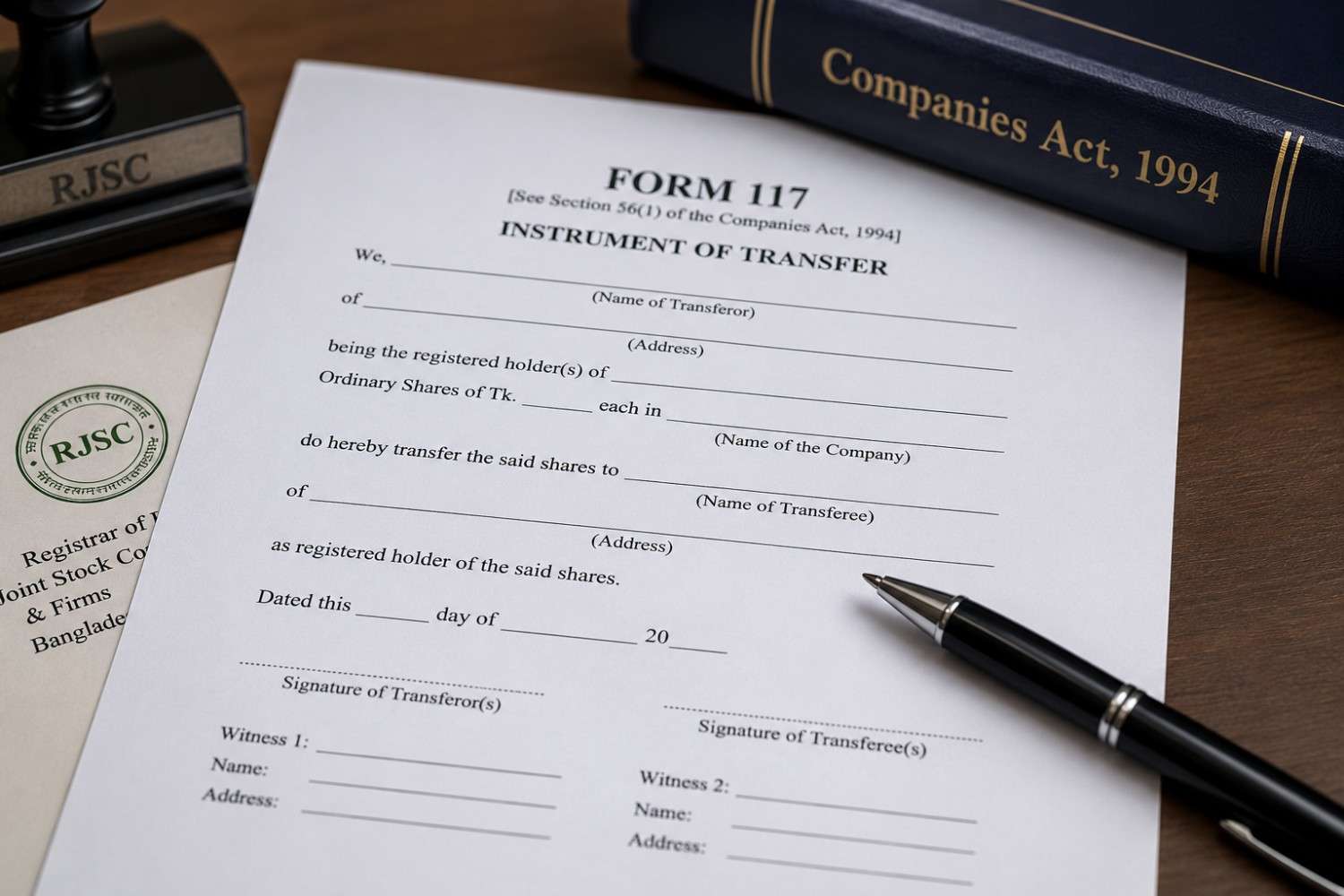
The instrument of transfer is the primary legal document between the transferor and the transferee. It must record full names, identification (NID or passport where appropriate), the number and class of shares being transferred, consideration amount and the effective transfer date. Accuracy and clear signatures prevent avoidable queries from the registrar.


Checklist — instrument fields to include: transferor name, transferee name, folio/ledger reference, share class and quantity, consideration, date, signatures of both parties, witness details and stamp duty endorsement. Ensure the instrument is stamped under current rules; insufficient stamping may invalidate the transfer.
Board Resolution Requirements for Share Transfers
A certified board resolution authorizing the transfer is normally required, particularly where the Articles of Association require board consent or pre-emption procedures. The resolution should record the meeting date, resolution text approving the transfer and confirmation that the transferee meets eligibility requirements.
Keep a certified copy of the resolution with corporate records and attach it to your RJSC submission. Where valuation was used, include the valuation report or director’s note and minutes confirming approval to provide a clear audit trail.
| Document Name | Purpose | Key Requirement |
|---|---|---|
| Instrument of Transfer | Legal ownership change | Proper stamp duty |
| Board Resolution | Corporate authorization | Certified copy |
| Share Certificate | Proof of ownership | Surrender old certificate |
Other documents commonly required: certified copy of the transferee’s ID, proof of payment (if any), valuation report where applicable, and the completed RJSC form(s)
Check whether Form 117 or Form XII applies in your case. Preparing these items before submission streamlines the transfer process and reduces queries from the RJSC.
If you need templates for the instrument of transfer, a sample board resolution or help confirming which RJSC form to file, download our document pack or contact specialist support to review your files before lodging with the registrar.
Step-by-Step Company Share Transfer Procedure Share Transfer
Follow these practical steps to complete a Joint Stock Share Transfer in Bangladesh reliably. A clear process and correct documentation protect both transferor and transferee and make the registrar’s review straightforward.
Step 1 — Execute the Share Transfer Form
Complete the instrument of transfer (share transfer form) with care. Ensure it records: transferor and transferee full names, NID or passport where relevant, folio/ledger reference, share class and quantity, consideration amount, effective date and signatures of both parties. Affix the correct stamp duty and include witness details —
inadequate stamping or missing signatures are common causes of rejection.
Step 2 — Obtain Board Approval
If the Articles of Association require it, secure a board resolution authorizing the transfer. The resolution should state the meeting date, the decision to approve the transfer, and confirmation that the transferee meets the company’s eligibility criteria. Record the valuation method (if applicable) and attach the valuation report or director’s note to the minutes.

Step 3 — Update the Register of Members
After execution and board approval, update the company’s register of members promptly. Enter the transfer date, new shareholder details and the updated shareholding. The register is the company’s definitive record of ownership; failure to update it can cause administrative disputes and affect voting rights.
| Action Item | Responsible Party | Required Document |
|---|---|---|
| Execution of Transfer | Transferor & Transferee | Instrument of Transfer |
| Board Approval | Board of Directors | Board Resolution |
| Register Update | Company Secretary | Register of Members |
| Final Filing | Authorised Signatory | Relevant RJSC Form(s) |
Step 4 — File with the RJSC and Close the Loop
File the required RJSC form(s) (check whether Form 117 or any other form applies) with certified copies of the board resolution, instrument of transfer, proof of stamp duty and updated register extract. If the transfer creates changes in the board or shareholding, file Form XII where required. Keep submission receipts and follow up via the RJSC portal to track progress.
Quick Troubleshooting
Common reasons for delay or rejection: missing signatures, incorrect stamping, inconsistent names/IDs, absent board resolution or un-updated register. Remedy these by cross-checking each document against the register and Articles before filing.
By following these steps you streamline the transfer process, reduce administrative risk and ensure the transferor, transferee and company remain compliant with RJSC requirements.
Integrating New Directors and Shareholders via Form XII
When a share transfer results in a new shareholder or the board appoints a director, you must formalize those changes with the RJSC. Correct filing keeps your register current and ensures the company remains compliant after the transfer.
When to File Form XII with the RJSC
File Form XII whenever there is a change to the board of directors or a material change in the shareholding pattern. Although practices vary, the standard expectation is to file within 14 days of the board resolution approving the change. Late filing can attract administrative penalties, so act promptly.
Documents to attach with Form XII typically include: a certified board resolution, the transferee’s consent or acceptance (if applicable), updated register extract and
copies of any instruments of transfer. Where Form 117 or other RJSC forms are relevant for a particular transfer, submit them together to avoid multiple rounds of queries.
Legal Implications of Adding New Stakeholders
Appointing new directors or welcoming new shareholders carries legal consequences. Directors assume fiduciary duties and must comply with statutory obligations; new shareholders acquire voting rights and dividend entitlements. Documenting these changes with the RJSC share allotment in Bangladesh establishes a clear, auditable record of who holds office and who owns shares.
Quick checklist before filing Form XII: 1) confirm board resolution and minutes, 2) obtain written consent from new directors/shareholders, 3) ensure the register of
members reflects the transfer, 4) include copies of transfer instruments and proof of stamp duty, and 5) complete Form XII (and Form 117 if required) and file within the prescribed timeframe.
Need help preparing Form XII or confirming which RJSC forms to file? Contact a specialist adviser to review your documents and reduce the risk of rejection.
Capital Expansion through Share Allotment in Bangladesh
Expanding via equity is a common route for growing businesses in Bangladesh. Joint Stock Share Allotment in Bangladesh lets a company issue new shares to existing shareholders or new investors, raising fresh capital without increasing debt. Proper planning and compliance with corporate requirements ensure the allotment strengthens operations while keeping the company compliant.


Any increase in share capital must follow statutory procedures and corporate governance rules — typically board resolutions, shareholder approvals where required, and filings with the RJSC. A well-managed Company Share Allotment in Bangladesh improves liquidity, attracts investment and supports long-term growth. For capital expansion, understand the difference between share transfer and Company Share Allotment in Bangladesh before proceeding.
Distinguishing Between Share Transfer and Share Allotment
A Joint Stock Company Share Transfer in Bangladesh transfers existing shares from one party to another and does not change total paid-up capital—only ownership changes. By contrast, Company Share Allotment in Bangladesh issues new shares and increases paid-up capital, bringing new funds into the business.
Use transfer when ownership needs to change between parties; use allotment when the company needs funding for expansion, new projects or to improve working capital.
Increasing Authorized and Paid-up Capital
If existing authorized capital is insufficient to issue new shares, the company must increase its authorized capital first for Company share allotment in Bangladesh to increase paid up capital. This typically requires a special or extraordinary resolution, amendment of the Articles of Association and filing the change with the RJSC before allotting shares.
Example: a company with authorized capital of BDT 1,000,000 and paid-up capital of BDT 500,000 wants to issue 250,000 new shares at BDT 2 each (BDT 500,000). It would first pass the necessary resolutions to raise authorized capital above the new total, amend the Articles, then allot the shares and update statutory records.
Quick checklist for share allotment: board resolution to propose allotment → (if required) shareholder approval and amendment of Articles → determine issue price and
terms → prepare allotment letters and share certificates → file required forms with RJSC and update the register of members. Adhering to these steps meets the regulatory requirements and avoids delays.
| Feature | Share Transfer | Share Allotment |
|---|---|---|
| Capital Impact | No change to total capital | Increases paid-up capital |
| Primary Purpose | Change of ownership | Raising new funds |
| Regulatory Focus | Updating member register | Issuing new certificates |
| Involved Parties | Buyer and Seller | Company and Subscriber |
Taxation and Stamp Duty Considerations
Understanding the fiscal consequences of a share transaction is as important as completing the paperwork. Whether you are completing a Company Share Transfer in Bangladesh or a Company Share Allotment in Bangladesh, you must plan for stamp duty, tax reporting and any payments due to the National Board of Revenue (NBR) to keep the company compliant and avoid penalties.
Good record-keeping makes tax compliance straightforward: keep copies of the instrument of transfer, board minutes, valuation documents and evidence of payments. For complex or high-value transfers, seek tax advice to confirm treatment and timing of any liabilities.
Stamp Duty Calculation for Company Share Transfer in Bangladesh
Stamp duty is payable on the instrument of transfer and is typically calculated on an ad valorem basis — a percentage of the consideration or assessed value. Rates and the applicable valuation basis can change; always check the latest government schedule published by the NBR or RJSC before you complete the instrument.
Worked example (illustrative only): if 1,000 shares are transferred at BDT 100 per share, the consideration is BDT 100,000. If the applicable stamp duty rate is 0.5% (check current schedule), the stamp duty payable would be BDT 500. Ensure the instrument bears the stamp and attach proof of payment to your RJSC filing — insufficient stamping commonly causes rejection.
Tax Obligations for Transferors and Transferees
Both parties have tax responsibilities. The transferor may be liable for capital gains tax on any profit realized from the sale of shares — this must be reported in the transferor’s tax return. The transferee should ensure the source of funds is documented and be prepared to show proof of payment if required by authorities.
Summary table — who pays what:
| Financial Item | Responsible Party | Purpose |
|---|---|---|
| Stamp Duty | Transferee | Legal validation of transfer |
| Capital Gains Tax | Transferor | Tax on profit from sale |
| Processing Fees | Company/Applicant | RJSC administrative costs |
Before you submit, consult the current NBR stamp duty schedule and, for significant transactions, obtain professional tax advice. Correct payment and documentation (including stamped instrument and updated share certificate) reduce the risk of rejection and ensure full compliance.
Common Challenges in Joint Stock Company Share Transfer in Bangladesh
Even with careful preparation, Joint Stock Company Share Transfer in Bangladesh can encounter practical and regulatory hurdles. Anticipating common issues—disputes among shareholders, documentation errors or administrative delays at the RJSC—lets you plan mitigation steps and keep the transfer on track.
Handling Disputes Among Shareholders
Disagreements often arise over valuation, pre-emption offers or perceived breaches of the Articles of Association. Address these early: circulate clear notices, share the valuation methodology and hold a shareholders’ meeting where necessary. Mediation or a neutral expert valuation can resolve disputes quickly and cost-effectively before they escalate to litigation.


Example: a dispute over valuation for 5,000 shares was resolved by an independent valuer. The parties accepted the valuer’s report and the transfer proceeded after the transfer of share.
Overcoming Administrative Delays at the RJSC
Administrative delays commonly stem from incomplete forms, missing signatures or incorrect stamping. Minimize delays by double-checking each document against your register and Articles of Association before submission and by including certified copies where required.
Practical tips: use the RJSC online portal where possible, keep digital and physical copies of submission receipts, and follow up with the RJSC helpdesk if processing exceeds normal timelines. Maintain a clear folder of correspondence to resolve queries quickly.
| Challenge Type | Primary Cause | Mitigation Strategy |
|---|---|---|
| Shareholder Conflict | Lack of transparency | Early mediation / independent valuation |
| Documentation Error | Incomplete filings | Checklist & double-check |
| RJSC Processing Delay | System backlog or queries | Regular status tracking & follow-up |
Typical timeline (indicative): best-case transfer can complete in 2–4 weeks if documents and stamping are in order; realistic timeline allowing for board approvals, valuation and RJSC processing is 4–8 weeks. For complex or cross-border transfers allow additional time for BIDA/Bangladesh Bank clearances.
If you face challenges, seek specialist support early — a corporate adviser or legal counsel can review documents, advise on dispute resolution and liaise with the RJSC to reduce delays and ensure a compliant outcome.
Special Considerations for Foreign Company Share Transfer
Share transfers involving foreign investors or joint ventures carry extra regulatory layers. When a Foreign Company Share Transfer in Bangladesh or a Joint Venture Company Share Transfer in Bangladesh is proposed, you must consider foreign investment approvals, foreign exchange rules and cross-border reporting in addition to the RJSC filing requirements.
Compliance with Bangladesh Investment Development Authority
Where foreign equity is involved, check the company’s registration with the Bangladesh Investment Development Authority (BIDA). Certain changes in ownership or shareholding structure may require BIDA approval or an update to the investment registration. Proceeding without BIDA clearance can lead to penalties or restrictions on fund movement.
Before filing at the RJSC, confirm whether BIDA consent is required and include any BIDA clearances with your submission. Also ensure board minutes and any amended Articles reflect the approved change so the documentation aligns across regulators.
Repatriation of Funds and Regulatory Reporting
Exiting foreign investors and cross-border payments are subject to Bangladesh Bank rules. For repatriation of sale proceeds, authorized dealer banks will require audited valuation reports and supporting documents confirming compliance with foreign exchange regulations. Prepare to submit detailed evidence of valuation, payment instructions and bank confirmations.
For joint venture, additional central bank reporting and documentation may be mandatory. Work with the authorized dealer bank and legal advisers to ensure the transfer, any capital movement and reporting meet Bangladesh Bank requirements.
| Requirement Type | Local Company | Foreign/JV Company |
|---|---|---|
| Primary Regulator | RJSC Only | RJSC, BIDA & Bangladesh Bank |
| Valuation Basis | Face Value / Market Value | Fair Market Value (Audit often required) |
| Fund Movement | Local Banking | Authorised Dealer Bank (Repatriation) |
| Reporting Scope | Internal Records | Cross-border Compliance |
Ensuring Compliance and Long-term Corporate Governance
To protect investors and directors and to meet regulatory expectations, keep your statutory books, share register and filings up to date. Regular internal audits and timely filings with the RJSC, BIDA and Bangladesh Bank help avoid penalties and preserve corporate reputation.

Three quick takeaways: 1) confirm BIDA and Bangladesh Bank requirements early, 2) secure audited valuation and proof of payment for repatriation, and 3) file the correct RJSC forms (including Form 117 or Form XII where applicable) with certified board resolutions and updated registers.
If you need assistance with cross-border compliance, Form 117 queries, valuations or preparing the required filings, contact a specialist adviser to review your documents and reduce the risk of delays or rejection.
Frequently Asked Questions About Company Share Transfer in Bangladesh
What is the process for Company Share Transfer in Bangladesh?
The process involves executing the share transfer form with proper stamp duty, obtaining board approval, updating the register of members, and filing required forms with the RJSC.
What documents are required for RJSC Company Share Transfer in Bangladesh?
Required documents include the instrument of transfer, board resolution, original share certificates, updated register of members extract, and relevant RJSC forms such as Form 117.
How long does a Company Share Transfer in Bangladesh take?
A standard RJSC Company Share Transfer in Bangladesh typically takes 4-8 weeks, depending on document completeness and RJSC processing time.
Why Choose Us for Your Company Share Transfer in Bangladesh?
✅ 100% RJSC Compliant Process
✅ 500+ Successful Company Share Transfers Completed
✅ Expert Legal & Corporate Advisory Team
✅ End-to-End Document Processing Support
For a successful Company Share Transfer in Bangladesh, always work with experienced professionals who understand the complete RJSC requirements. A proper RJSC Company Share Transfer in Bangladesh protects your business interests and ensures long-term compliance with the Companies Act.